Pão de queijo: Brazilian cheese bread recipe
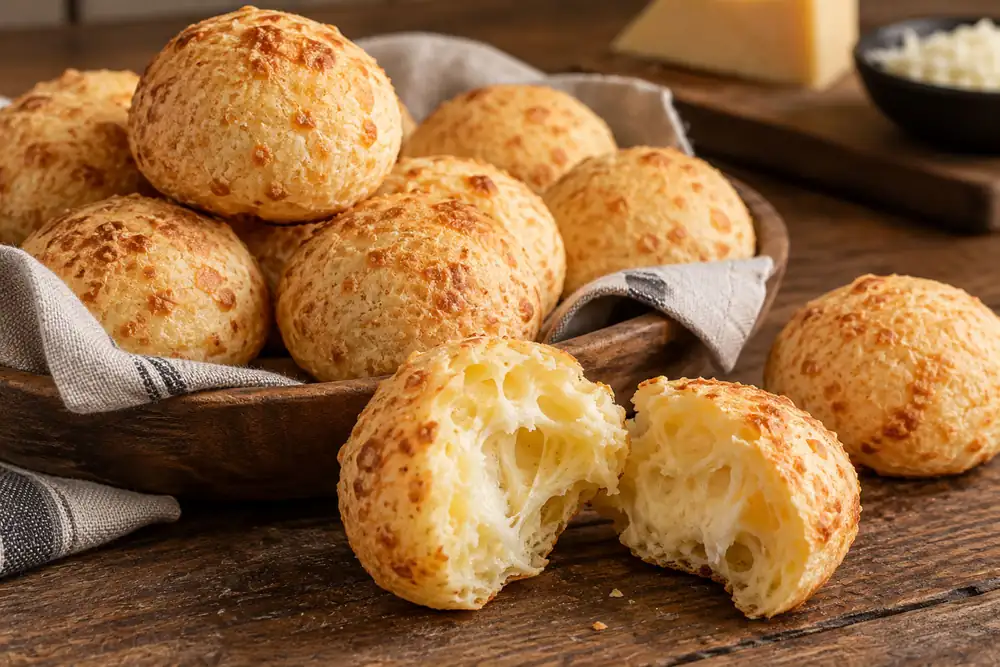
Small, golden, and irresistible when still warm: pão de queijo is one of Brazil's most recognizable flavors.
The secret is polvilho, the starch derived from cassava that gives the dough its distinctive texture, making pão de queijo instantly recognizable. In Brazil, it's eaten with breakfast, a coffee break, or as a mid-day snack. Making it in Italy is also possible, as long as you choose the right ingredients and follow a few steps.
Pão de queijo is closely linked to Minas Gerais, a Brazilian state with a strong gastronomic identity and a long dairy tradition. It is part of the world of quitandas, sweet and savory homemade preparations historically present on Minas Gerais tables and often served with coffee.
Establishing its precise origins is difficult. Historical reconstructions point to the colonial period and the use of cassava derivatives, already a fundamental part of the local diet. With the development of livestock farming and dairy production, milk, eggs, and cheese gradually entered these preparations, giving rise to the versions we know today.
Rather than looking for a single birth date, therefore, it is useful to consider pão de queijo as the result of a Brazilian gastronomic culture that developed over time around cassava, milk, eggs and local cheeses.
From a regional specialty, it has become one of the best-known Brazilian foods, spreading throughout the country and, subsequently, even beyond its national borders.
There are numerous family and regional recipes. The proportions, the type of polvilho, and especially the cheese used vary. This version produces soft and elastic pão de queijo with a lightly browned surface.
Ingredients for approximately 20 cheese breads
- 250 g of sweet manioc starch
- 150 ml of whole milk
- 35 ml of seed oil
- 2 eggs
- 200 g of grated mature cheese
- about 5 g of salt
In Brazil, one of the traditional references is Queijo Minas curado. There's no perfectly equivalent Italian substitute, but you can achieve a good result using a flavorful, fairly mature cow's milk cheese, possibly combined with a bit of Parmigiano Reggiano or Grana Padano.
It's best to avoid excessively moist cheeses: they can alter the consistency of the dough and make it more difficult to achieve the typical structure of pão de queijo.
The procedure
In a small saucepan, heat the milk, oil, and salt. When the liquid is almost boiling, pour it over the polvilho and stir. This step helps dissolve the cassava starch and is important for the final consistency.
Let the mixture cool before adding the eggs. Incorporate them one at a time, working the dough until they are completely absorbed.
Then add the grated cheese and continue kneading until the dough becomes soft and workable. The consistency may be slightly sticky; this is normal.
Lightly grease your hands with oil and form balls of about 30 grams. Place them on a baking sheet lined with parchment paper, leaving a little space between each one.
Bake in a preheated oven at 200°C (390°F) until the pão de queijo are puffed up and lightly golden. Baking time may vary depending on your oven and the size of the balls: rather than relying strictly on the number of minutes, it's best to monitor their development and color.
This is one of the most confusing aspects of making pão de queijo in Italy. Polvilho isn't just a generic cassava flour: it's the starch extracted from the root and comes in two main varieties.
Sweet polvilho is an unfermented starch. It tends to have a more compact and elastic texture and has a relatively neutral flavor.
Polvilho azedo, on the other hand, undergoes a fermentation process before drying. It has a more distinctive aroma and allows the dough to expand more during baking.
In Brazil, you can find recipes prepared exclusively with one of the two, but also versions that mix them to balance elasticity, lightness, and flavor.
When purchasing ingredients in Italy, it is therefore important to check the packaging carefully: cassava flour and cassava starch are not automatically interchangeable.
Don't expect the dry, airy crumb of a traditional sandwich. Once opened, the pão de queijo should have a soft, elastic, and slightly moist interior, while a thin, golden crust forms on the outside.
This consistency arises from the interaction between starch, liquids, eggs, and cheese. This is also why the initial stage, in which the polvilho is scalded with hot milk and oil, should not be skipped.
Mistakes to avoid
- Confusing polvilho with cassava flour: they are different products and the result can completely change.
- Add the eggs when the mixture is still too hot: it's better to wait until the mixture has cooled down.
- Using a cheese that is too moist can make the dough difficult to work with.
- Prepare balls of very different sizes: the cooking will be uneven.
- Bake at a low temperature: the initial heat helps the pão de queijo to develop properly.
- Adding too much salt: you also need to consider the saltiness of the cheese you're using.
The best time to enjoy pão de queijo is while it's still warm or hot, shortly after coming out of the oven. This is when the inside retains its characteristic elasticity best.
In Brazil, it's consumed at various times of the day, from breakfast to afternoon tea, often with coffee. It can also be a savory snack or a refreshing aperitif.
If you have any cooked pão de queijo left over, it's best to reheat it briefly before serving.
Another practical solution is to freeze them before cooking. Form the balls, arrange them separately on a tray, and transfer them to the freezer. Once hardened, they can be placed in a bag or other suitable container.
When ready to use, they can be transferred directly from the freezer to the oven, simply considering a slightly longer cooking time.
Is pão de queijo gluten-free?
The traditional recipe uses polvilho, or cassava starch, rather than wheat flour, and is therefore naturally gluten-free. Those with celiac disease should still ensure all ingredients are suitable and be wary of any potential contamination during preparation.
Qual è la differenza tra polvilho doce e polvilho azedo?
Polvilho doce is unfermented cassava starch and tends to give pão de queijo a firmer, more elastic texture. Polvilho azedo, on the other hand, is fermented before drying and promotes greater expansion, as well as having a more distinctive aroma. Some Brazilian recipes use both.
What cheese can I use in Italy for pão de queijo?
Queijo Minas curado is one of the traditional cheeses used in Brazil, but there's no perfect Italian equivalent. You can choose a flavorful, sufficiently aged cow's milk cheese, possibly pairing it with a little Parmigiano Reggiano or Grana Padano. It's best to avoid cheeses with a high water content.
Can pão de queijo be frozen?
Yes. The most practical method is to freeze the balls while still raw, initially separated on a tray and then collected in a container. They can then be cooked directly from frozen, extending the baking time slightly.