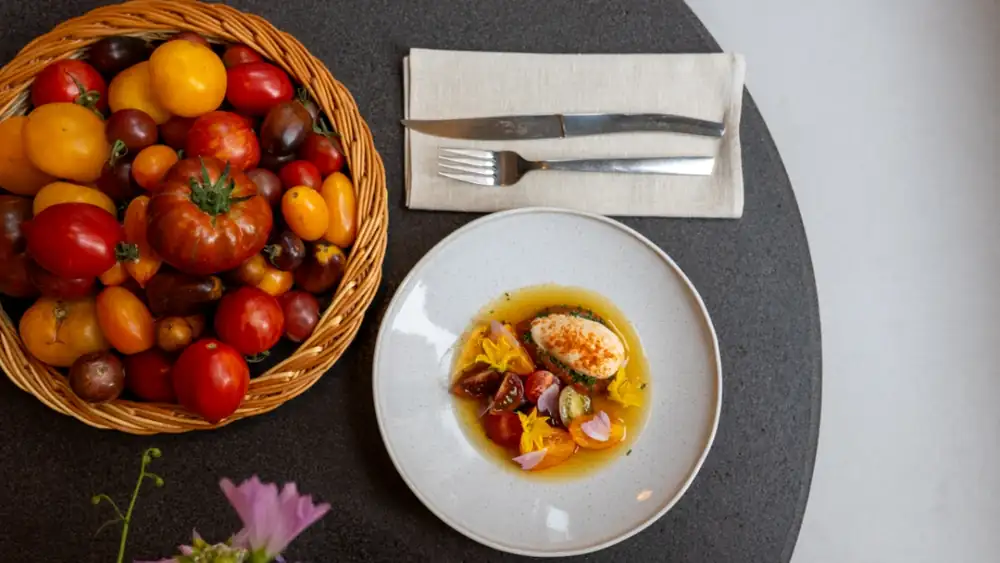
From farm to restaurant: Tanguy Hanoun and Raphaëlle Bathellier's project in Paris
A restaurant in Paris's 15th arrondissement, an 80-hectare farm nestled in Saint-Austremoine (Haute-Loire): between the two, a deep-rooted connection and a weekly delivery. La Borie is one of the rare establishments striving for self-sufficiency.
The New York spark
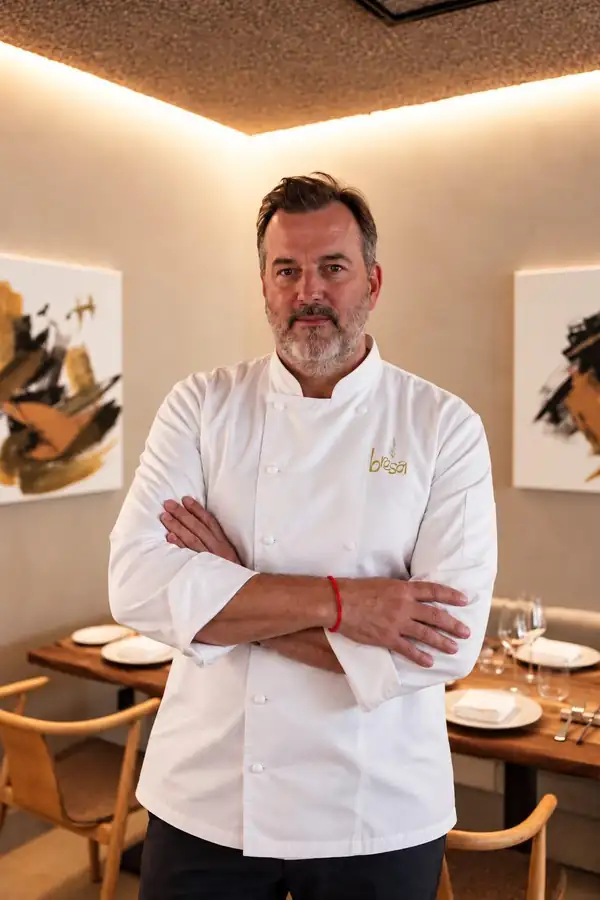
Tanguy Hanoun, the chef of La Borie, hails from Marseille and followed a classic path – Ferrandi culinary school, three-Michelin-starred restaurants, and a traditional restaurant in the Lot region – before crossing the Atlantic to join Blue Hill at Stone Barns, Dan Barber's restaurant, located on a farm in upstate New York – the quintessential farm-to-table concept. The scale, however, is nothing like La Borie: at Dan Barber's, there are over a hundred people in the kitchen, thanks to the support of the Rockefeller family…
What Tanguy brings back from his experience there isn't a setting or a recipe, but a method. "In the United States, you learn a lot by trial and error. At La Borie, you learn almost everything on the job; you probably mess up 90% of what you try each time." He considers this taste for experimentation too rare in France: "The weight of tradition bears heavily on the entire sector, both agricultural and culinary. They're completely free of that over there."
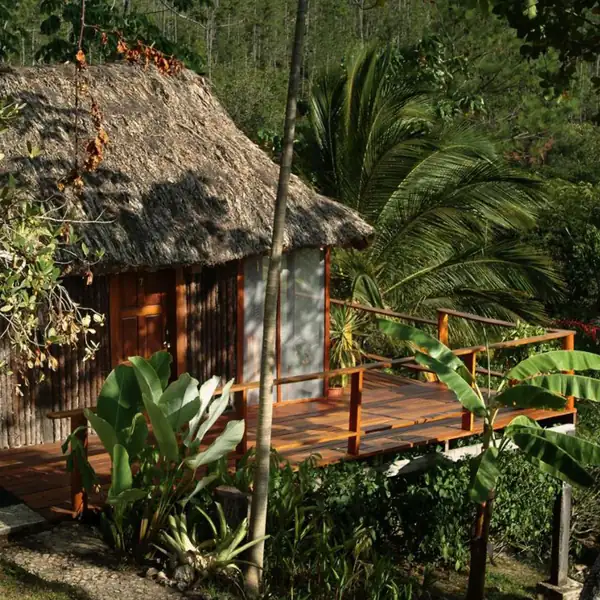
It was the encounter with Marc Fournier, a friend of his family, that decided the adventure. The latter, a successful investor, had just acquired an estate abandoned since the eighties, a former hippie campsite, in a fold of the Auvergne mountains, terraced between 600 and 900 m altitude.
A kitchen under constraints
The challenge now is to produce edible goods, a restaurant, a kitchen, a menu. A traditional restaurant often receives one or two deliveries daily; La Borie's van comes up once a week with the harvest, cut meats, and eggs. It then returns loaded with peelings to be eaten by the farm animals. No plastic, no garbage: only reusable crates.
The (small) Parisian kitchen is run daily by Raphaëlle Bathellier – Tanguy, a "cook and farmer" as he describes himself, who divides his time between Paris and the Auvergne region. Trained at Ferrandi, like Tanguy, and having worked in several Michelin-starred restaurants, she faces a challenge every week: working with the seasons, drought, pests, predators, unforeseen events, and the unknown. "But you can bring her just about anything from the farm, and she'll manage to create something magical – that's what's so wonderful." She adds, "The key is to be consistent with quantities and even with diversity. For example, this winter, I'm afraid we'll be eating nothing but cabbage for three months because that's all that grows here."
A radical polyculture
More than five hundred kilometers from the restaurant, three people watch over this rugged paradise. Of the 80 hectares of the estate, 70% are covered in forest. Ten hectares are pasture, a little over one hectare is used for market gardening, and orchards are planted everywhere, between the plots.
The figures are striking: three hundred varieties of tomatoes, a hundred peppers and chilies, a dozen eggplants, and just as many beans are regularly harvested. There are also about ten varieties of chickens, chosen for their color, cold hardiness, and egg-laying rate. "From an agricultural production standpoint, it's very interesting because it allows us to be more resilient to all kinds of challenges." Some varieties are resistant, others succumb to diseases and predators—birds of prey and raccoons that arrived from Germany during a recent continental expansion.
The ewes, sixty head of the Noire du Velay and Blanche du Massif Central breeds, graze on these poor, sloping soils, subject to a very continental climate — “from -18°C in winter to +40°C in summer,” Tanguy laughs. They grow slowly, on grass alone, without grain: the meat, less strong in flavor, is also redder. A one-year-old lamb weighs eighteen kilos carcass weight, while the market often expects twice that at six months.
This diversity defies the constraints of administrative frameworks. "We fit into several categories simultaneously: a real headache for the bureaucracy." To obtain a breeder's number and mark their eggs, they must declare one hundred hens; La Borie only has sixty. The professional beekeeping threshold is fifty hives; the La Borie apiary has fewer…
Long time
The orchards, meanwhile, continue to expand season after season. The vineyards, planned for next autumn, will mark a new stage in this ever-expanding diversified farming operation. Pig farming remains under consideration. La Borie is not about to fall under the CAP (Common Agricultural Policy) regulations…
And also...
Florent Ladeyn, chef of the Auberge du Vert Mont: a committed and radical chef in his choices: Let's head to Flanders and its hills, 40 km west of Lille, where the Michelin-starred restaurant of the Auberge du Vert Mont is located, chef Florent Ladeyn's headquarters for the past twenty years. A former contestant on the television show Top Chef, he champions a locavore cuisine here, a symbol of his attachment to his local region.
Chefs Christophe Hay and Valentin Loison: for responsible river fishing. They advocate for sustainable river fishing, working with small and few remaining fishermen. A cross-section of perspectives from two conscious voices in tune with their times: chefs Valentin Loison (Bulle d'Osier and Mirabelle, in Langres) and Christophe Hay (Fleur de Loire, in Blois; and La Table, in Ardon).
Armand Arnal, chef of La Chassagnette in Arles, dreams of creating an oasis in the heart of the Camargue. Nestled within a sublime yet fragile ecosystem—the Rhône Delta—the Michelin-starred restaurant La Chassagnette has become a place of resistance for chef Armand Arnal. For twenty years, this poetic chef has championed a unique terroir. Come explore the gardens of La Chassagnette by reading the portrait of Armand Arnal.