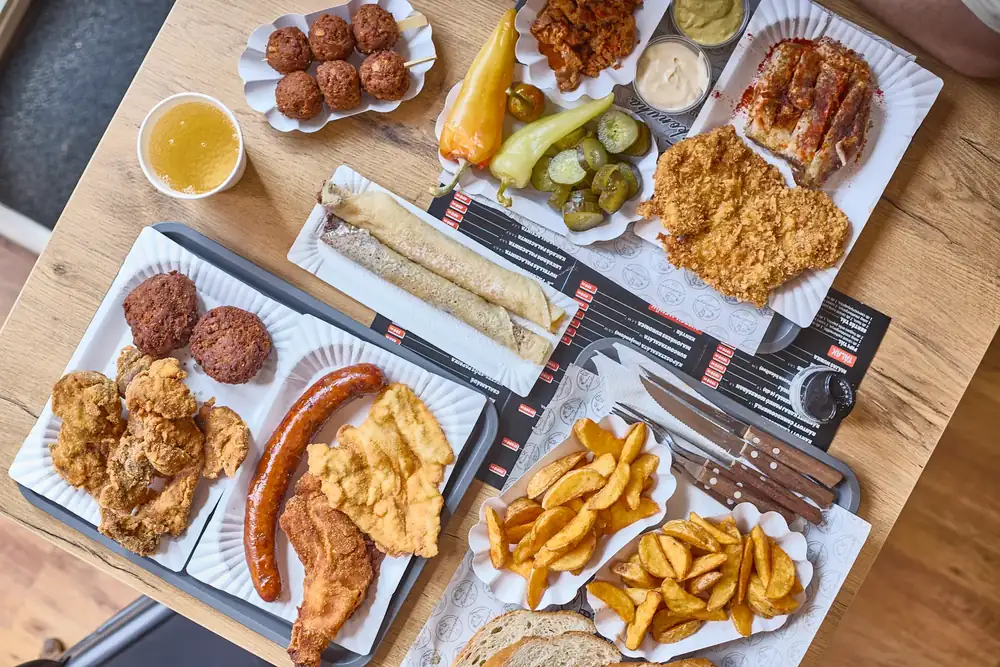
For over 50 years, dishes have been prepared based on Aunt Éva's recipes at Óbuda Lacikonyha
It's long past lunchtime, but there's still a constant flow of people coming and going in front of the counter at Óbuda's Lacikonyha. Some people just pop in for a meatball bun, while others bring a whole bag of food for their family to eat for dinner.
Generations have grown up on Aunt Éva's recipes
The Óbuda Lacikonyha was founded in the early 1970s, although it was located a little further away, on Szentendrei út. Since then, it has moved twice, and has been occupying its current, spacious premises since the end of last year. Over the decades, however, not only the address has changed, but also the owner. Lacikonyha was run by Aunt Éva Szabó for a long time, and it became one of the district's mainstays, largely thanks to her recipes. When she decided it was time to take a break five years ago, Tamás Benkő took her place. Not entirely as an outsider: she had been coming here regularly since childhood, grew up eating Aunt Éva's cooking, and eventually decided to take over the business.
“I ate here many times as a child, my mother too, and even my grandmother. She tried to copy the meatballs here, but somehow it never turned out like it,” says Tamás, who had never worked in hospitality before, so he was entering completely new territory. One of the biggest challenges was not running the shop itself, but taking over the recipes.
This is how Óbuda Lacikonyha preserves old flavors
Tamás didn't want to change either the well-established menu or the flavors that had brought generations back. Over a long process, Aunt Éva taught him what to prepare and how to prepare it so that old customers wouldn't even notice the change. Tamás himself admits that he never thought there could be such a big difference between two fried meats, for example. Since then, only a few small changes have been made to the menu, and most of the old suppliers have been retained. Aunt Éva still comes here regularly, and when she's there, she doesn't miss a quality check.
Perhaps this is the hardest part of running a place like this: not just learning how to make something well, but also ensuring that everyone who comes in gets the same thing on Monday, Wednesday, and Saturday, this year and next year.
Meatballs, sausages, robber meat: we tasted the classics of Óbuda Lacikonyha
The menu is both retro and timeless: fried meats, meatloaf, fried liver, steak, fried sausages and robber meat are lined up on the counter. They are not the kind of dishes that require a long explanation, and that is exactly the point. If someone is serious about tasting, they should try the four-person platter. However, the name is not bad to take seriously: the portion is really designed for at least four or five people, and almost all of the most important dishes of Óbuda Lacikonyha are included.
One of the most popular of them is robber meat, which here means something completely different than the combination of meat and vegetables pulled on a skewer. It is made from pork, roasted, with a lot of juice. It is paprika-flavored, slightly garlicky, and the meat is very soft, almost falling apart with a fork. Typically, it is a dish that requires bread, because it would be a sin to leave the juice on the plate at the end.
The fried sausage is not fussy about its size either: it comes in a thick, substantial piece, juicy on the inside and nicely fried on the outside. The seasoning is distinct, slightly spicy, but it doesn't want to be spicy at all costs. It's not a particularly complicated genre, but it's precisely with dishes like this that it quickly becomes clear if something is wrong – here it's fine.
For the fried meats, you can choose between chicken thighs, chicken breasts, and chops. None of them are pounded paper thin: the meat remains inside, while the coating is rustic, crispy, and properly envelops them. The portions here are also large, and a slice of fried meat in itself is not some kind of symbolic lunch.
The meatball is perhaps the most time-traveling item on offer. A large, chunky dumpling, soft on the inside, with a well-browned crust on the outside, and it's obvious that they didn't skimp on the bun either. This is what gives it such a homey, almost grandma-like character, which makes it understandable why someone would come back for the meatball for decades.
The steak is more subdued in comparison. It's not overly spiced, it's slightly garlicky, and the flavor of the meat remains the focus. This simplicity suits it well, especially next to the other, more characterful characters on the plate.
You can also order various sauces and pickles, as well as white bread. Be careful with the strong paprika. There is also sour melon, which you don't often find even in classically Hungarian places, but it works especially well with fatty, fried meats, and its acidity immediately restores the next bite.
As a dessert, pancakes can end the lunch, and they haven't started to rethink this front either. There are jam, cocoa and cinnamon, and of course Nutella. These are thin, simple pancakes, without any special tricks, just the kind that make it surprisingly easy to get two more after a hearty meaty lunch.
Times change, meatballs remain
In fact, the whole of Lacikonyhá is true that there is nothing overly thought out. In the past, you could order everything separately, but since then, several menus and dishes have been added to the menu to make the choice easier. However, the basics have not changed. Sausage, fried liver and meatballs are still among the most popular, but 45-50 pieces of sausage are sold out every day.
And somewhere this is the essence of the whole story of Óbudai Lacikonyha. It doesn't want to appear more modern, more exciting or more trendy than it is. While Óbuda is changing around it, the shop is moving, the owner is changing and new menus are being put on the board, the meatballs must still be what the old customers remember. And judging by the constant comings and goings in the afternoon, it seems that there is still plenty of demand for this constancy.