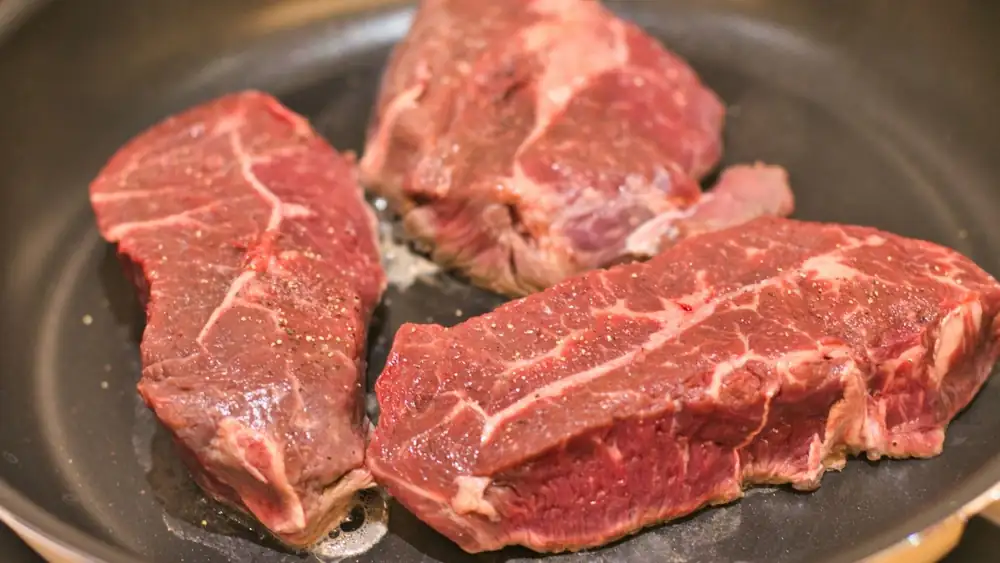
The chefs agree: “For a perfect grilled steak, don't grease the pan, instead brush the meat with oil.”
Pouring a little oil into the pan, putting it on the heat and waiting until it starts to smoke before adding the meat is a very widespread custom.
It is also, according to many professional cooks, a very bad way to start cooking a grilled steak.
Although the good one is, if possible, even easier, since you just have to do the exact opposite: first heat the pan completely dry and then put the oil directly on the meat.
This is explained by Pablo Cadavid, chef of La Yerbita, in Sobarzo (Cantabria), in one of the videos published on his YouTube channel.
The problem with heating a small amount of oil in an empty pan is that the fat reaches very high temperatures in a short time. If this heating process is prolonged, the oil burns and produces smoke, in addition to imparting unpleasant aromas and flavors to the food.
The solution, as we mentioned earlier, involves changing the usual order of the steps. Instead of greasing the cooking surface, you cover the piece of meat with a very thin layer of oil before placing it on the griddle.
To spread it evenly, you can use a kitchen brush or simply massage the piece with your hands until the entire surface is coated with oil.
Chef Alfredo Vozmediano (@avozmechef) recommends the exact same procedure in another YouTube video. In his demonstration, he also explains that this technique can be used when cooking in a pan without a non-stick coating.
Why is it better to put the oil on the meat?
The oil coating the meat increases in temperature rapidly, but the meat itself absorbs some of that heat.
This way, the fat doesn't stay on the hot pan long enough to burn.
This helps prevent both the fumes and the bitter taste that burnt oil can leave. Vozmediano also points out that when oil overheats, it becomes harmful.
Cadavid points out other advantages, such as that the browning of the meat is cleaner and it is also easier to control how much oil is being used.
This allows you to cook with a more precise amount of fat and have greater control over the cooking process.
There is also another curious effect that is avoided by working in this way, and that is what is known as thermocapillary convection.
This phenomenon is responsible for the fact that, when a very thin layer of oil is heated in a pan, the fat tends to move from the center to the sides, leaving the central area, where the food is usually placed, with less oil.
How to prevent meat from sticking to the pan?
Unlike non-stick pans, a stainless steel surface might seem unsuitable for cooking a steak without it sticking to the bottom.
However, when steel reaches the appropriate temperature, it can offer behavior very similar to that of a non-stick surface thanks to the so-called Leidenfrost effect.
A simple way to check if the pan is hot enough is to drop a few drops of water onto it.
If the droplets evaporate immediately or remain spread across the metal, the pan hasn't reached the right temperature yet. When, on the other hand, the water forms small beads that move quickly across the surface without actually wetting it, the pan is ready for cooking.
At that point, the previously greased meat can be placed directly on top.
By applying the oil to the steak, you take advantage of the hot surface effect to reduce the risk of the meat sticking and, at the same time, avoid subjecting the oil to excessive heat before cooking begins.