All the kebabs in the world: from döner to shawarma, passing through the Balkans and China
In the imagination of the casual Italian consumer, kebab occupies a precise place on the food agenda, somewhere between the last night bus and the morning-after remorse.
And in fact, speaking of "kebab" in the singular is already a simplification: under this name coexist very different preparations. Let's see which ones.
What does kebab mean and why is it spelled kebap in Türkiye?
The name originates in Mesopotamia, and linguists trace it back to the Akkadian verb kabābu, meaning "to burn" or "to toast." The same word later appears in Aramaic and Arabic, becoming kabāb, literally "roasted meat," and is inherited by Persian, Turkish, and Urdu, finally arriving in English, which only adopted it in the 17th century.
In Turkey, however, it's written kebap, because Turkish doesn't allow a b at the end of a word and replaces it with a p. The b returns to its place as soon as the noun receives a suffix, as in the famous Adana kebabı, or Adana kebab. In Italy, however, the Anglo-Saxon spelling has prevailed.
The oldest material evidence of kebab comes from Akrotiri, the Bronze Age settlement buried by the eruption of Santorini in the 17th century BC, where archaeologists have unearthed stone supports for skewers, perforated at the base to allow air to pass through the embers. Homer writes of the Achaeans roasting meat on long wooden poles, known as obeloi, and in the 10th century, Ibn Sayyar al-Warraq's Kitab al-Tabikh, the oldest known Arabic-language cookbook, mentions kebab both spit-roasted and pan-fried.
Is kebab the meat or the sandwich with chips?
In the dish's countries of origin, the word refers only to the meat. At a kebapçı, a Turkish rotisserie, they serve it on a plate with rice, salad, grilled green sweet peppers, and bread on the side. There's also a take-away version, but with different names than the ones we're used to: ekmek arası when the meat is placed inside bread, dürüm when it's rolled in yufka, the thin pastry similar to piadina, along with tomato and pickles.
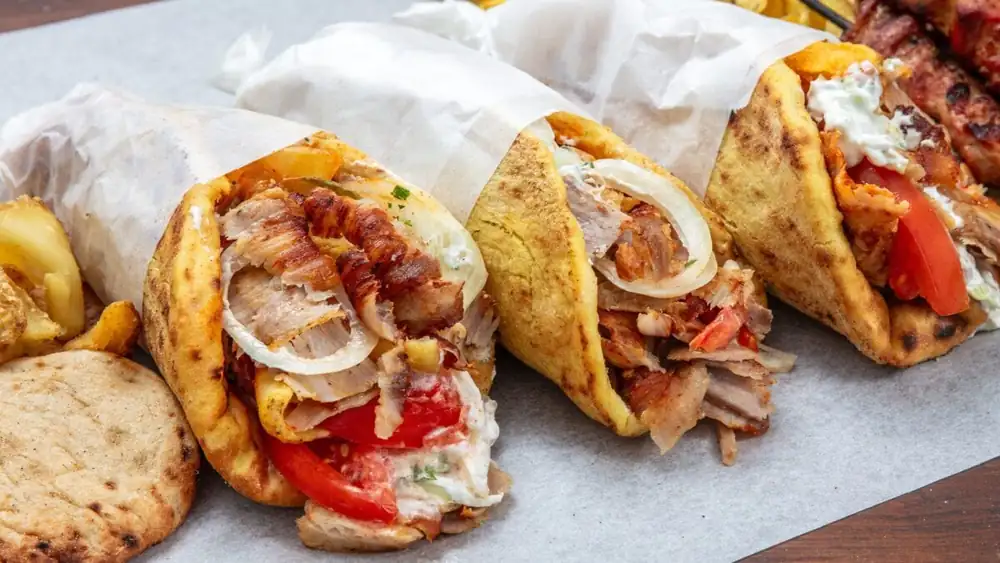
The bun we know, with onion, lettuce, and yogurt or garlic sauce, is a much more recent European addition, while the fries inside are not an Italian invention, but a Greek one. In fact, they're always found in gyros pita along with tomato, onion, and tzatziki.
You might think that it's the support, or skewer, that makes a meat dish "kebab." Not at all, because in Turkey there are testi kebabı, which cooks in a sealed clay amphora; tas kebabı, essentially a stew casserole; and fırın kebabı, which is baked in the oven. Kebab refers to meat cut into small pieces, cubes, thin slices, or minced, and cooked over direct heat—nothing more.
Who invented the döner kebab?
Döner takes its name from the Turkish verb dönmek, meaning "to turn." The most widely accepted theory attributes the idea of the vertical spit to İskender Efendi: in 1867, the chef opened a shop in the Kayhan bazaar in Bursa and began cooking meat vertically, no longer lying flat on the grill, with the fat dripping down the spit and browning the meat. This is also where İskender kebab was born, served on cubes of pide (Turkish bread) drizzled with melted butter, tomato sauce, and yogurt. Documents, however, tell us otherwise, as the vertical spit appears in a written record from 1842 and in an Ottoman photograph from 1853.
The panino we eat in Italy was born much later and much further north, in West Berlin in the 1970s, where Turkish immigrant workers adapted the dish to the city's rhythms and customs. Three people claim to have invented it: Kadir Nurman, who opened a stall in front of the Zoo station in 1972; Mehmet Aygün (Oranienstraße), who claimed it in 1971; and Nevzat Salim, active in Reutlingen since 1969.
The sector generates €3.5 billion annually, so much so that in 2022, the Turkish Federation filed a request in Brussels to register döner as a traditional specialty guaranteed, requiring only beef aged at least sixteen months, sheep aged at least six months, and meat slices of 3 to 5 millimeters thick. Unfortunately, Germany opposed the request, and the application was withdrawn in September 2025.
What is the difference between döner, shawarma and gyros?
All three rotate on a vertical spit, and their names mean practically the same thing: "to rotate." From philology onward, however, their paths diverge sharply.
Turkish döner is the essentials on a spit: lamb, beef, or chicken (in strips or compacted minced meat), marinated without too many frills in salt, pepper, onion, and yogurt.
Shawarma—the Arab and Levantine evolution of the Turkish döner—is made with the same meats but enriched with spices: coriander, cinnamon, cardamom, and cloves. It's then wrapped in khubz (a flatbread without a crumb, similar to flatbread) accompanied by chickpea hummus, garlic sauce, or amba, the pungent Iraqi pickled mango sauce.
Greek gyros also uses pork, since religious restrictions are no longer present. It's often seasoned with oregano and placed in a thick, carefully greased and grilled pita bread, accompanied by French fries and a generous helping of tzatziki. It's not to be confused with souvlaki, which is made with simple morsels of pork or chicken marinated for at least six hours in oil, white wine, oregano, and mint, and then grilled.
How many types of kebab are there in Türkiye?
Estimates speak of around ninety different types, a number that has neither been recorded nor certified, but it gives an idea of the magnificence of this dish. The Anatolian progenitor is Erzurum's cağ kebabı, where lamb or mutton marinated in onion, salt, and pepper are cooked horizontally over wood. The cook slices the meat from the skewer with a sword-length blade and serves it with grilled vegetables and lavash, the thin Armenian bread baked in a tandoor (clay oven).
The simplest is şiş kebap, which outside of Turkey we call shish, literally "skewer": it is prepared with cubes of lamb or chicken marinated in oil, lemon, and spices, with the vegetables cooked on another skewer.
Adana and Şanlıurfa share the same base of minced lamb shaped on a spit: the difference lies in the spiciness, present in Adana kebabı and absent in Urfa kebabı. In Cappadocian testi kebabı, diced lamb, shallots, tomatoes, garlic, and butter are cooked in a clay jar sealed with bread dough for an hour and a half to three hours; when it's time to serve, the jar is shattered in front of the diner with a loud bang.
Beyti, on the other hand, is named after Beyti Güler, the Istanbul restaurateur who in the 1960s created it with lamb fillets wrapped in strips of fat and rolled in crispy lavash, served with a yogurt and tomato sauce. This dish became so famous that it was even served to US President Richard Nixon aboard Air Force One.
Iranian chelow kabab, where meat accompanies rice
In Iran, the national dish takes its name from rice, because chelow kabab actually means "steamed rice on a skewer," and meat plays the role of side dish. The combination was consolidated under the Qajar dynasty, in power from 1789 to 1925, and appeared in the diet of Shah Naser al-Din. The most common kebab is koobideh, from the Persian verb koobidan, meaning to pound: ground lamb or beef is thoroughly mixed with grated and squeezed onion, then shaped with the fingers around flat, wide skewers.
Barg (“leaf”) is made with thinly sliced beef fillet or lamb sirloin marinated in onion, saffron, and oil; joojeh is made with chicken soaked overnight in saffron and lemon; and kabab torsh from Gilan and Mazandaran is served in a dark sauce of crushed walnuts, garlic, and pomegranate juice.
Alongside the rice, the waiter places a knob of butter, sumac, the dried and ground drupe of the Rhus coriaria shrub, followed by raw onions, grilled tomatoes, and a glass of doogh, yogurt diluted with sparkling water, salt, and mint. In historic bazaars, the ritual has mandatory steps, because first they serve the rice and side dishes, and only then the meat, still skewered on the metal. To slide it onto your plate, you cover it with a sheet of lavash, hold it steady, and remove the skewer. Finally, you also eat that bread, now full of juices, because in those parts, they used to mop up the meat centuries before us.
Melt-in-your-mouth Indian kebabs
In Lucknow, the capital of the state of Awadh since 1775, the kebab brought by Central Asian soldiers met the haute cuisine of the court and took on a new form. Galouti, from the Urdu galāwat, meaning "softness," was created to please Asaf-ud-Daula, the Nawab of Awadh, the governor installed by the Mughal Empire. The ruler had two distinctive characteristics: he was a meat-loving glutton but lacked teeth. The royal chefs were forced to resort to green papaya, a fruit rich in papain, an enzyme capable of breaking down collagen and reducing meat to a melt-in-the-mouth paste.
Legend has it that 160 spices were used to make this type of kebab, a figure not confirmed by any document, also because the Tunday Kababi restaurant, opened in 1905 by Haji Murad Ali, keeps the recipe like a family secret.
Kakori uses the same enzymatic principle, this time with green mangoes of the Malihabadi variety, while shami, also popular in Pakistan and Bangladesh, follows the opposite path: the meat is cooked for a long time in water with chana dal, or split lentils, then pounded, shaped into discs, and fried in a little oil, with the starch from the legumes holding everything together.
Kofta, sheftalia e mici
Kofta takes its name from the Persian kuftan, meaning to pound, and refers to the entire family of grilled kebabs in the shape of meatballs, generally made with minced lamb, parsley, and mint.
In the Balkans, these meatballs take on an elongated shape and are also made with pork: in Romania, mici, or mititei, are small sausages (without casings) made of beef, pork, and mutton, seasoned with crushed garlic, thyme, and a generous dose of baking soda, which raises the pH of the mixture, helps it retain water, and releases carbon dioxide during cooking, lightening it. In Bucharest, these morsels are eaten standing with spicy mustard, white bread, and cold beer.
In Cyprus, sheftalia is a meatball wrapped in caul fat, which in butchers call a net, the fat-veined membrane that protrudes from the animal's stomach and covers the intestines like an apron. Minced pork or lamb, onion, and parsley are rolled into the net, and the resulting parcel is then grilled. The net first tightens and holds the meat together, then melts, basting it with its own fat, and finally almost disappears entirely, forming a thin, flavorful crust.
Uyghur skewers, Chinese kebab
Along the Silk Road, skewered meat reached Xinjiang, where the Turkic-speaking, Muslim Uyghur minority calls it kawap, while the Chinese name is 羊肉串, yángròu chuànr, literally "mutton skewers." The pieces are cut to a size of one or two centimeters, and on the skewer, the lean meat is alternated with pieces of pure sheep fat, about a third of the total, so that, as it melts, it greases the pieces of meat underneath. Yes, these skewers resemble Abruzzo arrosticini.
The brazier is a long, narrow metal box filled with embers and devoid of a grate, and the skewers rest only at their ends, a few centimeters from the flame. Cooking takes two or three minutes, amidst continuous flames, and in the final seconds the vendor sprinkles cumin, chili flakes, and Sichuan peppercorns, the spice that causes the infamous numbing tingle known as málà (麻辣).
So, next time someone dismisses kebab as second-rate food, remind them that it's nearly four thousand years old, is eaten practically all over the world, and flew on Air Force One before us.