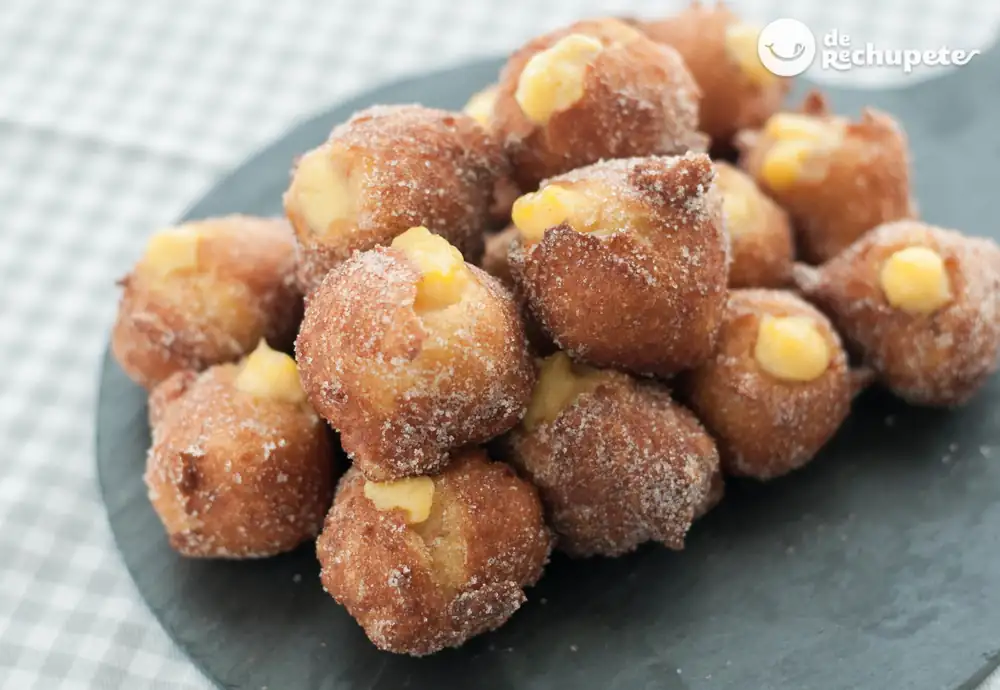
Wind fritters, the traditional All Saints' Day recipe
Para 8 0.8 €/pers. 408 kcal/100g.
- For the vanilla cream:
- 4 medium egg yolks
- 1/2 liter of whole milk
- 100g granulated sugar
- 50 g of cornstarch (fine corn flour)
- 50g of butter
- The peel of a lemon
- 1 vanilla pod or 1 teaspoon of vanilla extract
- 1 cinnamon stick
- For the fritters:
- 50g of butter
- 3 medium eggs
- 300 ml of water
- 150 ml of whole milk
- 3 tablespoons of granulated sugar (15 g x 3 = 45 g)
- 1/2 dessert spoon of salt (3 grams)
- 300g of all-purpose wheat flour
- 10 g of baking powder (Royal type)
- The zest of 1/2 an orange
- 1/2 liter of mild oil (extra virgin olive oil or sunflower oil) for frying
- To decorate the fritters:
- Sugar and cinnamon powder (to taste)
- The first step is to prepare the ingredients we'll use to flavor the milk. Wash the lemon thoroughly and peel its skin thinly, removing as much of the white pith as it might make the dessert bitter.
- We split the vanilla pod and scrape out the seeds, reserving them to add to the milk later. We set aside a small glass of milk from the total amount we'll be using.
- Heat the remaining milk in a saucepan over medium heat until almost boiling. Reduce the heat and remove from the stove. Add the vanilla seeds, lemon zest, and finally the cinnamon stick, broken in half. Let it all infuse for 10 minutes.
- Mix the cornstarch into the glass of warm milk and combine until there are no lumps; if necessary, use a blender or whisk. Separate the egg yolks from the whites.
- Place the egg yolks in a bowl and whisk with the sugar until frothy. Add the milk with the cornstarch dissolved in it. Whisk again until smooth and lump-free. Set aside.
- Strain the infused milk and return it to the saucepan. Heat to a gentle boil and add the cream from the previous step. Gradually add the cream, stirring constantly with a whisk or wooden spoon until thickened. Do not let it boil at any point.
- The cream should have a slightly thick texture and be smooth. It's very important to keep stirring constantly, as it can burn or stick to the pan. The secret, as with almost all recipes, is to be patient and keep stirring in the same direction until you have a smooth cream.
- We add the butter to finish creaming it; it makes it creamier and gives it a shine. We let it cool completely before starting on the fritter dough.
- We begin by preparing the ingredients. Wash the orange well and grate half of it. I like the citrusy touch of orange, but you can substitute lemon; it's just to flavor the dough. Set aside in a small bowl.
- In a small bowl, sift the flour through a sieve. Add a teaspoon of baking powder, mix well, and set aside.
- Place a saucepan over medium heat with the glass of water, half a glass of whole milk, the diced butter, the orange zest, the sugar, and the salt. As soon as it starts to boil, remove from the heat. Mix well with a whisk.
- Add the sifted flour and baking powder all at once and return to the heat. Stir with a wooden spoon until you have a smooth, lump-free batter. If you see any lumps of flour, don't worry, they will gradually disappear. The heat will eventually incorporate them into the batter.
- In the end, it will form a compact ball; it should pull away from the sides of the pan until it appears completely dry. Turn off the heat and remove the pan with the dough from the heat. Let it cool for a few minutes before adding the eggs.
- Add the eggs one at a time. Stir in such a way that the first egg is fully incorporated before adding the second. The result will be a thick, shiny, and much creamier fritter batter.
- Heat a pan over medium heat with plenty of neutral oil (sunflower or mild olive oil) so as not to add any extra flavor to the dough. Using two teaspoons, shape the fritters and fry them.
- The difficulty with this dessert lies in the oil temperature. If it's not hot enough, the batter sinks to the bottom and must be kept afloat. But if it's too hot, a dry crust forms around the fritter, preventing it from rising.
- Also, if the oil is too hot, they'll brown very quickly and remain raw inside. The first batch will serve as a test for the following batches, ensuring they turn out perfectly.
- We add them to the pan a few at a time, as they will double in size. When they are golden brown, we remove the fritters to absorbent paper. When they are lukewarm, we coat them with sugar and cinnamon. They would be perfect like this, but to finish, we fill them with pastry cream or your favorite filling.
- Although we've chosen pastry cream for the fritter filling, you can use whatever you like best. They're delicious as is, but at home, whipped cream or chocolate cream are also a big hit. We'll always make the filling first, whatever cream we've chosen. While it cools slightly, we'll prepare the fritters so we can fill them fresh with your favorite filling.
- This recipe makes approximately 35 fritters, enough for everyone at a family meal. They are small balls of dough about 5 cm in diameter; the ones you find in bakeries are usually almost perfectly spherical because they are piped.
- Since these are handmade using two spoons, the result is more irregular but just as delicious. When fried, the dough doubles in volume, puffing up considerably, hence their nickname, "wind fritters." Although they are delicious on their own, they are usually served with sugar and ground cinnamon.
- Many people ask why their fritters don't puff up. This usually happens because the dough is too dry or the oil is too hot. It can also be due to the dough not being properly dried over the heat before adding the eggs.
- Another common question is whether they can be baked. In that case, they wouldn't be traditional fritters, but rather a version of cream puffs or profiteroles, because the effect of the hot oil is what creates that characteristic round shape.
- Regarding storage, it's best to eat them the same day. They'll keep until the next day in an airtight container, but they lose some of their appeal. Filled ones should be kept in the refrigerator and eaten as soon as possible.
- Fritters filled with cream or chocolate
- Double chocolate fritters filled with chocolate cream
- Pumpkin fritters filled with pumpkin cream or whipped cream
- Pumpkin fritters filled with chocolate
- Baked filled fritters
- Potato fritters
In the autumn months, when chestnuts and pumpkins are plentiful, this recipe is a must-have—a classic dessert for All Saints' Day, November 1st. In Spain, dessert recipes for All Souls' Day, Carnival, and Easter are among the best of the year, rivaling even the nougat and marzipan of Christmas.
As is tradition, the week before November 1st I get to work preparing these little fried dough balls. It's a delicacy that everyone can make, because although it may seem like a difficult recipe, it isn't, and if you learn how to make them you can enjoy them any time of year.
If you'd like to continue with cakes, tarts and other dishes typical of these months, you can check out our special autumn recipes.
Like many other traditional desserts, this one also has Jewish heritage. Sephardic Jews were already making fried wheat flour buns called bimuelos in the 10th century to celebrate Hanukkah, very similar to the ones we know today. The Jewish Hanukkah is very close to the celebration of All Saints' Day, and Christians adopted this dessert, along with many others, for this holiday.
In some parts of Spain, they are also cooked during Carnival and Lent, where fritters, whether sweet or savory (like cod fritters), are very typical. In Madrid, they have become as famous as churros, porras, or torrijas, and bakeries offer them year-round.