Long live cooking stocks!
The reclaiming of the product is perhaps the greatest and most welcome development in contemporary gastronomy over the last 20 years. It's about bringing raw ingredients to the forefront, making them the protagonists of the dishes, showcasing them in their raw form and their origins.
It's commonplace today to know the origin of every vegetable and meat we eat: its variety or breed, how it was grown or raised, its traceability, and its optimal consumption time. These products appear on our plates unadorned, empowered, and powerful. A raw fish, freshly salted and sugared for a few minutes; a ribeye steak from a large, grass-fed animal, barely touched by the heat of the wood fire; asparagus with a delicious slice of lardo and a poached egg on top; aguachile of freshly picked strawberries; caramelized fennel on a cast-iron griddle. Frank, direct flavors that made headlines, bringing novelty, freshness, and youth. Their success can be seen as a response to the past, to that French cuisine full of intricacies and disguises, to that avant-garde, physicochemical cuisine that swept through the first decade of the 21st century. But in this triumphant march, some casualties remain. Among them are stocks, broths, and fumet, part of the ABCs of global gastronomy, which today, timidly, are beginning to recover the place they undoubtedly deserve.
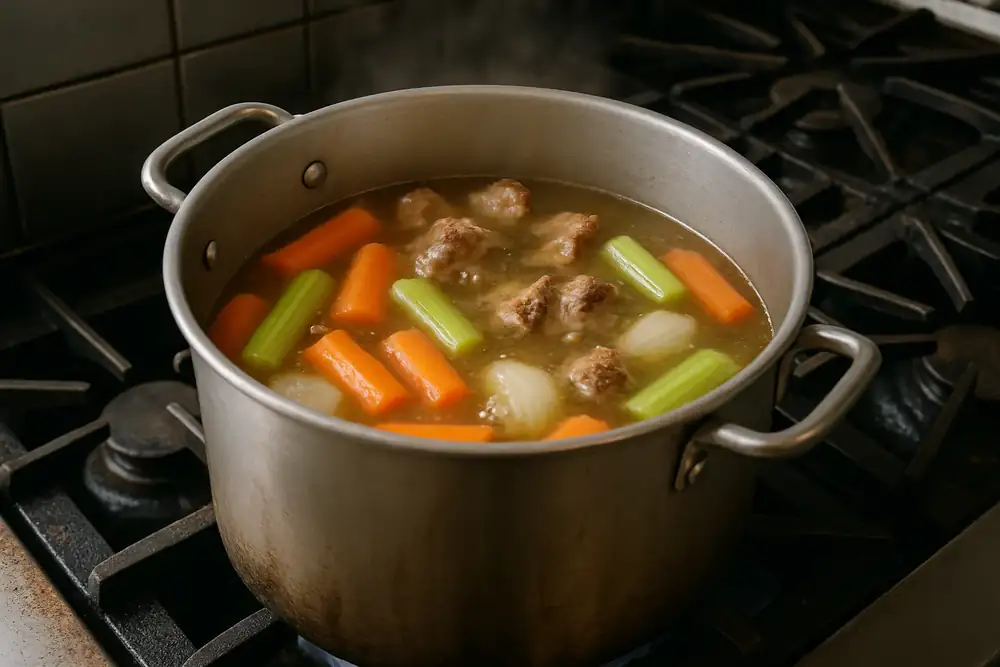
Today, Buenos Aires restaurants like Evelia (with its hearty pasta dishes), Mishiguene (with its traditional stews), Piedra Pasillo (with its use of game), Trescha (with its meticulous research in its first-floor laboratory), among many others, make these stocks and broths part of their identity. These are preparations that diners are unaware of, because their beauty lies precisely in their anonymity: long simmers, in some cases more than 24 hours over low heat, that belong to the intimacy of the kitchen, and which then arrive at the table disguised. Their brilliance is subtle, without marketing, far from the spotlight and Instagram: they aren't advertised on menus, they aren't seen on plates, but when they are, when there's a chef who understands them, they make all the difference, adding complexity, depth, and flavor.
Stocks and broths originated historically as a way to make use of ingredients that were otherwise unused and lacked glamour. Their preparation doesn't require the finest meat or the perfect vegetables, but rather scraps, bones, leftover bits after shaping vegetables, dried herbs, a fish head, the last of the wine in the bottle, whole spices, or citrus peel. “Stock is key in my cooking. The person I've studied most throughout my career is Thomas Keller, and stocks are very important in his books. At Evelia, we make beef stock using the kneecap bone, a cut that's often overlooked but has a unique flavor and is incredibly high in collagen; we also make dark chicken stock and brodo for other dishes. Our stockpots are always full,” says Máximo Togni.
In that Manichean dichotomy of chef-driven cuisine versus product-driven cuisine, stocks are essential bridges. A basic technique, learned in the first year of culinary school, yet imbued with the flavor of time, memory, and also of the land and culture. Its aroma evokes the scent of country houses in winter, of stews and casseroles; its uses are endless. As part of a leche de tigre, reduced into a demi-glace, enlivening dry rice, as a broth for cappelletti (a dish that, thankfully, is becoming fashionable in Argentina's best pasta restaurants), transformed into a velouté, cooking oxtail, among so many other applications.
In times of immediacy, where gastronomy demands visual stimuli and dramatic impacts, broths and stocks are defiant, a political statement: they demand patience and reflection. And that, always, is what the best gastronomy is about.