Mortar: essential even if it doesn't seem like it
The mortar and pestle is an essential utensil in my kitchen. It's true that in the Castilian-La Mancha cuisine where I grew up, it's used almost daily, if not daily, since many of our stews include a mortar and pestle that makes them so special.
What is a mash?
And since I have many readers who are just starting out in cooking and who don't necessarily know what a "majado" is, I'll start there.
A mash is the result of crushing ingredients in a mortar and pestle to incorporate them into another dish. You've seen it countless times in my recipes: in meatballs, in the artichoke and cod stew, in these garlic and chicken potatoes, in this chickpea stew, and in so many others.
Materials
The first mortar I ever owned (and still have) was a small wooden one that I brought from my mother's house. Although it served me well for a few years, a mortar and pestle should be something else entirely: it needs to be heavy, made of non-porous material so it doesn't absorb the aromas and flavors of the ingredients that pass through it, and made of a durable material to withstand being struck.
You may have also seen another mortar I own in some photos; it's beautiful, but more delicate and can't withstand such hard blows. It's an Emile Henry mortar that I use for making vinaigrettes and, of course, for my food styling.
A few years ago, a friend gave me one of Jamie Oliver's kitchen knives, which I love. I still have it, but since my mother is busy in the kitchen every day, it's quite large, and she needed a smaller, more manageable one.
Mortar Solomon, from Cilicia
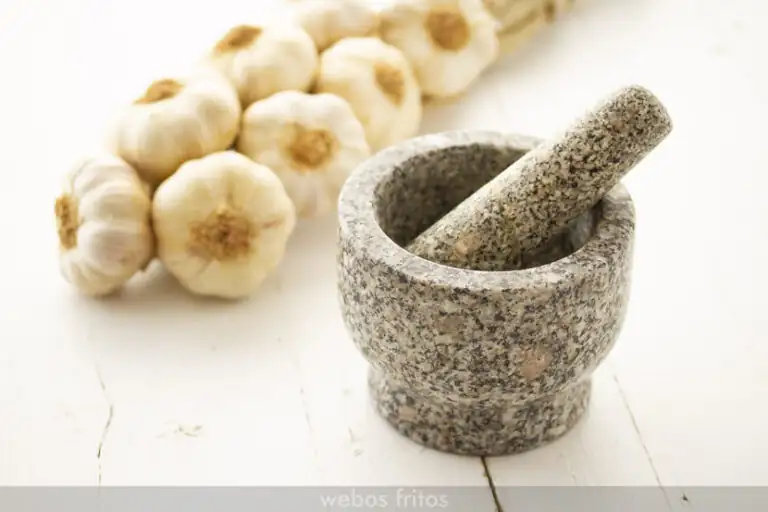
While searching, a couple of years ago I found the one that illustrates this article today, a 13 cm diameter Salomon mortar, made of 100% granite, from the German brand Cilio.
It's sturdy, yet very easy to handle. It weighs 2.5 kilos and doesn't move during the grinding process. Because the walls are high, nothing you're grinding will escape. And one thing I love is that the interior is slightly rough, so if you put something with a smooth surface in it, like a clove of garlic, it won't slip. Some mortar manufacturers recommend adding a little coarse salt to what you're grinding to achieve this effect. With this mortar, it's not necessary.
In addition, I use the pestle for other things, such as when I make a sauce and want to strain it, or to extract the juice from all the ingredients that I'm not going to use after cooking, pressing the ingredients against my chinois and thus ensuring that the sauce has all the flavor, or to shape some tartlets that you will see soon.
If your mortar and pestle wobbles a bit, here's a trick to keep it in place: rest it on a kitchen towel. This way you prevent movement, reduce noise, and protect your countertop.
My Cilio mortar is from here. Although these mortars last forever, I'll update this post as time goes on.
Thank you for reading!
Are
Your kitchen with
Our suppliers offer you special advantages. Being a web user means a guaranteed gift….