Osteria Da Rioba in Venice, review: lagoon gastronomy with a contemporary twist
Fondamenta della Misericordia, where Osteria da Rioba is located, is one of the most charming streets in Venice. It's also one of the busiest, unfortunately, a factor that has led to a profound transformation in recent years: small businesses have given way to bacari, bars, and restaurants—with vastly varying success and quality—rendering the area a jumble of establishments where it's difficult to
The name, the history, the managers
Not far from the restaurant is Campo dei Mori: here stands Palazzo Mastelli (known as Palazzo del Cammello for a bas-relief depicting a camel and its driver, located on the façade). Dating back to around 1100, it was owned by three brothers (Rioba, Sandi, and Afani, the Moors after whom the campo is named). Having fled from Morea (Greece), they found refuge in Venice, where they began a thriving and, it is said, dishonest trade in fabrics and textiles. Legend has it that they were turned to stone after defrauding a Venetian noblewoman, who placed a curse upon them. The three statues embedded in the bases of the buildings adjacent to Palazzo Mastelli are thought to represent the three merchants: in reality—less poetically—they are three stone figures assembled during the 1300s from pieces of sculptures from different eras. Of these, the one we are interested in is the one with the metal nose: that is Rioba. During the period of maximum splendor of the Serenissima, Rioba became what Pasquino was for Rome: a statue used to display poems and satirical writings against power and politics.
Rioba's history, however, does not end with the Venetian Republic, but continues through the following centuries, right up to the present day, in a decidedly eventful fashion. In the 19th century, Rioba lost its nose, which was replaced with its current iron one, which is said to bring good luck when rubbed. Finally, on the night between April 30th and May 1st, 2010, Sior Rioba was beheaded, leading to widespread distress among the citizens and a general mobilization. The head was found a few days later and returned to its original location.
The restaurant's fortunes have been less troubled, with its name honoring the statue's role as a "speaking" figure. Run by the Milner family, it has a history as an osteria. In 2005, they decided to create a space that would certainly be distinctive in terms of ingredients and dishes, but much more contemporary in style and workmanship. What immediately stands out, however, in the direction set by Tomaso Medici and his mother, Eloisa Milner, is that they never push the envelope, offering dishes that are "understandable" and enjoyable. The restaurant is also part of the "Osti in Orto" project, which sees a group of local restaurants involved in managing a vegetable garden in Sant'Erasmo, whose vegetables become both ingredients for the dishes on the menu and products sold at the market.
Environment and service
While diners drawn to the idea of dining along the canal might find the outdoor space (seating about seventy) charming, it's actually the interior that makes the place welcoming and distinctive: despite its small size, all the key elements are present. A counter at the entrance, the kitchen to the left, and the single dining room to the right. The old beams, exposed brick, photos and paintings on the walls, and above all the Venetian flooring transform the space and its 40 seats into a setting where intimacy doesn't translate to cramped or suffocating. Each table, in short, manages to carve out a space of its own. The service is young, cheerful, and courteous: the dishes are explained in a breezy yet precise manner. The wine list is extensive: alongside the "traditional" offerings, a focus on natural and artisanal producers stands out, a focus further confirmed by the existence, adjacent to the restaurant and under the same management, of an adjoining space dedicated primarily to wine. It's called La sete and is a wine bar serving cicchetti.
The menu and the dishes
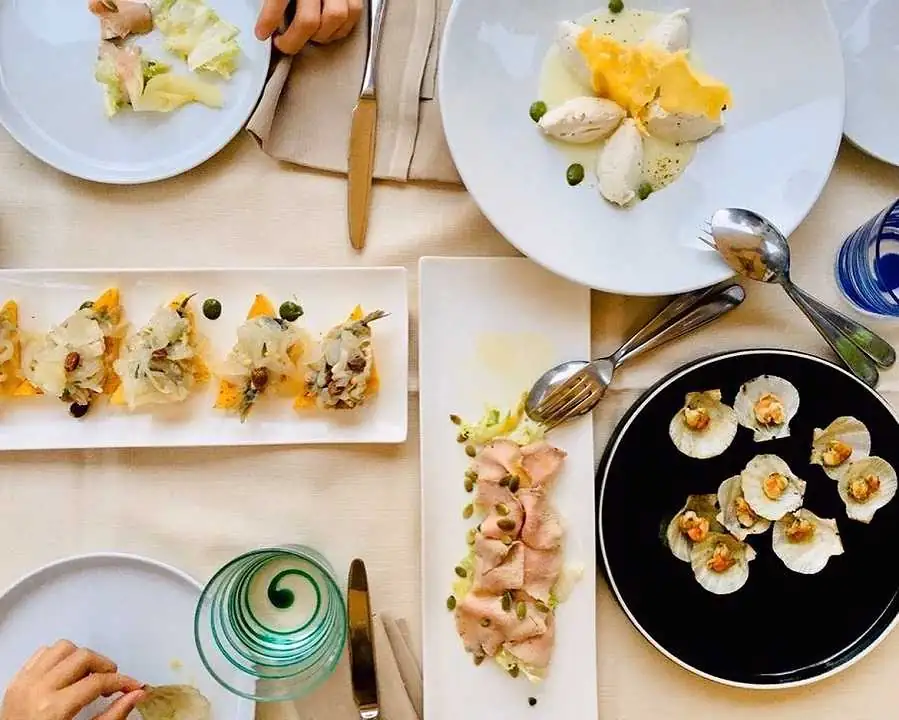
Rioba's menu is intelligently constructed: appetizers, first courses, and second courses are divided into three parts, divided into "from the sea," "from the land," and "from the garden." These cross-cutting references are rooted in traditional grammar (for example, creamed cod or sardines in saor among the appetizers, as are creamed bean soup or linguine with crab among the first courses, as well as grilled sea bass or turbot for the second courses). However, pairings and reinterpretations, cooking methods, or the appearance of ingredients as co-protagonists (spaghetti with clams features broccoli, creamed bean soup pairs with baby squid; the cooking oil for the mackerel follows the same pattern) paint a fresh picture. The meat dishes, despite the omnipresent tagliata, quickly stand out, with a guinea fowl and plum ragù or a duck breast. As elsewhere, off-menu items are offered verbally. Prices range from 15 to 28 euros for appetizers, 18 to 22 for first courses, 25 to 28 for second courses, and 8-9 for desserts. We're in the middle. The opening course, featuring veal tongue with Belgian endive, beetroot, and anchovy, is a success, both in terms of flavor and texture and color. The tenderness of the tongue pairs well with the crisp turnip, and while the sweetness of the turnip provides a foil, the burst of flavor comes from the anchovy paste and the endive, so full of character it resembles a leek. The first course—a crespella with carletti, wild mushrooms, and dandelion greens, off-menu and an expression of a very short season—is a leap back in time: we're looking at an issue of "La Cucina Italiana" from the 1970s, with the crespella folded in four and garnished with béchamel sauce. While the plating certainly isn't cutting-edge, the flavors are nonetheless impressive: the herbs are noticeable, as is the béchamel sauce, which doesn't overpower but rather adds depth. A less anachronistic presentation would have enhanced the filling even more. The grilled sea bass with creamed celeriac, marinated red cabbage, and caper powder seems to counterbalance the tongue it opened with, in terms of colors and similarities. The quality of the fish is high, its flesh flavorful and firm, cooked carefully to prevent stringiness. The bold, acidic character of the cabbage elevates the dish, balancing the excessive softness of the celeriac. It's a shame the caper powder isn't noticeable: it would have allowed the celeriac to do its job properly and would have enhanced it. The flavors are there, however, and the dish, crafting a single bite that encompasses all the ingredients, works. The finish is entrusted to a pistachio Bavarian cream, Maldon salt and cocoa earth: more similar to a mousse, it is pleasant and well executed: also in this case, allowing the teaspoon to collect each element saves the pistachio from excessive sweetness and the Maldon salt from a role perhaps assigned more by contrast "on paper" than by actual contrasting identity.
Opinion
In the Fondamenta della Misericordia area of Venice, now hostage to mass tourism and a series of similar establishments, Osteria Da Rioba is not only a historic landmark but also a place that continues to maintain an uncompromising approach: quality, carefully selected ingredients, and a contemporary take on lagoon gastronomy make it one of the area's most trusted eateries.
PRO
- The inclusion of valid land and vegetable garden proposals, which are not just a stopgap.
AGAINST
- Some dishes deserve more courage, pushing a little more on contrasts and combinations capable of enhancing the ingredients.