Eataly's pizzeria in Turin is the Eataly philosophy applied to pizza
The Eataly pizzeria in Turin exists within a series of opposites: artisanal yet industrial, quantity yet quality, fair prices for the poor producers yet demanding for the poor consumers. These are the apparent, and seemingly irreconcilable, opposites within which the Eataly project as a whole exists.
We're familiar with the Eataly model: refined, sophisticated products—so-called "excellences"—typical of small shops, but packaged in a department store setting. Furthermore, to fully expand the gastronomic offering, these delicacies can be sampled on-site in a series of themed restaurants. This last aspect underwent a reorganization not long ago: previously, there was a section for pasta, pizza, meat, fish, vegetables, and I'm sure I'm forgetting something. Now, all these lines have been consolidated into two or three macro areas: the one we're interested in combines pasta, pizza, and a bit of mixed cuisine.
Eataly's pizzeria benefits from the thematic and operational proximity of the Bakery, managed by Fulvio Marino and featuring flours from the eponymous mill (Eataly's Pizza Team, as stated on the website, also includes Francesco Pompilio, Eataly's master pizza chef, and Enrico Panero, executive chef). In short, when it comes to leavened products, we're in the hands of art, as they say.
But, on the other hand, the dining environment is still the noisy and crowded one of a large supermarket: in the row of tables squeezed between the counter and the shopping areas, between those buying bread and those passing by with shopping carts. The outdoor seating is more spacious and relaxing; sure, we're still in Lingotto—a suburban area now well-served by the metro, a former industrial zone (it used to be all Fiat) and now a trade fair site—and not in the hills or on the Po, but it's a lovely open space.
The menu of Eataly's pizzeria
The first thing you notice about the Eataly Pizzeria menu is how few pizzas there are: eleven in total, plus one less prominent one among the "seasonal specials." And that's a good thing, of course—we love short menus for a variety of reasons, but it all depends on what's on them. The second thing you notice is that there aren't any great flashes of inventiveness: two Margheritas (one buffalo mozzarella), a 4-cheese pizza, a Diavola, a Capricciosa, a Calzone... basically, the classics—except for the marinara, which is missing—and not even the contemporary pizzeria ones, the ones straight out of pop culture history. But—and this is the third thing you notice—despite all the popular simplicity of the offerings, the prices are anything but affordable: the entry-level price, Eataly's original Margherita (that is, the margherita), is significantly lower than all the others—€5.80, yes, point eight, more like a supermarket than a restaurant. Then the Margherita with buffalo mozzarella at 7.8 and everything else around 10 euros, up to 13.
Furthermore, for an extra euro and 50 cents – or rather 1.50 cents (that's what's strange, the lack of a zero in the cents) – you can have an alternative dough, Ancient Grains, with Enkir, spelt, rye and Kamut flours, also organic from Mulino Marino.
The opening menu features a nice selection of fried foods, dominated by leavened pastries, but there are also supplì, croquettes, and chips. The rest (pasta, salads, other dishes) aren't our cup of tea, and we're not interested here.
The drinks menu is consistent with the somewhat ambiguous characteristics seen so far: good-quality industrial beers, a limited but varied selection of wines – only the markups are impressive, in most cases 100% or more.
Eataly's appetizers and pizzas
When you move from theory to practice, it must be said, the music changes. The appetizers are more like small bites than entrées. But with the first bite of montanara, all doubts evaporate: the fusion of the warm, sweet sauce with the salty/umami flavor of the pecorino is perfect, albeit familiar. Special mention goes to the "Antonella" tomato, which we happily find on all the red pizzas. The escarole on the calzoncino is also excellent, and the dough is beautifully thin. The fried pizza is dry, as it should be.
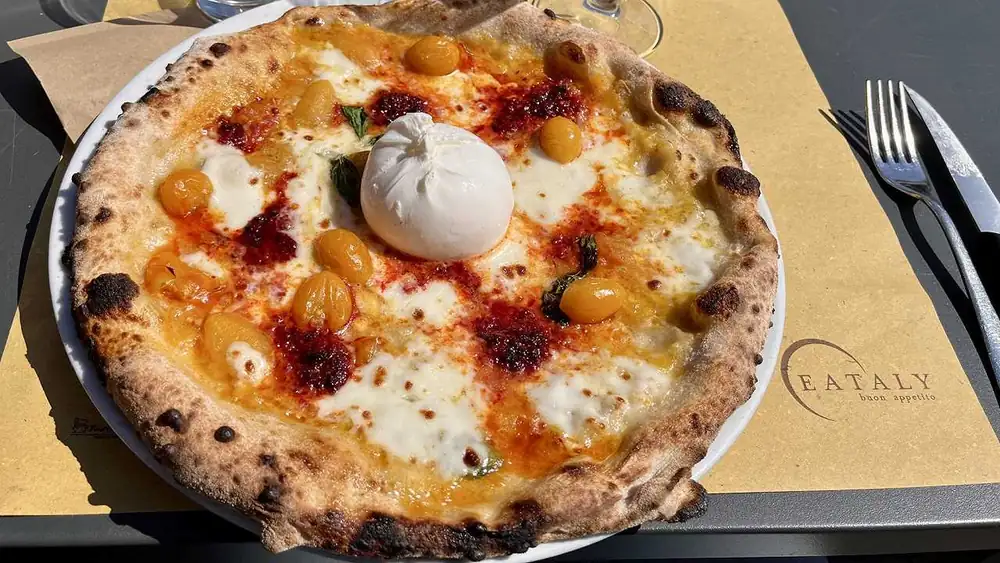
The pizzas are incredibly delicious. Nothing particularly original, as mentioned: for example, the one off the menu—yellow datterino, burrata, and 'nduja—is a trio you've seen almost everywhere these days; yet it's a truly mouthwatering experience. This is also, and above all, thanks to the ingredients: the 'nduja in particular, now somewhat overused for spiciness, is often of a less-than-stellar quality, so much so that it makes you forget it's a cured meat; here, however, the meat shines through. The Valdostana is simple, the fontina doesn't overpower the rest, and it all pairs beautifully with the rustic dough.
Now, where there's a bit of a disappointment is in the dough itself: nothing obviously flawed, but nothing transcendental, as one might have expected. The classic pizza is thin but well-cooked, flexible but not tending towards rubbery like the (worst) Neapolitan ones. An honest pizza in the so-called "Italian" style, which means everything and nothing, whose standardization is thanks to the rotating oven that partially relieves the pizza chef of responsibility and stress. The pizza made with ancient grains is, as the menu already states, rolled out with a rolling pin, and here it's not so much the Neapolitan in me who rebels, but the dough nerd who is a bit surprised: flours like this, low in gluten, should be handled more delicately than usual, not less. The result, while not unpleasant, resembles a piadina more than a pizza.
Digestion is long and slow, and requires water: but in these cases I attribute the effect more than anything to the saltiness and abundance of condiments. The bill comes to over 30 euros per person: not including the bottle of wine—which is expensive anyway, see above—that still comes to 20 euros per person. You eat well, but you pay a bit high. Or. You pay a lot, but you eat very well. The choice is yours.
Opinion
Eataly's pizzeria embodies all the hallmarks and hallmarks of Eataly in general: good quality, high prices, and a pop-up exterior.
PRO
- The environment, if you're out.
- The superlative condiments.
AGAINST
- The environment, if you're inside.
- Prices are generally quite high, especially for drinks.