Sophia Loren in Florence: A Review of a Disappointment
There's a Sophia Loren with Francesco Martucci, physically present inside the beautiful open kitchens of one of Florence's most controversial restaurants and pizzerias. And there's a Sophia Loren without Francesco Martucci, rightly busy at his award-winning pizzeria "I Masanielli" in Caserta.
The grand opening of 2020 on Via dei Brunelleschi has two faces that deserve two separate (and markedly different) reviews: the first with an excellent rating, the second with an inevitable failing. Or a political six based on factors unrelated to the pizza, if you prefer. Which is a disappointment in any case.
The service
The opulence and, above all, the size of such a large restaurant require a large staff attentive to the needs of the countless guests, both Italian and international, who visit every day, almost hypnotized by its captivating neon signs. The limited offerings during this delicate historical period may be an excuse to consider, but—despite significant improvements since the last time we visited—Sophia Loren still lacks the hospitality, responsiveness, and experience in interacting with diners. We don't necessarily ask for the warmth of a ten-seat pizzeria (it would be impossible to replicate this concept in such a large establishment), but at the very least, we want the pizzas to be brought at the same time and not separately. We also want customers to be asked immediately, as soon as they sit down, whether they would like still or sparkling water. And other basic service shortcomings that would make even the least pretentious tourist impatient.
The menu
Abundance. The criticism (from the Greek verb κρίνω, and therefore intended as an objective judgment) in this case is absolutely positive. Sophia Loren is a full-fledged tribute to Neapolitan and Campanian cuisine, not limiting itself to pizzas (there are 17 on the menu), but also offering appetizers, Neapolitan-style fried foods (Montanare, Crocchè, Arancini, Frittatine, etc.), first courses (such as Mixed Pasta and Peas, Neapolitan Lasagna, and Spaghetti with Clams), meat and fish main courses (such as Sausage and Beans, Meatballs in Tomato Sauce, Cuttlefish and Peas Stew), and an interesting selection of buffalo mozzarella.
High-quality products and ingredients, combined with the names of the key figures who worked on its opening (the aforementioned Martucci for the pizzas, chef Gennarino Esposito for the kitchen, pastry chef Carmine di Donna for the pastries) and its central location, justify the above-average prices. The wine and craft beer list is also very good, especially the compelling selection of national wines (divided by region) that showcases many of the classics, and even a few surprises, of the Italian wine scene.
The pizza
But let's get to the focal point of our analysis: pizza. That there are differences between those baked by Sophia Loren with Francesco Martucci on site and those without is plausible and, in its own way, understandable. First of all, because it's a consultancy and not a permanent collaboration, despite the pizza menu explicitly stating "La Pizza di Francesco Martucci" (unlike the kitchen and pastry menus). Secondly, because in pizza, perhaps more than in any other branch of cuisine, the artist's hand and his signature touch maintain a romantic uniqueness that not even franchises, cheap copies, and various chains will ever be able to fully emulate.
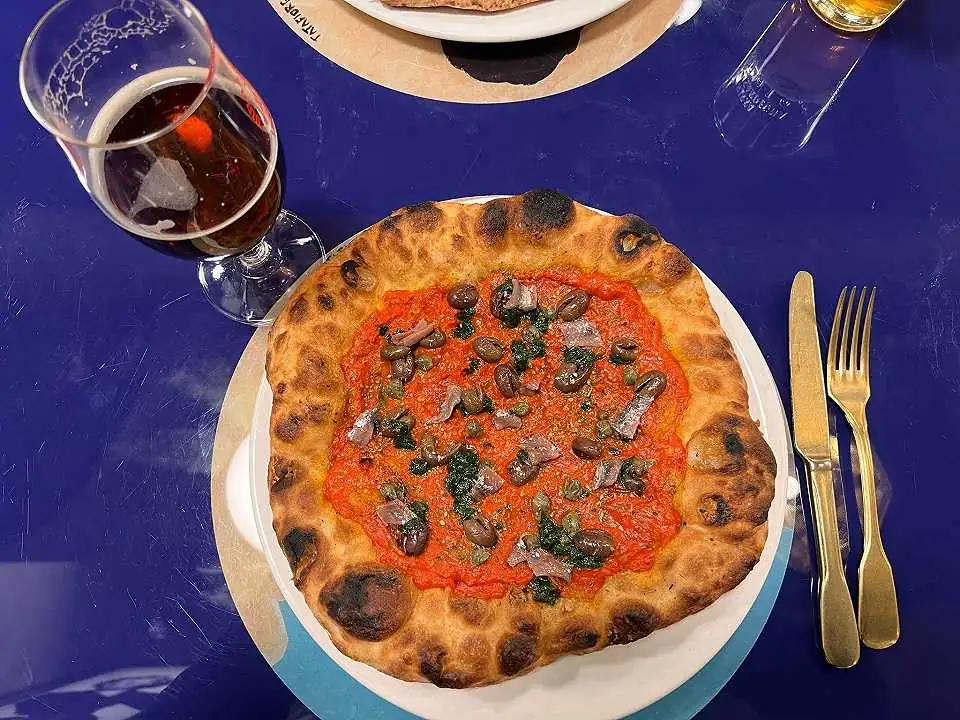
That said, we were disappointed to first try the "perfect pizza" (at press events with Martucci present) and then a very distant imitation of it (without Martucci, of course). Two pizzas with the same soul, the same ingredients, and—we're not questioning it—even the same underlying passion, but the results were truly far, far apart. And so the "5 consistencies of onion" (creamed, fermented, crispy, charred, and onion mayonnaise with fiordilatte, extra virgin olive oil, and basil), the closest thing we've ever eaten to Michelin-starred cuisine, has become a difficult pizza to digest, discordant, and at times rubbery in its declared Neapolitan style. The gap widened even further with the "Futuro di Marinara" (double-cooked pizza, fried at 180°C and baked at 400°C, with roasted tomato cream, wild garlic pesto, capers, Caiazzo olives, oregano left uncooked, and Trapani anchovies). The one Martucci made some time ago was amazing, while the one tried and tested by customers over the past few months was incredibly greasy and consequently heavy. Not to mention the Montanara Genovese that preceded the pizzas, with enough oil in the dough to fill a glass (so much for the seed oil crisis!).
The sweets
The dessert menu showcases Campania and boasts top-quality ingredients, but this too—like the pizzas—is much more appealing to the eye than to the palate. "La delizia al limone," for example, is a dessert completely devoid of lemon's acidity, as well as its traditional sweetness and the contrasting textures that distinguish it, confirming at the same time what Sophia Loren could have been (one of the best pizzerias in Florence) and what, unfortunately, it is today.
Opinion
A real shame, the capital "P" is intentional. For the potential Sophia Loren has in her veins. For having "disturbed" the Muse of Italian cinema. For the high prices, which would be more than appropriate with a completely different service and a pizza that doesn't reappear during the night. More generally, for failing to capitalize on the foundations that three benchmarks of Italian dining (starting with one of the sacred monsters of pizza, Francesco Martucci) have left as a legacy to this restaurant-pizzeria, complete like few others. Quality isn't in the name, but in the dish: as Florentines, we hope Sophia Loren manages to reverse this trend soon without becoming a place exclusively for tourists.
PRO
- The rich menu, the splendid location, the enormous potential.
AGAINST
- Fried foods are too greasy, pizzas don't live up to their reputation, and the service is improving but still inadequate.