Assaje in Turin, review: the chain pizzeria full of abundance (in every sense)
Assaje in name and in fact: the chain founded to bring Neapolitan pizza throughout Italy, starting in Milan (sic), has opened its latest location in Turin. Where it lives up to its promise of abundance—and not just in taste and portions, as we'll see in this review.
The Assaje pizzeria chain
Assaje is a franchise brand: the various locations operate under strict surveillance, the menu is the same for all, and the decor is uniform—classic Neapolitan yet free of dated elements. In addition to the Milanese locations (currently three), Assaje also has locations in Trieste, Udine, and Bergamo: all well north of Milan, as you can see, so much so that the observations made for similar business ventures like Pizzium and Fra Diavolo can be echoed.
The intention is clear: "The slogan 'we eat a lot'... means retracing the gastronomic culture of Naples and the opulence of its dishes." The first thing Assaje possesses in abundance is conviction: it believes it very much, as we would say in Naples. Slow Food Presidia, "local tradition," "territory," "long leavening"—the fundamentals (or clichés) of contemporary pizzerias are all there, but they're presented as if they were something highly original. Then there's the definition of "gourmet pizza" that stands out on the website and even at the entrance to the Turin restaurant: a designation that, besides sounding a bit passé, in my opinion shouldn't be given to oneself.
The size of the place is also noteworthy: spacious interior rooms, two ovens (both open-fire and gas), and dozens of tables outside under awnings; it seats well over a hundred. It overlooks a wide sidewalk on Via Andrea Doria, a central but short street in Turin, where two other pizzerias we mentioned are located (Magno just before, and La Lampara further on); in an area that is increasingly becoming an open-air food hall.
The Assaje menu
The gastronomic offering is also characterised by abundance: the menu starts with Neapolitan fried foods (10), starters (6), bruschetta (4). Then the pizzas, divided into three categories: there are the traditional ones (10), that is the classic ones but without the tacky stuff and with the valuable presence of the Cosacca; followed by the contemporary ones (10) that is always whole but with more refined ingredients, and therefore there is no lack of some pop excesses such as the one with the filled crust and the one in the shape of a racket; finally the gourmet ones (5) divided into slices. Finally the fried pizzas (5) finish.
Prices are proportionate to the type of pizza: under €10 for the traditional ones (€7 for a Margherita, €6.80 for a starter for a marinara and Cossack), between €10 and €12 for the contemporary ones, and between €16 and €18 for the gourmet ones. All fried pizzas are €10, appetizers are around €15, and fried foods and bruschetta are also moderately expensive.
The drinks menu is fairly dull and modest, with the only standout being the Assaje-branded craft beer produced by a local craft brewery (Brasseria Alpina).
Assaje's fried foods and pizzas
After so much theoretical abundance, it must be said that in practice, you're not disappointed: the mixed fried food, where you can try almost everything, is a real test even when shared between you. Arancino and arancina (red and white) are each more umami than the other; the croquettes are also soft and crunchy, the one with the purple potato is also very beautiful to look at (but nothing that distinguishes it in flavor); the stuffed zucchini flower has the unusual presence of cooked ham, but it's acceptable; only the pasta frittata is a bit disappointing due to its lack of flavor.
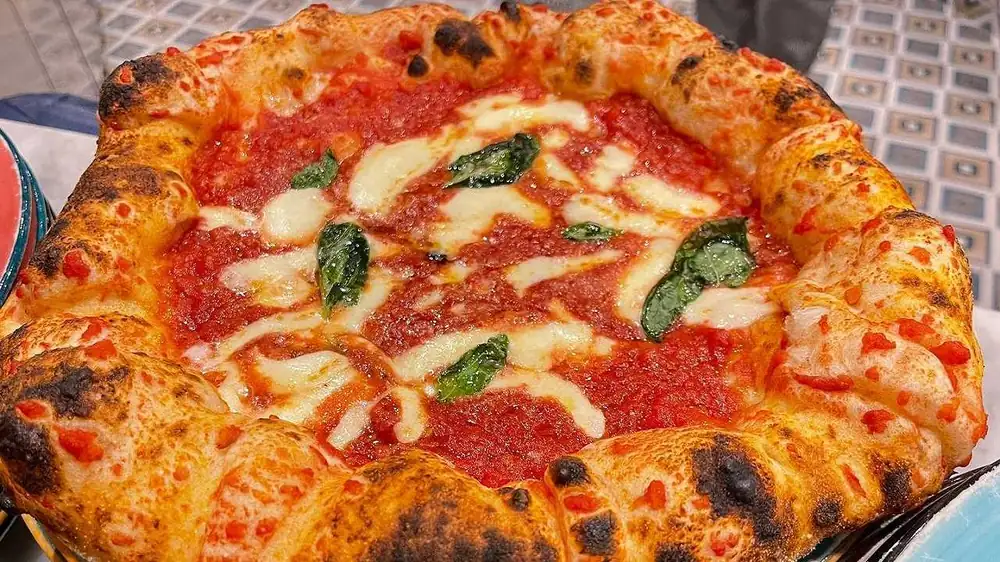
The traditional pizza has a nice, pronounced crust and a thin center. It's perfectly cooked on top, but has a slightly burnt side underneath; these are the pitfalls of Neapolitan-style pizza. The Cosacca is simple and tasty, just as it should be, with the pecorino cheese on top being a little yellow (isn't that what it's added to during cooking?).
The gourmet pizza—which, to stand out, comes on a cutting board rather than a plate—is smaller and taller: the inside is well-cooked, which isn't always a given with this type of pizza, but it's just a touch too firm to bite into. But it's commendable that with the same dough (I believe) and the same oven, you can make two such different, indeed mirror-like, types of pizza. The choice to cut them into four slices, rather than eight or at least six as is usually the case with tasting pizzas, is questionable: a slice is truly difficult to manage with such an abundance of layered ingredients. The Fichi e Culatello pizza boasts all the prima donna ingredients—buffalo mozzarella, culatello, fig jam, and even a wafer of Conciato Romano—but it finds its own miraculous balance between sweet and salty, fresh and fatty, crunchy and soft.
Digestion is good despite the quantities ingested. The bill is a tad steep: actually, quite a lot.
Opinion
Assaje is a contemporary Neapolitan-style pizzeria chain that focuses on quantity—portions, flavors, selection, seating—without sacrificing quality. And it succeeds (but also on the high prices).
PRO
- The service is very fast and very attentive.
AGAINST
- The quality-price ratio affects the final rating: a nice 7, no more.