Time is relative: Shelf life of milk, yogurt & co
12,000 liters of raw milk per day
The Höhn dairy has a streamlined product range. For almost 100 years, it consisted solely of milk and cream. "We've also been producing yogurt for 15 years, but we simply don't have the space for butter and cheese," says Christian Höhn, who runs the family business in its fourth generation. Indeed, space is tight in the small production facility on the Hirzel, a mountain pass between Lake Zurich and the Sihl Valley. A labyrinth of stainless steel pipes winds along the walls and ceilings, the lines are connected to massive tanks, and there's little room in between for all the equipment, hoses, and milk cans. But the space is sufficient to process 12,000 liters of raw milk per day. The products end up in the hands of baristas and chefs, in the muesli of hotel guests, and in village shops and supermarkets.
Fifteen seconds of heat makes the milk last longer.
Christian Höhn stands at the control center of his plant, "at the station," as he puts it. Here, the dairy master sets the parameters on a touchscreen. The cleaning cycle has just finished, and pasteurization is about to begin. Instead of water, milk is now flowing through the pipes again. This milk—like the cream—is pasteurized directly above our heads, in a pipe with several coils. A heat exchanger heats the liquid to 78 degrees Celsius for 15 seconds, thus extending the shelf life of the raw milk, which is only edible for a few days. The process is named after a French chemist: Louis Pasteur discovered in 1864 that bacteria in food can be killed by brief heating. "Pasteurization destroys up to 98 percent of germs," Höhn explains.
Pasteurization: Pasteurized milk can be kept in the refrigerator for ten to twenty days. For this process, raw milk is heated to at least 72 degrees Celsius for 15 seconds. Cream and butter are also preserved through pasteurization. UHT milk, on the other hand, is heated to at least 135 degrees Celsius. This makes it germ-free and allows it to be kept at room temperature for up to three months.
Lactic acid fermentation: In the production of yogurt and cheese, lactic acid bacteria convert lactose into lactic acid. This process preserves food by lowering its pH value. Because microorganisms can hardly grow in this acidic environment, yogurt and cheese can be enjoyed for months.
You can turn 10 days into 20.
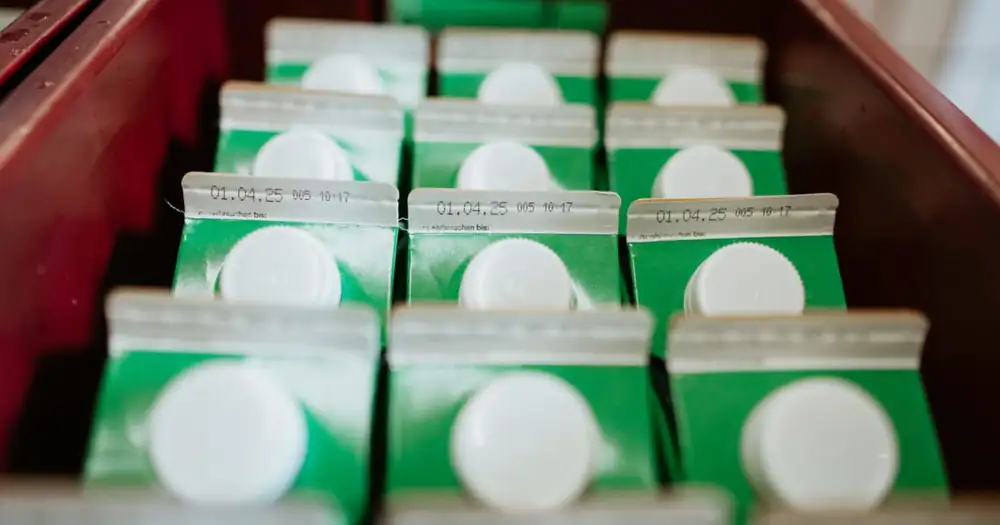
After pasteurization, the milk is cooled down to 2 degrees Celsius and temporarily stored in a tank. From there, it flows into the packaging machine, which churns out freshly filled 1-liter cartons every second. According to the use-by date, the milk has a shelf life of 10 days, but Christian Höhn puts this into perspective: "Paste milk is considered a fresh product, and therefore the food safety requirements are particularly high. We deliberately calculate conservatively because no cold chain is perfect, and milk often sits on the table for too long." With consistent refrigeration below 6 degrees Celsius, pasteurized milk can be stored for up to 20 days, the expert explains – and before it spoils, it can also be frozen: "My father used to always keep a supply of milk in the freezer at our holiday home," Höhn recounts.
Pasteurized milk is considered a fresh product, and therefore the requirements for food safety are particularly high.
Lactic acid fermentation takes half a day.
Making yogurt takes considerably more time. Lactic acid bacteria are added to pasteurized milk, and the mixture ferments for four to five hours in a tank at 40 degrees Celsius. The lactic acid bacteria convert some of the milk sugar into lactic acid, which makes the yogurt shelf-stable: "Yogurt is acidic, and therefore harmful bacteria cannot survive in it," explains Christian Höhn. Today, the employees are producing 600 kilograms of Greek-style yogurt, the dairy's latest creation. The packaging bears a best-before date, which guarantees impeccable quality. Unlike pasteurized milk, yogurt is not considered highly perishable, and therefore no guarantee of food safety is required.
The use-by date ("use by") guarantees food safety for highly perishable products. Unopened, pasteurized milk and cream can usually be kept in the refrigerator for a few days beyond the date on the packaging.
The "best before" date ("best before") guarantees the quality of taste, smell, color, and consistency of long-lasting foods. A sealed yogurt is usually edible for several weeks beyond the printed date. Butter, if well-packaged, also generally keeps considerably longer.
If you want to learn more about the date on the packaging, then check here.
Yogurt is acidic, and therefore disease-causing germs cannot survive in it.
Yogurt can be enjoyed for up to a month longer.
The "best before" date offers even more leeway than the "use by" date. Christian Höhn jokes that it's called "best before" and not "toxic after." Yogurt is generally edible for up to a month past the printed date, sometimes even longer, although the taste may suffer slightly: "The lactic acid bacteria continue to work, which is why it tastes increasingly sour," explains Höhn. A watery liquid often forms on the surface over time, but this whey is harmless. Only mold is a definite warning: hands off! Before it gets to that point, why not quickly make some frozen yogurt? Höhn's Greek-style yogurt is particularly well-suited for this due to its high fat content.
Consistency: As soon as milk or cream becomes flaky or lumpy, it is no longer edible.
Smell and taste: Pasteurized milk and cream smell and taste sour when spoiled, while expired UHT milk tends to smell musty or bitter.
Milk whey: A watery liquid may form on yogurt. The reason: Over time, the protein structure contracts and pushes the water to the top. However, the milk whey is completely harmless and can simply be poured off or stirred in.
Mold: Milk hardly ever molds, but cream and yogurt can. In that case, it's definitely best to keep your hands off, as the fungal spores extend far below the surface. Unlike cheese, the mold can't simply be generously removed.