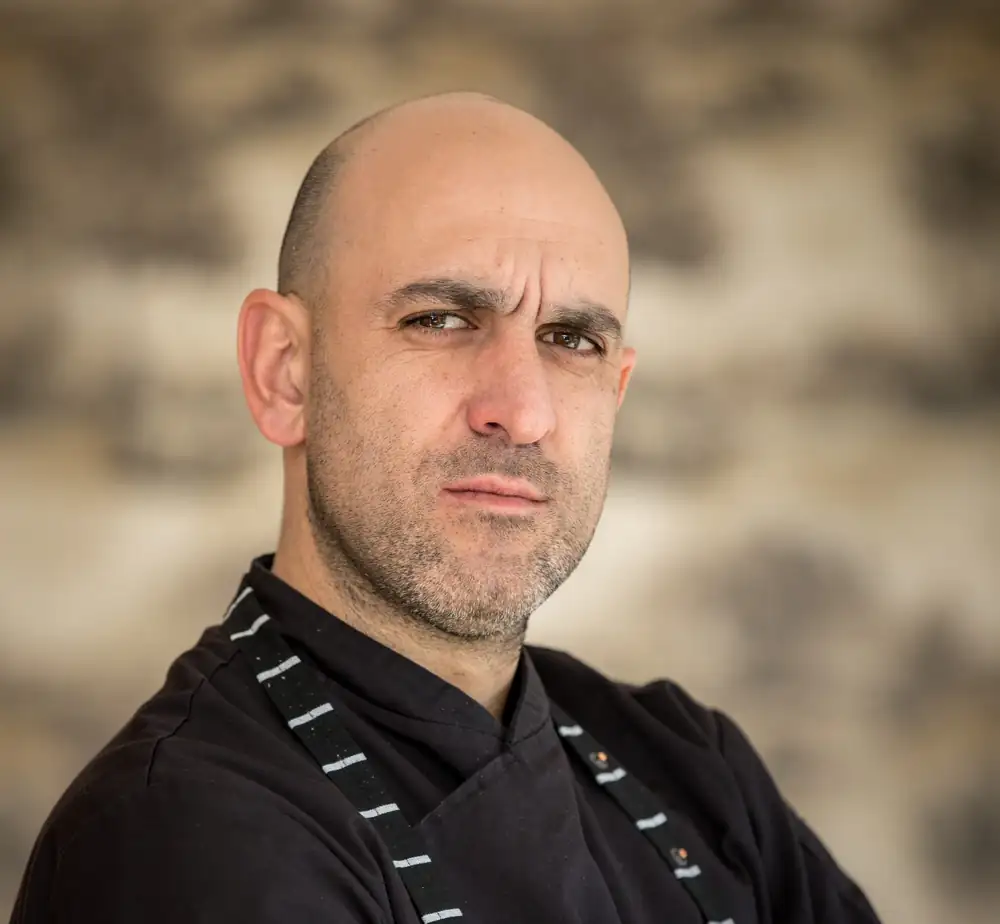
“They told me I was crazy”
Luis Alberto Lera is one of the most sought-after chefs of the moment. At the helm of the Lera restaurant—an evolution of the Mesón El Labrador that his parents founded in 1973—Luis Alberto Lera (Zamora, 1977) earned a Michelin star at the last Gala and “the warmth of the industry.” Before his participation in Madrid Fusión, we chatted with this disciple of Luis Irizar and passionate hunter, so mu
Lera reflects on her career and "crazy" moments, talks about emerging projects and selfishness, about Instagram, even about how she prefers to enjoy a hare: "Game is already powerful enough without adding a stock or a reduced demi-glace." No one can tell her what to do when it comes to hunting. Nor when it comes to her love for the land and her commitment to recovering traditional recipes and saving them from "certain death." Is such an undertaking necessary? "I don't know about the rest of the world. For me, yes."
It was last December, but they must still be congratulating you. You finally got the Michelin star, and they gave it to you with one of the biggest—if not the biggest—applauses of the night. Was it deserved?
“I’m obviously thrilled with the star, and with everything that’s coming as a result. At Lera, of course, we’ve never worked for awards, but the star has been very well received. Aside from the star itself, what I took away from the gala was the affection of the industry, of my colleagues. That ovation left me speechless. The love from my colleagues is truly beautiful.”
You are very well-liked throughout the industry…
“Yes. It’s true, and I’m grateful for it. I feel that warmth. Imagine now, but even before the star, bookings were already going very well. 2019 was a very good year, 2020 slowed down a bit, of course, but 2021 was tremendous. Before the Michelin star (December), I had bookings until May. With the star, it’s been extended. It’s fantastic.”
I want to talk about your schedule. Curious.
“We close Tuesday night, all day Wednesday, and Thursday midday. There’s a reason for that. Of the two days we were closed, I needed one to be a hunting day, since I’m a hunter. And the hunting days are Thursday and Sunday. And Sundays weren’t an option.”
What kind of customer do you have at lunchtime in a restaurant lost in the Castilian steppe, 90 kilometers from any large city?
“Yesterday (Monday) I had several tables of people related to the hospitality industry.”
Okay, Monday, industry stuff... A Tuesday midday.
“Well, there are customers passing through or heading towards Madrid or Asturias, for example, who stop and eat. And some companies too. But I'm seeing more and more people who travel specifically to eat, who save up a few days.”
And what about weeknights?
“Almost everyone who comes for dinner stays overnight at the hotel.”
The hotel is a good business.
“That’s what allows us to offer those dinners. Because there’s nothing else to see in this area…”.
But the hotel was built before the restaurant.
“The hotel is a project my parents started, which I took over when I returned from Toro. The economic crisis hit, and it was madness. I managed to finish it in 2009, and I ran the Mesón together. The truth is, the hotel never really took off. We didn't give it the care it has now at the beginning. Then I proposed Lera, and everyone jumped on me. They said I was crazy. A restaurant and hotel in rural Spain? Six years later, here we are.”
You mention Toro. That's where the Lera project started…
“I opened Lera in Toro in 2004, and I had four tough years where I learned a lot. I was 25, young, but it was good for me to learn about this profession on a business level and also to find my culinary path. I started making delicious and good food, but much more commercial than what I do now.”
Go on.
“I realized I had many influences, but since I came to Castroverde, to the family home, so often, I never lost touch with that. Traditional cuisine has always been in my mind. And I ended up committing to it.”
With Lera. A bold move. Traditional cuisine given a twist in the Castilian steppe.
“They told me I was crazy. It’s true that it was, that it’s a bold move, but it also has a touch of authenticity, a differentiating factor. We’re at a point where we need to create distinctive projects. If everyone opens restaurants in Madrid, a popular and traditional cuisine will be lost. Besides, there’s a touch of selfishness. I’m from here, and I wanted to live here. I have hobbies that are decidedly rural, like hunting, horseback riding… I have deep roots here. I don’t consider myself a champion of anything, but if you can bring some life back to your area, all the better.”
Would Lera make sense outside of Castroverde?
“No. Another project by Luis Alberto Lera outside of Castroverde would make sense, but not a Lera restaurant. It wouldn't make sense, and I wouldn't propose it. My cuisine is best understood by eating here. When you're a chef and you've mastered the technique, you can cook anywhere. But with my products, which sometimes amount to two pigeons and sometimes three hares, I can do it because I'm here.”
I've been guessing that there are new projects...
“Projects come up, but the more they do, the more I consider doing nothing. If I've learned anything during the pandemic, it's to value what I have, where I live, and what I do, and to appreciate what's truly necessary. Sometimes I'm curious to do other things, but I love cooking, and at the same time, I can only focus on one thing. It's a personal perspective. I'm fascinated by colleagues who start businesses and maintain them with excellence. I have the utmost admiration for them.”
Speaking of fellow restaurateurs' restaurants, Ángel León recently mentioned on a television program that his restaurant was operating at a loss…
“In my mind, I don’t understand how a business can be loss-making. But I understand that Aponiente can be loss-making because of the work it’s doing, from which we all benefit. Aponiente, like Mugaritz or Disfrutar, to name a few, should be a subsidized business. We all benefit from their work.”
A Don Quixote with real windmills
What is Lera?
“The only thing that worries me, and has always worried me, is that anyone who comes here eats well, and knows they've eaten in Tierra de Campos. Now, Lera is perhaps more focused on a culinary exploration, not of creativity, but of essentiality. How can we improve the produce that the land gives us? There's also a quest that concerns me, which is the search for traditional cuisine, the cuisine of my ancestors, which is dying out because there's no one left to make it. And in that search, more or less avant-garde techniques appear, traditional techniques… and that's how we shape it. Yesterday, for example, we were trying to make an ethereal fried milk, because I'm looking for that new texture in that traditional dish. It didn't work out, and we had to throw it all away. It's okay. We'll keep searching.”
Your business is nice, but maybe people don't want traditional food anymore. They don't want fried milk anymore. Is what you're doing necessary?
“I don’t know about the rest of the world. But for me, yes. I don’t do anything to get people to applaud me. But I believe I have a duty to do so. Life has put me here, and, for better or worse, I’m a bit of a megaphone. So I have a moral obligation to do something for my land, which is dying.”
At the end of 2019, you participated in the first edition of Terrae, an event that Vocento is organizing again this year to “raise your voice in defense of rural environments as generators of life and wealth.” There, you stated that “if the paperwork for developing the environment isn't streamlined, rural businesses are doomed to disappear.” How are things standing?
“We’re still in the same situation. I’d like to take this opportunity to thank Vocento and Benjamín Lana for creating this small congress where we can voice our concerns and talk about rural communities. Every company has its problems, but because there are fewer of us in rural areas, our voices are heard less. Things are still the same here. We still need access to local produce. We need flexibility because otherwise, I repeat, our restaurants here don’t make sense. It’s common sense.”
“The other day, someone was telling me that I was cooking market cuisine here in Lera. And I asked them: ‘Which market?’ ‘No, market cuisine,’ they kept repeating. Look, there’s only one small market here, which is where we buy socks, fruit, vegetables, jackets… There’s no market. There aren’t any people left. We have to get our game from suppliers, and then there’s a part (free-range eggs, herbs…) where we have to rely on common sense and everyone’s responsibility to do it right.”
I believe I read that more and more entrepreneurs are investing in pigeons and dovecotes, aiming to revitalize rural areas. Is that true?
“Sometimes I believe it. But I don’t see it that clearly. We’ve created a cooperative and reopened a slaughterhouse, where we’ve already done the first slaughters, but it’s really hard to find young partners and workers to run it. People don’t believe in this.”
In the midst of the pandemic, you started another business selling packaged pigeons in partnership with the company Cascajares. How's it going?
“We’re still working on it. It’s an expensive product because of the health regulations involved, and it’s not something you’d eat every day at home, so we’re just getting by. But I’m happy we did it. Also, to show that you can still do things in small towns.”
Lera is renowned for its handling and cooking of game. Is it available year-round?
“No. We have closed seasons for small game. The general season opens in October and closes at the end of January. The mid-season runs from August 15th to September 15th. Right now, we're hunting due to rabbit damage. So, it's not available year-round. What we do in Lera is, during the general season, we freeze the number of game animals to make it last as long as we can. Then, when it's about to end, we have to adapt to what the land provides. We do have big game hunting year-round. The thing is to adapt, because hunting has its pros and cons. The good thing is that it's very good meat; the bad thing is that it's not on supermarket shelves.”
No problem with freezing?
“We freeze 95% of our game. Freezing is especially beneficial for big game because it breaks down fibers. It's also good for small game. We just have to be careful not to freeze fatty animals for too long, to avoid rancidity.”
The power of hunting
I've read that if you had to choose one game animal, you'd pick hare. How do you like to cook and eat it, and how don't you like to eat it?
“I like hare prepared any way I like it. I love stewing it, or grilling the loin until it's well seared, especially with the hares from here, which aren't overly aromatic. What hare dish don't I like? What I don't like is the excessive flavor that's given to game. Game already has a strong intrinsic flavor without adding a stock or a reduced demi-glace. The idea is to let the animals bring out their own flavor.”
We're done. Instagram. You have it, but the restaurant doesn't.
“I didn’t have time. I did mine, time got away from me, and I was too lazy to do the restaurant’s. I’m not exactly very active… Besides, I’m running it myself, and that’s how I want to do it. I don’t let anyone else run it, so that’s how it’ll stay.”
Can't you delegate that job? You must have had offers…
“Yes, but I’ve been very pragmatic. I wanted to do it myself. Just as the restaurant is something very personal, I understood that the social media had to be too.”
You're participating in the next edition of Madrid Fusión. What will you be explaining?
“We’re going to talk about cooking and produce, about what exists now but could disappear if we don’t take care of it. We’ll probably cook a partridge, which everyone thinks is everywhere, but the reality is that there aren’t that many.”
An environmental problem?
“It’s entirely environmental. If you take everything the land has to offer and give nothing back, these things happen. Crops are being treated worse and worse, and more and more herbicides are being used on the land… In the end, that affects small game. It has less and less space to take refuge, less and less space to live… We need the people who make the laws to come up with ways to ensure that game has its habitat and can continue to be part of our lives. And I’m not saying this as a hunter, although I am, but also as a consumer.”