Dulse: the return of a forgotten food
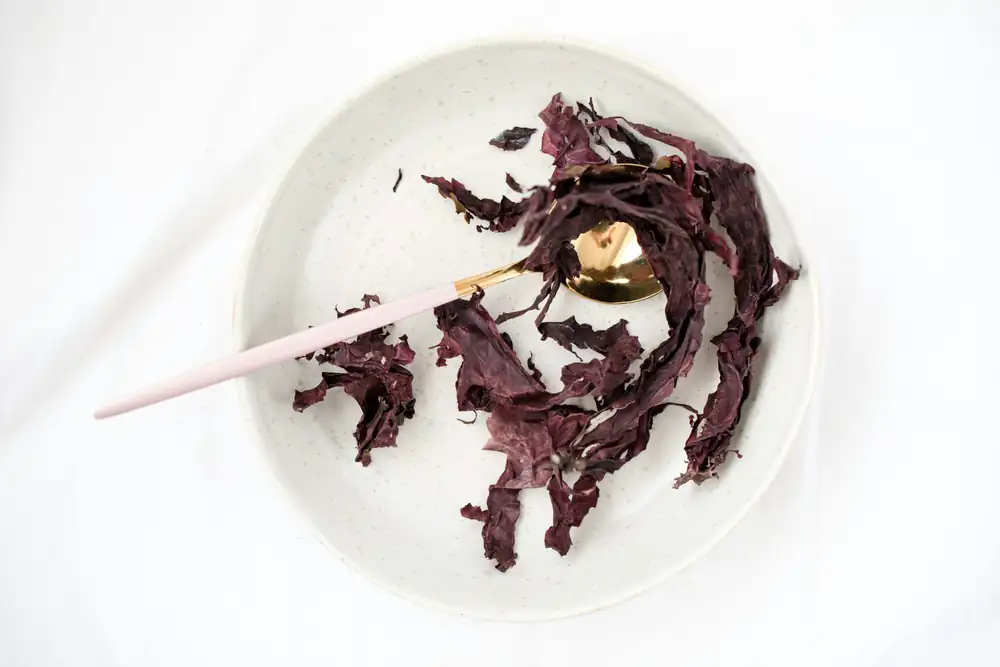
Dulse – named for its finger-like leaves and palm-like shape – is officially a ‘forgotten food’ and is part of the Ark of Taste programme, set up by Slow Food UK to preserve and celebrate our culinary heritage.
It also conquers in high gastronomy
Renowned chefs such as Andrew MacKenzie and Brett Graham use dulse as an innovative and delicious ingredient in sauces, emulsions, breads and to create crispy crusts. The late food critic AA Gill, a great fan of the seaweed, called dulse a “subtle yet bold flavour bomb” and “the most intense source of umami” of any seaweed. Just as kale has enjoyed a resurgence as a trendy and nutritious snack, dulse has made a comeback. It is now readily available in delicatessens, farm shops and even on the shelves of M&S – a real triumph for a marine plant that has been quietly living in the oceans for 1.5 billion years.
Why is dulse worth rediscovering?
Dulse is a dark brown-purple color and is harvested from late spring to fall. It grows up to 30 cm long and lives on rocks and seaweed in the intertidal zone. It is found in cold seas, along the coasts of North America and Europe. It is extremely rich in iron, contains all the trace elements, and ten times the amount of minerals than land vegetables. It is high in protein, yet low in fat. In addition, its sodium content is significantly lower than that of gourmet salts (10% compared to 98%) and is an excellent source of iodine, with one serving covering 86.7% of the daily recommended intake.
The historical significance of dulse
Ancient texts indicate that dulse has been an important food for centuries. As early as the time of St. Columba, it was considered as valuable as garlic or salt. According to Fergus Kelly's book on land values, a rock covered in dulse was worth the same as a cow. An old Irish proverb goes:
"If you are a stone-carved god, you will be a duileasg or a femnach"
(That is, "A cow for a fertile rock from which to pick dulse.")
In the early 19th century, Walter Geikie captured a typical Edinburgh street scene in an etching, where a vendor sells "crispy, salty" dulse in small packets from a wicker basket. Two centuries later, the same seafood delicacy is available in sandwich bars and lunchrooms as "seaweed chips" - the perfect, nutritious snack for people on the go.
Dulse in modern gastronomy
Seaweed has come back into fashion thanks to the New Nordic Cuisine movement, where culinary experiments have shown that dulse even surpasses the umami content of Japanese kombu seaweed. Research has used dulse dashi to flavor cheese, ice cream, and sourdough bread, and the results have shown that dulse is an excellent flavor enhancer.
How to use dulse at home?
For home cooking, it can be added to our dishes in dried, ground form to provide extra flavor and nutrients. Excellent for:
for seasoning lamb
for flavoring sauces, hamburgers and stews
for pickling, marinades and emulsions
for toasting, either in the oven or in a pan, with soy, nuts and seeds
for slow-roasted meats
The most intense source of umami
Other umami-rich foods like green onions, cooked tomatoes, shiitake mushrooms, shrimp, bacon, parmesan, tuna, oysters, and squid are all high in glutamate, but seaweed surpasses even these. So dulse is not just a forgotten sea vegetable, but a rediscovered, highly nutritious, and delicious food that deserves a place in the modern kitchen.