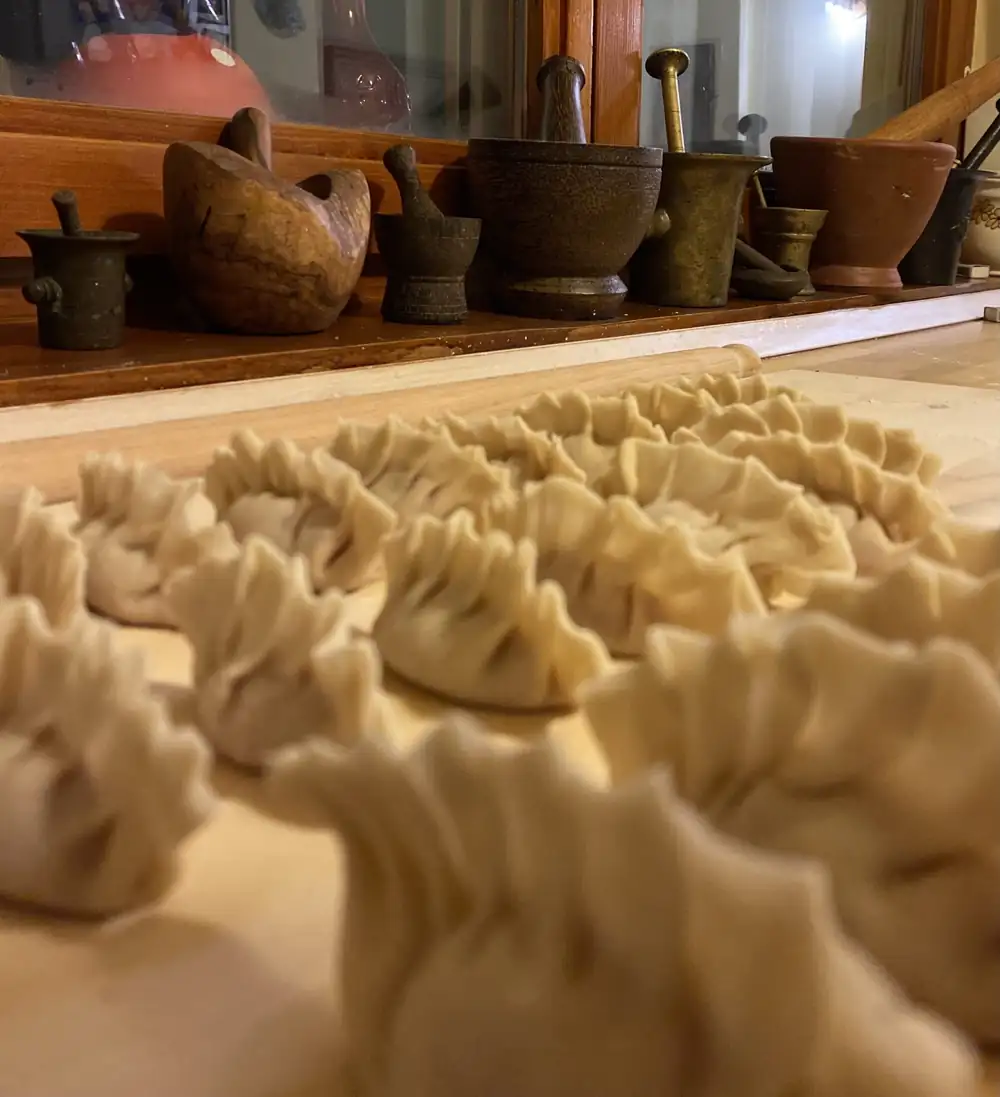
This is how harissa is made in Ádám Barna's mortar
A few months ago, I visited the Petőfi Literary Museum’s exhibition entitled The Society of Objects, which “presents the collecting passion of writers and the history of their objects, organized into six thematic groups of artifacts.” Between Áron Tamási’s cigar boxes, Tibor Gyurkovics’s hats, Dezső Tandori’s toy bears, and Ervin Lázár’s ties, it was a strange experience to think about the power o
I became curious about how this all works with chefs and gastronomy professionals: can we get to know another side of them and their cuisine through their direct or accidental collections?
In the first part of this article series, chef Ádám Barna reveals some behind-the-scenes secrets about his mortars, and we can even learn why our spice paste will be tastier if we prepare it in a mortar instead of a blender (or perhaps a poorly chosen knife).
Which was the very first piece in your mortar collection? Does it have any special characteristics?
Perhaps not a collection (or not necessarily consciously), these nine pieces are more like objects of use. The first was the copper mortar found in almost every family, which is a classic piece.
Which countries do your mortars come from? Did you mostly get them during your travels, or did you usually order them?
Some of them I bought during my travels, but some of them I received as gifts or bought at home. There is a coconut one from Cambodia, an olive wood one from Greece and Croatia, a clay mortar from Kőbányai út, and a very small copper mortar from a flea market…
How does their raw material affect their use?
The granite mortar and pestle is easy to crush green spices in, and you can also easily crush the ingredients for a green curry with such a mortar. It is well-suited for making pastes where the formation of an emulsion is also the goal, such as in aïoli.
A mortar made of olive wood or coconut is best suited for grinding dry spices. A large clay mortar with a wooden pestle is best suited for making a green mango salad – both because of its size and because the wooden pestle does not crush the fruit.
Apart from the raw material, what else is worth paying attention to when choosing a mortar?
Definitely its ingredients! This is what determines its function the most. Or, its size, as you can also make one or two servings of mango salad in a clay mortar.
If we buy a mortar for our home, we can solve almost everything with a piece of granite mortar.
What do you make most often in them when cooking at home? Of these, would you share with us your favorite recipe and practices?
I like to use capsaicin peppers, I often make harissa with it.
Roast the peppers in a very hot oven or over charcoal, lightly oiled, until black, then cover them in a pot while they are still hot so that they can be easily peeled.
In a mortar and pestle, crush the toasted cumin and coriander seeds, lightly toast the seeded chili and garlic in olive oil, then add the roasted capsicum peppers and salt and crush until creamy.
Add olive oil, season with lemon juice, lemon zest, pepper, mint, parsley, spring onions, a pinch of brown sugar, and even a few drops of good raspberry vinegar.
Do you use all of them, or are there any treasures you keep carefully guarded among them?
These are really more of a utility item. Some are used very rarely, and some are so small that they are only suitable for breaking a few grains of spice.
Where/what pieces would you like to add to your collection?
It's been said so many times that it's a collection that now I'm sure to buy it if I see a nice piece!
Do you think there is a culture where a chef is almost as attached to his mortar and pestle as he is to his knife?
Far Eastern cuisine is almost unimaginable without it, but in Mediterranean countries there are also many spice pastes that were traditionally made in these ways, as the taste cannot be compared to what we dissolve in a blender, for example... It's like when someone cuts a green herb with a blunt knife or "chops" it very finely - the cell walls are damaged, the flavor becomes oxidized, and the herb loses its essential oils.