An Eastern European cake that became world famous in New York
Rugelach is a small, rolled-up cake that fits easily with a cup of coffee, yet it has a surprisingly diverse history. It is tied to Central and Eastern European Jewish cuisine, 20th-century immigration stories, and the world of American bakeries.
Eastern European roots
Rugelach is part of Ashkenazi Jewish cuisine and is primarily associated with the areas of Poland, Hungary, and Austria. Its name is of Yiddish origin, and most linguists believe it comes from the word "rugel," which means a small twist or fold, thus directly referring to the shape of the cake, which is made from thinly stretched dough rolled up with a filling.
Early versions were not necessarily made with the shortcrust pastry we know today, as several sources suggest that 19th-century and earlier versions were made with a yeast-based, cake-like dough and appeared in a shape similar to a croissant. Walnuts, cinnamon, honey, and jam were common fillings even then, which fit well with the regional flavors.
Relationship with other pastries
Rugelach is often compared to other Central European pastries: due to its shape, many people associate it with a roll or croissant, but the connection between the two is more formal than technical. Historical parallels point more towards kalács and filled, rolled pastries, which are present in many cuisines of the region. This common ground helps to understand how rugelach was able to appear in the gastronomic memory of several countries.
The American turn
The widely known form of rugelach developed in the United States in the 20th century. Eastern European Jewish immigrants brought the recipe to New York and other major cities, where it continued to evolve with new ingredients and local tastes.
The most significant change has been in the dough itself: the American version has become more popular with cream cheese, which gives it a softer, crumbly texture. This solution is not part of the classic European tradition, but it has now become almost completely intertwined with the modern interpretation of rugelach.
Rugelach became a permanent item in New York bakeries by the mid-20th century, and from there it rose to international fame.
Forms and techniques
Although the recipe for rugelach is based on relatively simple ingredients, the final result is largely determined by the shaping. In the classic method, the dough is rolled out into a circle, then cut into triangles, which are then rolled into a croissant-like shape.
There are also rod, spiral, or small, bite-sized versions, but the common point in all cases is the ratio of filling to dough, and the contrast between the layers.
The point: the filling
Walnuts and cinnamon are still among the most common fillings today, and were present in early versions. This continuity shows that in the case of rugelach, the flavor remained more stable than the dough technology.
At the same time, modern bakeries are bolder in reaching out in new directions: chocolate, pistachio, or caramel have also appeared, but these complement rather than overwrite the classic basics.
In modern, especially American versions, the filling is not only placed between the dough, but also fits into the rolled structure in a thin layer. The chocolate thus does not appear as a separate element, but during baking it forms together with the dough to form the layered, characteristic interior that now gives rugelach one of the most well-known forms.
From a festive cake to an everyday favorite
Rugelach was originally associated with festive occasions, especially Jewish holidays, where the smaller, shareable cakes served both a practical and symbolic role. However, over time, it has moved beyond this framework and become a part of everyday life.
This shift fits well with the operation of 20th-century urban bakeries, where quickly consumed yet distinctive pastries gained an increasing role.
One of rugelach's greatest strengths is its adaptability: it is based on simple ingredients, can be easily varied, and fits well into different consumption situations, whether it is a festive table or a snack with coffee. Its history is a good example of how a regional pastry can take on a new form through migration and cultural encounters, while preserving the essence of its original character.
Rugelach, as made at SALT Bakery
At SALT Bakery, rugelach was introduced to the menu based on a more personal story, which includes an interest in Jewish gastronomy and family memories.
"When developing our offer, the goal is always to include classic Hungarian pastries alongside items that are less available at home, yet are closely linked to Central European traditions. In addition, I have many childhood memories of these: my grandmother made a lot of pastries for us when we were children. This is how babka, flódni and rugelach came to the counter, which complement the usual offer well while giving it a new direction."
"Our own version differs from classic recipes in several ways: the dough is completely plant-based, does not contain eggs or dairy products, and is made with oil instead of butter, so the end result is a lighter, yet well-functioning structure," explained Lea Lefkovits, co-owner of SALT Bakery.
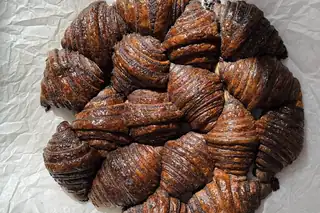
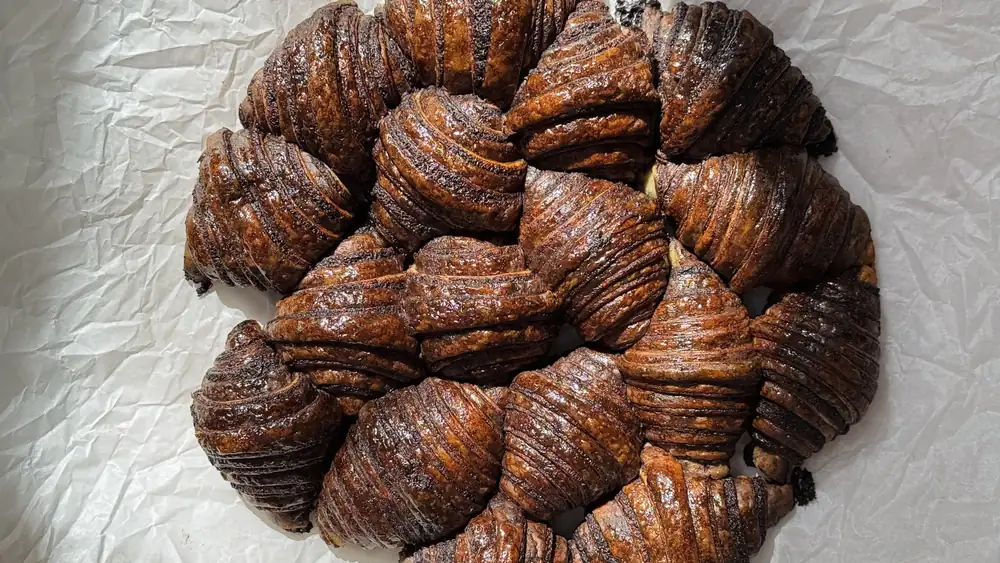
In the rugelach of the bakery, which already has three units, chocolate is incorporated into the dough: the stretched dough is spread with a thinner chocolate sauce, then folded and re-stretched, repeating this process several times. This creates the layered, intensely chocolatey structure that is clearly visible and spectacular even after baking.
"We also changed the shape: instead of the classic, separate pieces, we bake them all at once, making them more of a slicable, round cake that is more spectacular and casual. Chocolate dominates the flavor because, according to experience, this is the version that guests connect with the most easily."