Tastes of Croatia: Gastronomic Experiences from the Coast to the Inland
Croatia's gastronomy is closely linked to its landscape: it is shaped by regional ingredients, seasons and traditions. From the coast to the hinterland, each area offers its own unique flavours, experiences that are worth venturing off the beaten track.
Truffle Hunting in Istria Some of the world's finest truffles are found in the forests of Istria, a peninsula in northwestern Croatia, bordered by the Adriatic Sea. The moist, clayey soil is ideal for black truffles, which are available year-round, as well as the rarer, strictly seasonal white varieties.
In autumn, it is worth joining a truffle hunt in the hilltop area of Motovun, accompanied by experienced dogs. Those who would rather focus on the result can taste freshly grated truffles in a local tavern: on pasta, omelettes or gnocchi, in a simple but characteristic form. And if you are looking for a more complete experience, the Karlić family's guided tours also introduce the traditions of the area
Forest honey tasting in Gorski Kotar
About an hour and a half from Zagreb lies the mountainous Gorski Kotar region, which is almost another world: a region of wild, romantic forests and mountain peaks, home to brown bears and wolves.
The forest has long been a source of ingredients – from wild garlic to game meats – but perhaps its most special treasure is Goranski medun. This honey is made not from flower nectar, but from honeydew, secreted by insects that feed on plant juices. The result is a mineral-rich, subtly sweet honey with a dark character, resinous, forest notes.
Local farmers markets, such as those in Fužine, are a good place to start, but Vrbovsko is also an important meeting point for local producers. For a more hands-on experience, it's also worth visiting a local beekeeper, where you can learn more about the workings of the hives and the honey-making process.
Pag's world-famous cheese The island of Pag, located off the Dalmatian coast, is a sun-bleached, almost lunar landscape where stone, sea and wind shape the environment. It is a true pilgrimage site for cheese lovers, primarily thanks to its iconic sheep's cheese, Paški sir, which has earned numerous international awards.
Its character is determined by the local conditions: free-grazing native sheep feed on sage, fennel and wild thyme, which are delicately coated with salt by the famous, strong Bora wind. This gives the cheese its characteristic, slightly salty, aromatic profile.
It's worth sourcing locally: due to limited pastures and a short milking season, demand often exceeds supply. The award-winning Gligora Manufactory also offers tours and tastings. In spring, look out for Paška skuta on menus: this creamy, fresh ricotta-like preparation is made from the whey left over from cheesemaking.
Ston oysters – straight from the sea
About an hour north of Dubrovnik lie Ston and Mali Ston, on a narrow spit of land leading to the Pelješac Peninsula. The peninsula itself is worth a detour – with its beaches and steep vineyards – but Mali Ston is best known for its oysters.
The European flat oyster has been cultivated in the bay since Roman times, for which the confluence of the Neretva River and the Adriatic Sea creates ideal conditions. It has a meaty yet delicate taste – best fresh, straight from the sea, with a little lemon. It is also worth taking a boat out to the oyster beds, where the tasting takes place literally on the water. The restaurants in the area offer a wide range of mussels and other seafood.
Wines on the Pelješac Peninsula
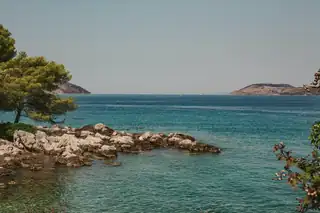
Continuing from Ston, we arrive at the Pelješac Peninsula – a lush, green peninsula surrounded by the Adriatic Sea.
The vineyards, which cling to the limestone hillsides, are mostly hand-cultivated, ripening in the strong sun and reflected light from the sea. These conditions are ideal for the native Plavac Mali, which produces full-bodied, characterful red wines – the best known from the Dingač and Postup areas, on the stony southern slopes.
Among the white wines, citrusy Maraština and golden Pošip stand out – the latter is an indigenous variety discovered on the nearby island of Korčula. The peninsula is home to numerous family-run wineries, where you can sample the character of the local varieties. In addition to the historic wineries, new-generation wineries are also gaining attention, especially with the Dingač wines.
The “green gold” of Dalmatia
Like Istria, Dalmatia is famous for its olive oils, although the character of the landscape is different: here the trees grow more slowly on rocky terraces, their roots penetrating deep into the soil.
The oils produced in this way have a special quality: with aromas reminiscent of figs and fresh herbs, and a softer, rounder character than the pepperier Istrian versions. They are mostly produced on smaller, family-run estates, where the harvest is done by hand, and tastings take place in an informal, personal atmosphere – often accompanied by a glass of wine. Many oil estates in the region offer tastings, where you can learn about the local varieties and processing methods. In some places, guided tours of the oil mills and plantations are also available.