Christmas sweets from another era that you can savor with a click
Just as in the world of cinema there are magnificent supporting actors capable of stealing scenes from the protagonist, in the increasingly global universe of Christmas sweets, overflowing with pistachio cream (that gastronomic plague!), there are understated treats that, besides being delicious, are part of the confectionery heritage of many corners of Spain. Today we can buy them online. Here ar
Seville: Mille-feuille (filled puff pastries)
In Andalusia, traditional puff pastry sweets have their roots in the Moorish era, although from the 16th century onwards, they were Christianized by replacing all other fats with lard. The town of Alcaudete (Jaén) popularized hojaldrinas (small puff pastries). The Christmas confectionery industry in Seville has revived them under the name milhojas (mille-feuille), adding fruit preserves to the traditional orange aroma of the pastry. The orange one is the most famous, but there are other fruit varieties as well. At Obrador Real.
Aragon: Almudévar Braid
Aragon has contributed to Christmas sweets with treats like the chocolate-covered candied fruits that bear its name, or the guirlaches (a type of almond brittle). Less well-known outside the region is the Almudévar braid, a puff pastry filled with candied fruits that is the specialty of the artisan bakery Pastelería Tolosana. Today they offer braids with various fillings. They have physical stores in Almudévar (Huesca) and Zaragoza, but those who live further away can buy them in their online store, and if they want them as gifts, they are available presented in elegant wooden boxes.
Balearic Islands: real pasta fish from Fornet de la Soca
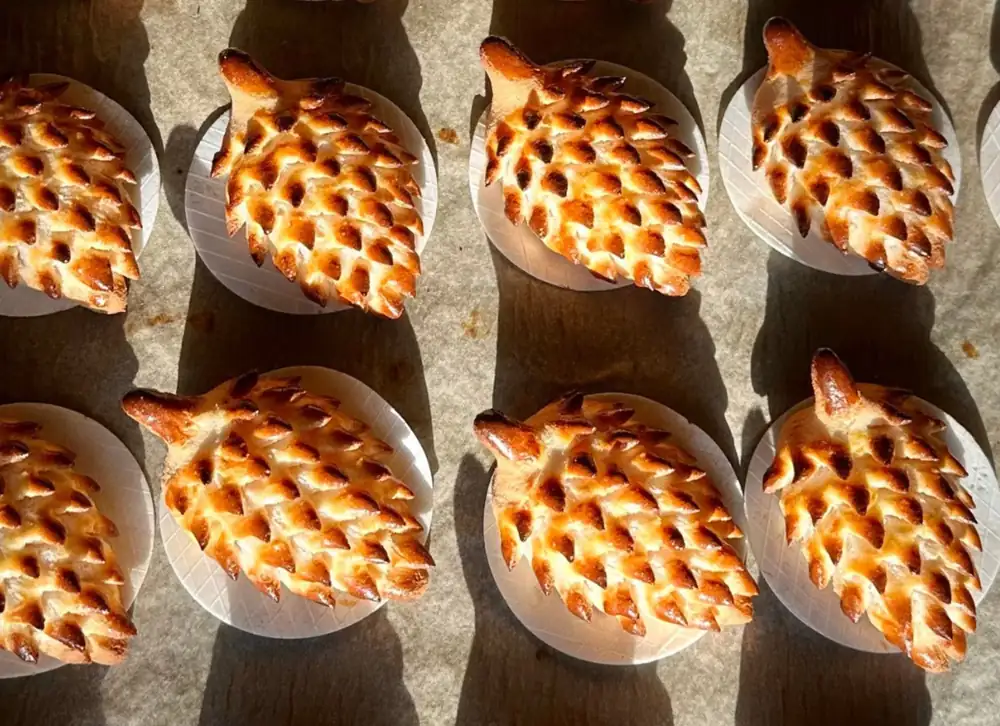
El Fornet de la Soca is a kind of Willy Wonka factory come to life. Its Instagram account is wonderful, but even more valuable is the culinary archaeology work carried out by Tomeu Arbona and María José Orero. Among other treasures recovered and handcrafted in their home, the peix de pasta real stands out. This dessert, once enjoyed in the wealthiest homes on the island, consists of marzipan filled with layers of almonds, jam, sponge cake soaked in aged wine, egg yolk, and chocolate, all baked in a fish-shaped mold. Like so many other Christmas traditions, this recipe is inherited from another religion—in this case, Sephardic. Orders can be placed on their website.
Catalonia: Neules
The delicious neules, crispy wafer rolls often enjoyed with a glass of cava, are widely known, but perhaps less so (at least outside of Catalonia) are the artisanal ones. Casa Graupera pastry shop has been making wafer rolls for 130 years, some specifically traditional for Christmas, although they are now sold year-round. The jewel in their crown is the wafer roll shaped by hand on a wooden stick. A centuries-old recipe that Enric Graupera Iglesias reformulated in the 1960s. For the more adventurous, they also make a wafer roll following a medieval recipe dating back to 1267, and another version using the 1895 recipe of the founder of this family of pastry chefs, made with lard. They can be purchased here.
Castilla-La Mancha: Alajú de Cuenca
Alajú is a traditional sweet of Andalusian origin. The name comes from al-hasú, which means filling in Arabic. It's a sweet that survives in some parts of the Iberian Peninsula, but it has a special tradition in the mountains of Cuenca. In the past, alajú was cooked in a pan, heated just enough to solidify a paste made with honey, walnuts, almonds, orange and lemon zest, breadcrumbs, and cinnamon, which was then served between wafers. The Chapela pastry shop are consummate specialists in this dish.
Valencian community: patissets
Empanadas filled with angel hair (a type of sweet pumpkin preserve), sweet potato, or jams are found throughout almost all of Spain, and their origin dates back to the Andalusian period. It is said that fillings with sweets made from vegetables are of Moorish origin, because the Moriscos were the quintessential gardeners in that multicultural world. In any case, in a region whose wealth of Christmas sweets is overwhelming, the pastisset (a type of pastry) remains discreetly found in local areas. Very typical in Valencia and parts of Catalonia, it is baked instead of the fried Andalusian version, the borrachuelo. It is delicious and light. Those filled with sweet potato are called pastissets de moniato, and in this case, their origin is later, because the sweet potato arrived from the Americas. They can be bought here.
Navarra: Txantxigorri Cakes
Txantxigorri means pork crackling in Basque, and those crispy bits of meat, fat, or pork rind that solidify when the lard melts are the essence and defining characteristic of this traditional flatbread from Olite, which, incidentally, is featured in the 'Baztán Trilogy' by author Dolores Redondo, who makes it the protagonist inspector's afternoon snack. Pork crackling cakes are, above all, a testament to Christianity, and secondly, a magical sweet and savory combination, where sugar and cinnamon contrast beautifully with the crackling that usually finishes browning on top. They aren't exclusive to Navarre; they can also be found, for example, in the Andalusian mountains of Cádiz and Ronda, but those from Casa Vidaurre are a true institution.
Murcia: Almond Cordials
Marzipan extends its reach from Central Europe, where the aromatic notes of bitter almond are preferred, to North Africa. Its origins are Arabic. In Murcia, a version as rustic as it is addictive is made. Cordials are glazed marzipans, often filled with sweet potato or potato and flavored with lemon zest. Those from the Roch confectionery in Moratalla are a work of art. They are made following the family's great-great-grandfather's recipe and are a must-have on the sweets platters in homes throughout the region. You can find them here.