Young people and gastronomy at Madrid Fusion Dreams: Jordi Roca's apple with five million views
How can we spark young people's interest in food news? Unlike generations accustomed to reading the news, young people interested in gastronomy demand new approaches and ways to capture their attention.
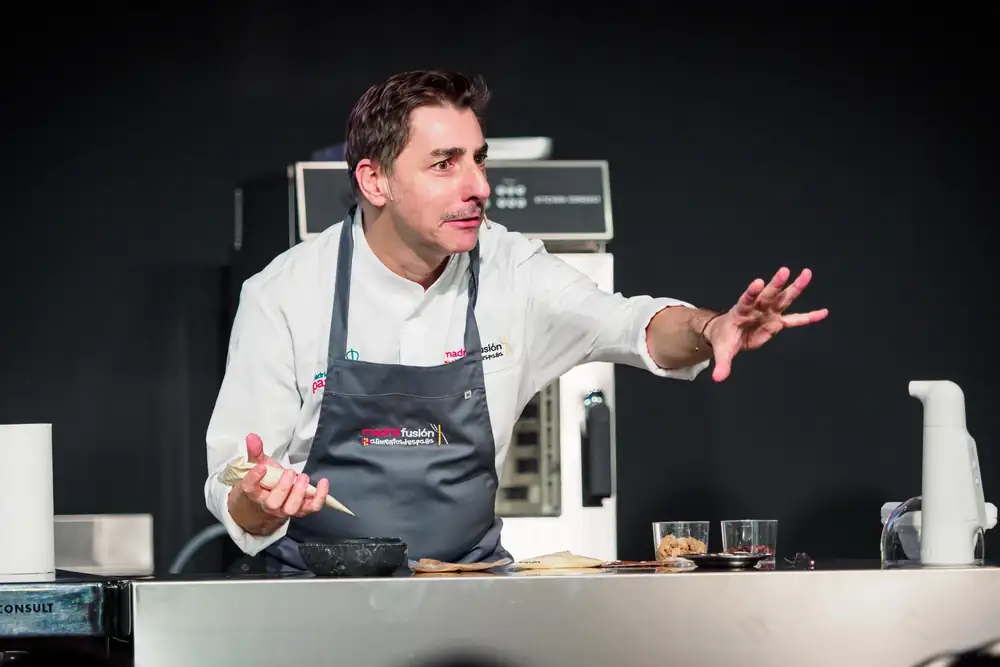
It's a style that has come naturally to Jordi Roca (El Celler de Can Roca***, Girona), and which has ultimately made him "a true influencer," in the words of the expert. The youngest of the Roca brothers, who has garnered five million views by roasting an apple, believes his success lies in "sharing my passion for cooking in a relaxed way, and conveying that haute cuisine is neither rigid nor just for the elite." Javier Sanz and Juan Sahuquillo, of Grupo Cañitas Maite (Albacete), members of Generation Z, pursue the same objective, prioritizing "normality" in their communication. "A young person is a powerful megaphone," they added.
The success of the forum that addresses gastronomy from outside the plate
Madrid Fusión Alimentos de España kicked off its most innovative forum, Dreams#spainfoodtechnation, yesterday for the third consecutive year. Joining Benjamín Lana, CEO of Madrid Fusión Alimentos de España, and Toni Massanés, Director of the Fundació Alícia and coordinator of the forum, was Elisa Carbonell, CEO of ICEX, the forum's main sponsor since its inception. Carbonell stated that "innovation is the only way to address the challenges facing humanity, such as health and sustainability. Because eating," she said, "is not a mere formality, and if Spain wants to maintain its leading position, it must continue to invest heavily in foodtech."
The day began with a presentation on how taste has played a role in human evolution. Juli Peretó, Professor of Biochemistry and Molecular Biology at the University of Valencia and Researcher at the Institute for Integrative Systems Biology (I2SysBio), explained the biological function of gastronomic pleasure. Drawing on findings in genetics, neuroscience, and evolutionary ecology, he explained why primates are attracted to ascorbic acid (Vitamin C) despite its association with spoiled food and the lactic acid produced by fermentation. “Taste is the driving force of human evolution, and cooking is a major evolutionary innovation; if cooking with fire made us human, learning to ferment food made us even more so,” he argued, “because cooking makes food more chewable, digestible, and nutritious, but also tastier and longer-lasting.”
Home cooking isn't destroyed, it's transformed
The uncertain future of home cooking was also a topic of discussion at Dreams#spainfoodnation. “More than 98% of households consume ready-made food, in a market that is growing twice as fast as any other in the food sector.” This is how Laura Gil, from WorldPanel by Numerator, began a roundtable discussion on home cooking and the risk that the practice of cooking at home will eventually disappear.
For Raúl Martín, CEO of the food corporation Familia Martínez, in addition to food quality, “it’s essential that it be simple and tasty, because if it’s not good, nobody will buy it. That’s why the industry must offer solutions that combine quality and convenience, improving technology,” he said. And will the kitchen as a physical space disappear? In the opinion of Manuel Delgado, Head of Interior Design at IKEA Spain, “not only is it not disappearing, but it’s becoming the heart of homes by integrating with the living room.” It’s not disappearing, but it’s transforming with the introduction of home automation technology, which, he said, “is especially appealing to food lovers. Other relevant trends in kitchens will be the use of sustainable materials and a warm, inviting atmosphere.”
Restaurants, new models for new challenges
At a time of relative saturation in fine dining and constantly rising restaurant costs, five leading figures in the hospitality industry analyzed the crisis of the traditional business model. The problem, according to Nino Redruello, chef and head of the family-run La Ancha group, “is maintaining our artisanal DNA, something that becomes more complicated as the business grows. The important thing is to develop a strategy beforehand to anticipate the different phases the project will go through,” he said. Diego García Azpiroz, CEO of Pescaderías Coruñesas and a member of a family of fishmongers, explained that his company maintains sustained growth thanks to self-financing, adding that “costs have squeezed the profit margin, as we try to ensure the customer doesn't suffer.” Diego René, chef and co-owner of Beluga and eight other successful restaurants in the center of Málaga, pointed out that “the time has come for the customer to do their part, now that the hospitality industry is finally paying a fair price for everything after having survived for many years by exploiting the business owner, their staff, and their suppliers.” Carlos Crespo, partner at Grupo Cañadío, emphasized the importance of the relationship with investors, “who must speak our language.” “In my experience, my best investor is the bank, because as long as they pay, they never give their opinion; "Besides my wife, who says yes to everything," joked Nandu Jubany, owner and gastronomic director of ten restaurants in addition to his flagship Can Jubany * (Calldetenes, Barcelona).
And within the new business models, Dreams #spainfoodtechnation also gave a voice to two chefs running solo micro-restaurants: Martín Comamala, who serves eight diners per shift at the 539 Plats Forts restaurant in Puigcerdà (Girona), said: “I wouldn't trade the direct connection with my customers. It's a viable model because you learn to be profitable, but it can't be transferred, because the customer comes to see you.” Beatriz Pascual, whose restaurant Almazen, located in the small town of Salinas de Añana (Álava), serves four shifts of 15 diners a week, agreed. “The freedom to develop my passion means that creativity never runs dry, although you learn from your mistakes,” she acknowledged.