Top 10 Korean Dishes You Must Try
These are the 10 Korean Dishes I Love the Most —not because they’re flashy or trendy, but because they’ve been with me through all seasons of life. They’ve comforted me in loneliness, celebrated with me in joy, and reminded me where I come from.
I hope you try one—or all—of them. But more than that, I hope they remind you of your own stories, your own loved ones, your own roots. Food is never just food. It’s memory. It’s love and it’s identity. And these dishes? They’re mine.
Now tell me—what’s your favorite Korean dish? And how many of the 10 Korean Dishes I Love the Most have you tried?
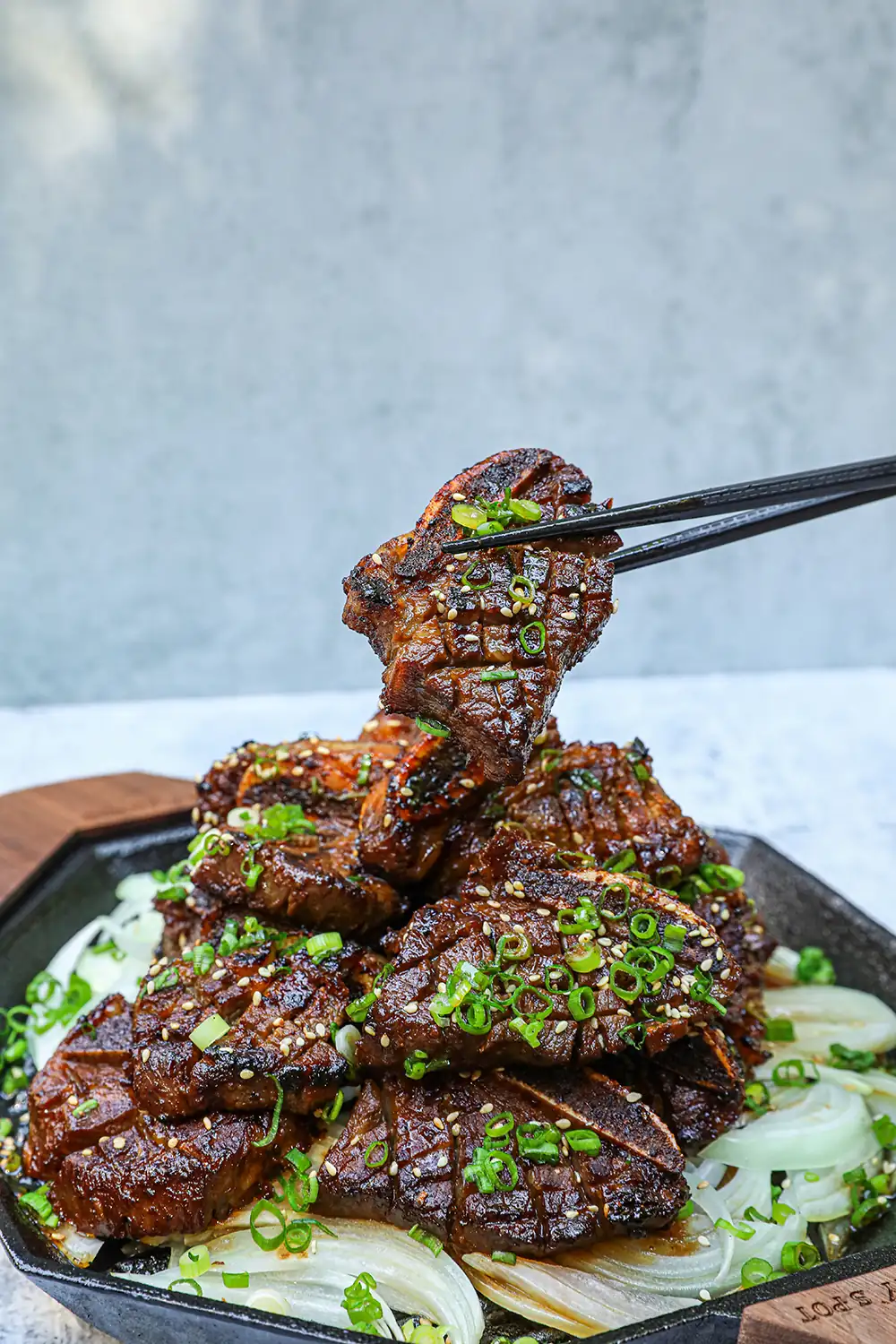
Galbi Korean BBQ Short Ribs
My family used to run a Korean BBQ restaurant. My dad raised his own pigs and grew his own organic vegetables to use in the restaurant, and business was booming. This was back before the internet, yet word spread so far that people traveled from as far as Busan and even Jeju Island just to eat there. But after my parents divorced, the restaurant didn’t survive. Still, during those few years, we did really well. Looking back, our family was kind of a group of foodies—before that word was even a thing in Korea. In the 90s, that wasn’t so common. Whenever my parents had time off, we’d go on little road trips just to eat somewhere delicious. And our all-time favorite dish? Galbi.
Gilgeori Toast Korean Street Toast
In my early twenties, I was working as an apprentice cartoonist, commuting every day from Mapo to Gangnam. The neighborhood I lived in—Mapo—was quiet. Not a commercial area, just rows of homes and alleys. But once I stepped off the bus in Poi-dong, Gangnam, surrounded by tall buildings and people in suits, I’d immediately catch that familiar smell: margarine melting on a hot griddle from a blue one-ton truck. We called it “ street toast.” Because it was toast, sold on the street. Simple as that. Before places like Isaac Toast spread out as a franchise, this is how we got our breakfast. Just during morning rush hour, from blue one-ton trucks parked here and there. Behind them, a busy ajumma or ajeossi would be flipping toast after toast for office workers in a hurry. When you ordered, they’d start by grab a brick size margarine and melt right on the flat top. Then came two slices of plai
Sundubu Jjigae Silken Tofu Soup
In Korea, you can’t really rank kimchi Jjigae and doenjang Jjigae —those two are forever swapping places at the top. But outside of Korea? The favorite Jjigae(Korean stew) among foreigners caught me off guard. It wasn’t doenjang Jjigae —that one tends to be for people who are already pretty deep into Korean food. And kimchi jjigae, surprisingly it’s hit or miss for a lot of people. The number one stew for non-Koreans was sundubu jjigae —Korean spicy silken tofu soup. And honestly, I was kind of surprised when I found out about this. Growing up, sundubu jjigae was what you ate when you were tired of the usual lineup: kimchi jjigae, doenjang jjigae, and budae jjigae. It wasn’t exactly a “craving” food for me. If anything, the red chili oil floating on top made it seem a little heavy and greasy.
Naengmyeon (Cold Buckwheat Noodles)
As far back as I can remember, naengmyeon was something you went out to eat in Korea—not something you made at home. Especially mul-naengmyeon (the cold, broth-based version). The broth alone is a labor of love. It takes time, care, and a lot of prep—definitely not something you’d casually whip up in your kitchen. And then there’s the noodles. Maybe it’s just me, but growing up on freshly made naengmyeon noodles—hand-pressed from dough that was made within couple of days, pressed fresh to order and plunged straight into boiling water to order—it set a standard that felt impossible to recreate at home. But as Korean food gained popularity around the world, I started getting tons of requests for a naengmyeon recipe. So I rolled up my sleeves and got to work.
Korean Chicken Noodle Soup Dak Kalguksu
Every country seems to have its own version of chicken noodle soup. This one is Korea’s. Or more specifically—mine, with a little upgrade. Chicken noodle soup has a way of warming not just your body, but your spirit. That’s probably why it’s the food we crave when we’re sick, or when we feel lonely. When I’m sick—or when Jacob’s sick and I’m making it for him—I just simmer chicken in broth and keep it soft texture and simple. But when I’m feeling down and blue, I take a little extra care for myself by pan-fry the chicken until it’s golden and crispy and place it gently on top.
Korean Spicy Vegetable Soup Chaegaejang (Vegan Yukgaejang)
If you’re familiar with Korean cuisine, you probably know Yukgaejang. It’s not one of the most internationally recognized Korean dishes, but those who know it, know it well. And this vegetable version is one of my most cherished recipes I created. Traditional Yukgaejang is made with beef, and honestly, it’s hard to mess it up. But making a version without beef—just with vegetables—that’s a different story. I personally prefer this one. It’s lighter, easier on the stomach, and feels wholesome and nourishing. Still, for those curious, I’ll link my original beef Yukgaejang recipe (TAP HERE) as well. You can also make that one with chicken instead of beef, if you’d like.
Korean Spicy Pork Bulgogi Jeyukbokkeum
Growing up, we ate spicy pork bulgogi way more often than the beef bulgogi. I always preferred pork to beef—and just like I was a jjamppong kid rather than a jjajangmyeon one, I was firmly on team spicy pork bulgogi rather than the sweet soy-based beef bulgogi. And that’s why I thought this spicy pork is perfect for the Top 10 Korean Dishes You Must Try list.
Korean Spicy Chicken Stew Dakbokkeumtang
Talking about Korean spicy food, I have to introduce this iconic Korean chicken stew—Dakbokkeumtang. To be honest, I wasn’t a big chicken fan growing up. As I mentioned before, I’ve always been on team pork. Unless it was fried, I wasn’t really interested in chicken when I was young. 😅 But there were two exceptions: Dakbokkeumtang and Samgyetang. (And later, in my early twenties, I added Dakgalbi to the list.) Dakbokkeumtang isn’t one of those dishes you fall in love with after one or two bites. Near the end of the meal—when there’s just a little sauce left, your bowl of rice is nearly finished, and your lips are tingling from the spice—that’s when it hits you: this dish is amazing!
Korean Army Stew Budae Jjigae
The 10 Korean Dishes I Love the Most wouldn’t be complete without this one. To be really honest with you, now that I’m older, I don’t really reach for Budae Jjigae anymore. It’s not exactly a health food, after all. And maybe that’s why I want to recommend it even more—to those of you who are still young. Eat it now, and eat it often, while your body can bounce back! I didn’t eat enough Budae Jjigae, and I regret it deeply. 😭 Even now, I sometimes think about it. A bubbling pot of spicy Budae Jjigae, a shot of soju on the side. But now that I’m in my forties, I choose to imagine it rather than eat it—for the sake of my health.
Korean Pork Neck Bone Soup Gamjatang
The 10 Korean Dishes I Love the Most include many memories, but this one holds something extra. I still remember the shock of tasting Gamjatang for the first time. It was during a late lunch at my parents’ restaurant, before dinner service began, with the staff gathered around a big pot. A towering mound of pork neck bones, potatoes, kkaetnip(wild sesame leaves), and the rich scent of toasted wild sesame seed powder. The broth was bubbling away when it was placed on the table. I didn’t know where to begin. My dad, sitting next to me, simply said, “Eat.” He picked up a pork bone, place on his plate. Blew on it gently, and began pulling the meat off from the bone. I followed his lead. I’d always been a chopsticks prodigy, so before long I was faster than him—scraping meat from between bones, even the marrow. My dad watched quietly, then pulled a potato from the pot, mashed it into his plat