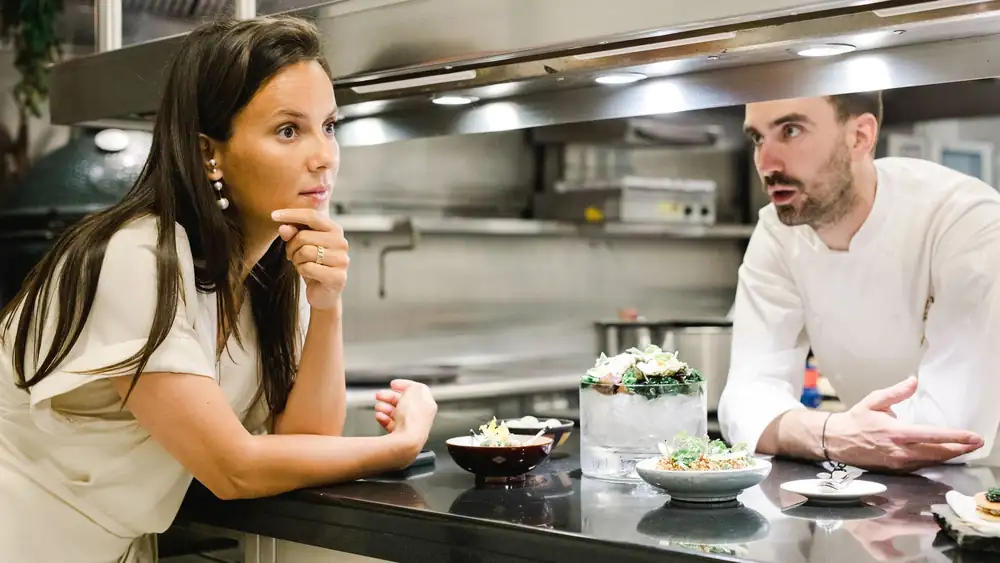
Marina de Massiac (37) on her French cuisine: 'I'd rather save on something else than have bad food'
Food and lifestyle journalist Marina de Massiac grew up as the child of French-Russian parents, but primarily calls herself French.
In the Netherlands, she saw how limited Dutch food culture still was thirty years ago: her parents regularly drove to Lille to do groceries while simultaneously cooking varied meals at home with great care. Since then, Marina has completed culinary training in Paris and writes professionally about the international hospitality industry. Her love for good food has certainly not diminished as a result.
Marina de Massiac: 'Food is almost sacred within my family'
I grew up as the child of French-Russian parents. I am three-quarters French and one-quarter Russian: my father is half Russian and grew up alone with his brother and French mother, because his Russian father abandoned the family at a young age. The Russian influence on my upbringing is therefore (unfortunately) minimal.
Although Marina was born in France, she moved to the Netherlands with her parents as a young child. That was a very different Netherlands from the country we know today. “About thirty years ago, the Netherlands was not nearly as developed in terms of restaurants, food trends, and good products in the supermarket.”
Her parents thought the Netherlands was a great country, but they criticized the limited and boring food culture that prevailed there every week. That is why they regularly drove to Lille to do the shopping. “They didn't necessarily buy very fancy ingredients, but rather vegetables, fruit, meat, dairy, honey, chocolate, and Le Petit Marseillais soap.”
Although the family of six did not often eat in high-end restaurants, they certainly ate very well at home. “There was a lot of attention, care, and love in our food, no matter what day of the week it was.”
That love of food has clearly stayed with Marina. “Food is almost sacred in my family. If necessary, we would rather skimp on clothing, tech equipment, and travel than eat badly.” She upholds that tradition herself. “I would rather eat excellently every day than live in a very spacious home or own the latest gadgets.”
By that, however, she does not mean that she lives on caviar and champagne. “I mean rather that I can cook fresh and varied meals using as many excellent, seasonal products as possible.” That food is so important to her is also evident from her career: in 2013 she completed a culinary course in Paris, and she now writes professionally about the international hospitality industry.
From Tarte Tropézienne to 'rabbit food'
When Marina thinks of the cuisine of her youth, several dishes immediately come to mind. Roast chicken with oven-baked Provençal potatoes, for example, with a fresh, tangy salad without any fuss. Or cherry clafoutis, “a very easy and accessible dessert that almost everyone in France makes at some point.”
But her very best memory is of tarte Tropézienne, a cake typically eaten in the South of France. “It is a round cake made of fairly light batter, filled with orange blossom cream.” Although she is no longer so fond of sweet desserts, you can still wake her up for this.
Marina spent her summer holidays in the South of France. “I remember clearly that it felt like a gift when someone in my family bought such a big cake at the local bakery.” She was a big fan of the inventor, Alexandre Micka, a Polish baker based in Saint-Tropez. “I thought he was amazing, because I found it such a great combination of simple flavors and textures.”
Nowadays, she mainly eats the cake in Saint-Tropez, where it originally comes from. “It might sound very superficial, but I am so happy when I walk through those small, colorful streets with one or two slices of Tropézienne in my hand!”
Another dish from her childhood is far less romantic. Carottes râpées used to be served often as a side dish: raw carrots that have been run through a food processor and seasoned with salt, parsley, vinegar, mustard, and some lemon and orange juice. “Back then, I really thought it was rabbit food or hospital food.”
By now, she thinks very differently about it. “Nowadays I make it occasionally too, because it is so healthy and deliciously fresh!” Actually, she believes it characterizes French cuisine well: “Lots of flavor and few processed ingredients.”
From old-fashioned stew to chic French sauce
Classic French dishes have also changed in meaning for Marina over the years. “I used to think classic dishes like coq au vin and boeuf bourguignon were just old-fashioned, heavy on the stomach, and overrated.”
Nowadays, she appreciates them precisely for their rich, complex flavor, provided good wine is used. Moreover, her training at Le Cordon Bleu Paris in 2012 changed her perspective on French sauces. “I have come to appreciate French sauces immensely, because they can really make a dish.”
Where she used to take them for granted or didn't find them very interesting, she now sees their beauty. “I find a refined French sauce really so chic.”
Not all culinary customs from her youth have received the same appreciation. She remembers how foie gras on lukewarm toast and free-flowing champagne during Christmas and New Year's were a real thing at her home. “Morally speaking, I have a strong objection to the way foie gras is produced, and I simply don't like champagne.”
French cuisine does not drown in butter
According to Marina, moreover, there are persistent misconceptions about French cuisine. “That the entire French cuisine is drowning in butter or haughtiness and is inaccessible.”
According to her, cooking in the South of France is not at all standard with butter. “Unless frying, but then with olive oil.” And according to her, that image of the haughty French cuisine isn't entirely accurate either. “French cuisine isn't that haughty at all (the French themselves generally are, of course).”
According to her, the difference lies more in the value attached to food. “It is more that, relatively speaking compared to the Dutch, the French invest more money in good food and take more time for it. To each their own, right!”
French, Southern European and Indian
Marina herself lives in the Netherlands and cooks with what is available. “Of course, you can (still) find much better quality products in French supermarkets, but food isn't everything!” According to her, there are now excellent options in the Netherlands, especially if you buy locally and from small producers.
However, traditional Dutch food is rarely served at her home. “I’m not fond of Dutch food at all.” The standard cheese, peanut butter, or chocolate sprinkles sandwich and fries with a thick dollop of mayonnaise are not for her either.
At her home, they mainly eat French, Southern European, and Indian food, even for hot or cold lunch. However, she does stick to a specific weekly budget. “It’s not like we eat very extravagantly or excessively!”
When she is in France, she likes to bring ingredients home: salt, Provençal herbs, orange blossom water, sausage, dark chocolate biscuits from Monoprix Gourmet, and Savora mustard. “That last one is something many top chefs cook with in France!”
Inspiration is everywhere
Because Marina travels a lot for her work, she draws most of her inspiration from traveling. “From a good supermarket with more niche brands to market stalls, bakeries, and restaurants in France: inspiration is everywhere for me.”
Her grandmother in Paris also introduces her to traditional dishes, such as blanquette de veau, a type of veal stew with vegetables and broth. Cookbooks and social media inspire her as well, although she clearly prefers the former. “I do like cookbooks more than social media, because it is less fleeting and because the recipes are often much more professional. In that respect, I am old-fashioned!”
She thinks François Régis Gaudry’s French cookbooks are amazing, precisely because he delves deeper into the history and techniques of a dish. She calls *Tasting France: Everything You Want to Know About French Cuisine* and *Let's Eat Paris* “top books if you want to know more about French cuisine and don’t feel like dealing with boring, monotonous content.”
But her culinary horizons naturally don't stop at France. “I just got back from Athens, and God, is that inspiring!” From street food pita with chicken and homemade spicy sauces to the very best and cheapest iced coffee ever: Marina is enthusiastic.
She also finds the combination of different culinary traditions interesting. “What I also think is amazing is when Indian chefs mix French cooking techniques with Indian ingredients. I consider that culinary globalization at its very, very best.” As an example, she mentions Tresind Studio in Dubai, her favorite Indian fine dining restaurant.
The Netherlands does not have a strong dessert culture.
If Marina wanted to give more attention to one ingredient or flavor in Dutch kitchens, it would be herbs like rosemary, thyme, and marjoram. “They not only add a lot of flavor to main ingredients, but are also simply medicinal. Throw it into traditional Dutch dishes or mayonnaise if you like!”
Additionally, she finds it a pity that the Netherlands does not have a strong dessert culture. “A fresh piece of apple pie is delicious, but French patisserie is also incredibly interesting and beautiful, because so many different techniques and flavor combinations are possible!”
Her wish? “How cool would it be if cooking and baking with Dutch regional products were much more dynamic?”
Marina puts this on the table.
A dish that summarizes her culinary identity depends heavily on the season and the time of day. Although she spends at least two hours a day in the kitchen during the week and makes a lot from scratch, she believes it must remain achievable.
In the morning, you make me very happy with 2 oeufs à la coque with sourdough soldiers; for lunch, leftover meat or poultry, a stew made with white or red wine; and in the evening, varied dishes from France, Southern Europe, or India.
But if she really has to name something, she chooses duck breast with orange sauce, creamy mashed potatoes, and very thin haricots verts with plenty of olive oil and some garlic. “Not very difficult to make, healthy, and colorful.” For dessert? A very dark 85 percent chocolate fondant with some red fruit. “Oh, and I also think chicken with morels and wine cream sauce is a fantastic dish.”
If you were allowed to let Marina taste one meal in the summer, you would get a richly filled Salade Niçoise with almost all the colors of the rainbow, lamb with rosemary jus, and potatoes. For dessert: “A long rectangular tartlet made of crispy shortcrust pastry, not-too-sweet cream, and filled to the brim with the very best local fruit: strawberries, raspberries, or apricots.” To finish, a strong verbena-thyme herbal tea.
You give the best of what you have at that moment.
The tradition Marina primarily wants to pass on goes beyond French recipes. “The French generally do not like highly processed products. I was raised that way and still live strongly according to that philosophy.”
She hopes that the next generation stays far away from products that are highly processed and made in large factories, and continues to support the local farmer, neighborhood supermarket, and specialty store by shopping there—even if only partially—and showing interest.
But she considers French hospitality at least as important. “They are also generally much more generous and receptive towards (spontaneous) diners: when you have guests, you bring out the best from the fridge.”
According to her, that doesn't have to be expensive or spectacular at all. “But in any case, you give the best of what you have at your disposal at that moment. That is a tradition that deserves to live on for centuries, if you ask me.”
Our most popular articles of this week:
- Award-winning steak at Lidl: for 9.99 euros, you can take home 'the best meat in the world'.
- 8 flavor enhancers that take up almost no fridge space but deliver an incredible amount of flavor