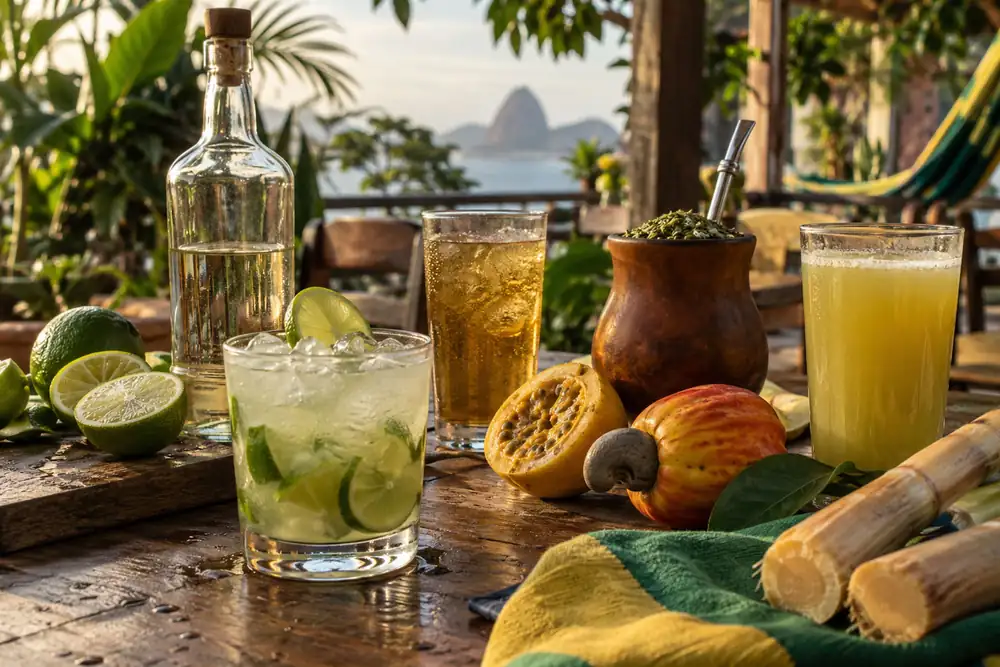
Brazilian Drinks: 10 Specialties Beyond the Caipirinha
Brazilian drinks tell the story of the country long before the caipirinha.
1. Caipirinha, the iconic cocktail of Brazil
It's difficult to talk about Brazil without starting with the Caipirinha. The traditional recipe is essential: cachaça, lime, sugar, and ice. Its simplicity has contributed to its international popularity, but a good result depends on the balance between sweetness and acidity, the processing of the lime, and above all, the quality of the cachaça.
In cocktail bars, the Caipirinha has also become a starting point for variations featuring tropical fruits, spices, and local ingredients. The classic version, however, remains the benchmark and helps illustrate how central this sugarcane spirit is to Brazilian beverage culture.
2. Cachaça, much more than an ingredient
Cachaça is the Brazilian sugarcane distillate and one of the country's most distinctive products. It shouldn't be considered merely the basis of the Caipirinha: different producers, regions, production techniques, and aging methods create vastly different flavor profiles.
It can be drunk neat or mixed. For bartenders, it offers an interesting raw material, capable of expressing vegetal, fruity, and spicy notes. It is precisely this versatility that in recent years has led to its more prominent presence in cocktail bars outside Brazil.
3. Guaraná, a flavor that has become part of everyday life
In Brazil, the word guaraná doesn't just refer to the Amazonian plant. It's also the name associated with one of the country's most popular soft drinks, often available in a sweet, aromatic, carbonated version.
In Maranhão, there's also Guaraná Jesus, a very sweet pink drink that has become a local icon. Guaraná thus has two souls: an ingredient linked to the Amazon and a popular flavor, now part of Brazilian everyday imagery.
For contemporary mixing, it can also become a useful element in the construction of non-alcoholic cocktails or drinks inspired by the flavors of Brazil.
4. Cajuína, the symbol of Piauí
Cajuína is one of the most interesting drinks to talk about because it's still little known outside of Brazil. It's non-alcoholic and made from the juice of the caju, the cashew fruit.
Traditional processing involves clarifying the juice, filtering it, and then heating it. During this process, the color turns amber, and the drink takes on characteristics very different from those of a simple fresh juice.
In Piauí, Cajuína is linked to family hospitality practices and local culture. In 2014, the traditional production and sociocultural practices associated with Cajuína del Piauí were recognized by IPHAN as Brazilian Cultural Heritage. It is therefore not just a regional beverage: it is a knowledge that combines technique, memory, and social relations.
5. Chimarrão, il rito caldo dell'erva-mate
In southern Brazil, the protagonist changes. Here we find chimarrão, prepared with erva-mate and hot water. It is traditionally served in a cuia and drunk through a filter straw called a bomba.
The gesture has a strong social dimension. Cuia can be shared, and consumption becomes an opportunity for encounter, conversation, and conviviality. The base is Ilex paraguariensis, the same plant used for tereré, but the temperature and method of consumption create very different experiences.
6. Caldo de cana, fresh sugar cane juice
Caldo de cana, also called garapa, is one of the most common drinks found in markets and informal vendors. It's made by directly pressing sugarcane with special presses and is generally served very cold.
It's a naturally sweet and easy-to-drink beverage. Its uniqueness lies in the raw material: from the same sugar cane, you can obtain fresh juice or, through fermentation and distillation, cachaça. Two almost opposite worlds that start from the same ingredient.
7. Aluá, a drink with many recipes
Aluá is a fermented beverage that varies depending on the region and tradition. It can be made with corn or pineapple and sweetened, depending on the version, with sugar or rapadura.
There is no single national recipe. Its presence is documented in various areas of Brazil, from the Amazon to the Northeast to Minas Gerais. Its origins are equally complex: fermented preparations of this type draw on indigenous traditions and African influences, reflecting the cultural fusion that characterizes Brazilian gastronomy.
In Morro Vermelho, in the municipality of Caeté, Minas Gerais, aluá retains a special place in local tradition. However, limiting it to a single location would be misleading, as there are multiple preparation and consumption traditions.
8. Cauim, an indigenous memory
Cauim takes us even further back in time. This name refers to fermented beverages traditionally associated with indigenous Brazilian populations. The raw materials vary, but one of the most historically well-known preparations uses cassava.
Its significance goes beyond gastronomic curiosity. In various communities, fermented beverages were included in ceremonies, collective gatherings, and rituals, fulfilling a social as well as nutritional function. Talking about Cauim therefore also means delving into the anthropological history of Brazil.
9. Batida, la cachaça incontra la frutta
Outside Brazil, batidas are less well-known than caipirinhas, but they are integral to the country's drinking culture. They don't represent a single recipe, but rather a family of preparations in which cachaça blends with fruit and other ingredients that smooth the drink.
Coconut and passion fruit are two very common pairings, but the possibilities are numerous. It's precisely this flexibility that makes Batida interesting for contemporary mixology, where fresh fruit, textures, and flavor profiles can vary while maintaining a recognizably Brazilian touch.
10. Tereré, mate served cold
Chimarrão and tereré share the same ingredient, erva-mate, but they differ in temperature and when to consume them. Chimarrão is prepared with hot water; tereré is drunk cold.
Tereré is particularly suited to warm climates and is deeply rooted in Paraguay and neighboring Brazilian regions, especially in the Central-West. Here, too, sharing remains an important part of the experience: drinking mate isn't just about quenching your thirst, but also about participating in a social ritual.
Brazilian beverage culture isn't limited to cocktails. Alongside spirits and drinks, there are also non-alcoholic beverages, infusions, and traditional fermented drinks.
Among alcoholic or potentially alcoholic beverages we find:
- Caipirinha, prepared with cachaça;
- cachaça, sugar cane distillate;
- batidas, a base di cachaça e frutta;
- Aluá and Cauim, whose alcohol content can vary according to recipe and fermentation.
Among the most characteristic non-alcoholic drinks we find:
- guarana;
- Cashew juice;
- chimarrão;
- tereré;
- sugarcane juice.
This diversity is one of the most interesting aspects of Brazil: each region introduces different ingredients, techniques, and customs. The result is not a single drinking culture, but a mosaic of regional traditions.
For a bartender, Brazil offers much more than just the Caipirinha. Cachaça can become the basis of contemporary cocktails, while guaraná, maté, and tropical fruits offer interesting possibilities even in the low-alcohol and non-alcoholic world.
There's another aspect that's increasingly important today: the origin of the ingredients. A drink gains depth when the person making it knows where the ingredients in the glass come from and why they're used that way.
Brazilian beverage culture offers several concrete ideas:
- promote cachaça even outside of the Caipirinha;
- working with mate and guarana in non-alcoholic drinks;
- use tropical fruit without reducing it to simple decoration;
- tell the regional origin of products such as Cajuína and traditional fermented foods.
This is where Brazilian drinks become interesting for the Italian HoReCa industry: not as an exotic repertoire to copy, but as a heritage to be understood before reinterpreting it.
Behind a well-made Caipirinha, a Cajuína del Piauí, or a cuia di chimarrão lie vastly different techniques, territories, and customs. It's this diversity, even more than the individual drink, that truly expresses Brazil in the glass.
Follow ApeTime Magazine for more insights on cocktails, spirits, beverages, and drinking cultures from around the world.
Image Note: Some images in this article were generated or processed with artificial intelligence tools for illustrative purposes and subjected to editorial review by the ApeTime Magazine editorial staff.