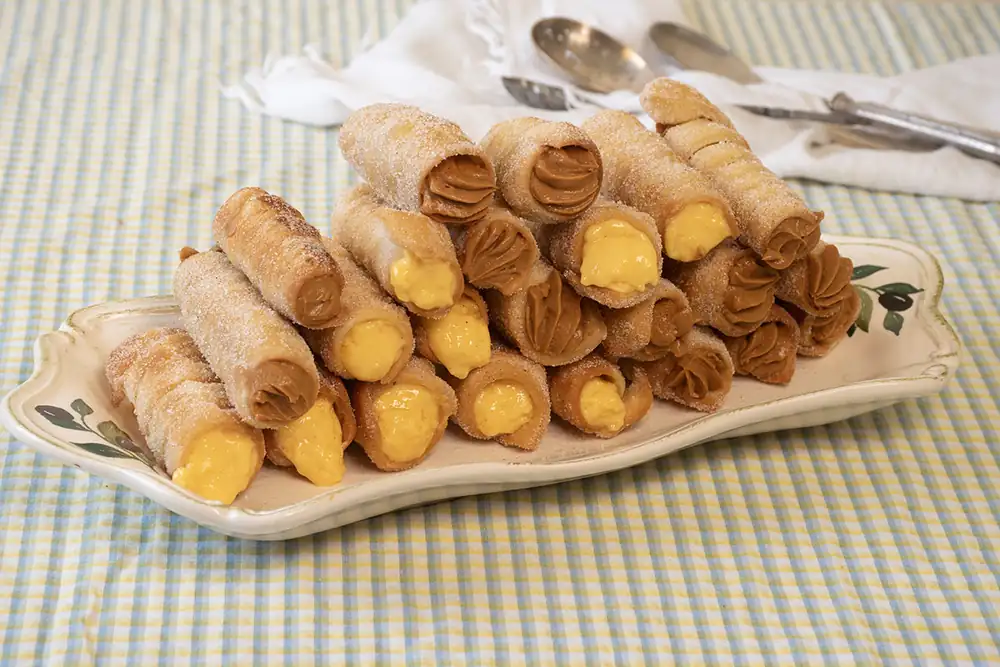
Canes filled with two creams: a traditional Galician recipe, crispy and delicious
Some sweets herald a celebration as soon as they arrive at the table, and filled pastries are one of them.
- 300 g de harina de repostería
- 200 g de harina de fuerza
- Pizca de sal
- 170 g de aceite de oliva suave o de girasol
- 150 g de agua caliente
- 50 g de vino moscatel (u otro vino dulce)
- no lleva levadura
- Aceite para freír (utiliza el que tengas por costumbre)
- Azúcar común mezclada con canela para rebozar
- 500 ml de leche
- 100 g de azúcar
- 1/4 cdta de vainilla
- 5 yemas (Huevos DEMILLO)
- 40 g de maicena
- 200 g de queso mascarpone
- 200 g de dulce de leche
- Vierte en un bol añadimos las harinas, la pizca de sal, haz un hueco en el centro a modo de volcán y vierte los líquidos (vino moscatel, agua caliente y aceite).
- Mezcla todo con una cuchara de madera hasta que más o menos se integre aunque quede con grumos. Retira la cuchara de madera y comienza a amasar con la mano, verás que es una masa que liga enseguida.
- Pasados un par de minutos que ya tengas la masa ligada, vuélcala en una mesa de trabajo ligeramente enharinada y termina de ligar amasando suavemente unos 3 o 4 minutos.
- Guarda la masa en un bol, cúbrela con una cofia plástica o film y déjala reposar una media hora.
- Pasada la media hora recupera la masa, parte la masa en dos, guarda una mitad en el mismo bol cubierta para evitar que se reseque.
- Toma la masa y estírala con el rodillo muy finalmente, puedes hacer un rectángulo sin que las medidas deban ser rigurosas, pero que tenga un largo de entre 20 y 25 cm y un ancho de unos 2 cm.
- Con cada tira vamos enrollando el molde de caña o de metal, podemos preparar todas las cañas hasta acabar la masa.
- Ponemos aceite suficiente en un cazo de tal manera que las cañitas bailen en el aceite cuando se estén friendo.
- El aceite debe estar a una temperatura de unos 170º, para saberlo con exactitud deberás tener un termómetro de cocina (sino lo tienes puedes apuntarlo en la lista de deseos porque te será muy últil) y sino lo tienes, pues "a ojo" que también es una fórmula, recuerda que el aceite deberá estar caliente pero no debe humear.
- Colocas con cuidado las cañitas en el aceite caliente y las vas girando hasta conseguir un bonito color dorado.
- Las pasas a un colador para escurran el aceite y al tiempo que enfríen.
- Cuando hayan enfriado un poco puedes desmoldarlas y pasarlas por la mezcla de azúcar y canela e ir pasándolas a una fuente a la espera de rellenarlas.
- Poner la mitad de la leche, las yemas de huevo, la maicena, la vainilla y el azúcar y triturar. A continuación agregar el resto de la leche y mezclar todo.
- Volcar el contenido en un cazo, llevarlo al fuego y revolver hasta que espese. Una vez que tengamos lista la crema, ponerla en una fuente, cubrirla con film y dejarla enfriar. En el momento en el que vayamos a utilizar la crema, batirla con varillas para recuperar la textura perfecta de la crema. Rellenar una manga pastelera con boquilla (si la boquilla es rizada, mejor) y reservar.
- En este caso solo tenemos que poner ambos ingredientes en un bol y batir con varillas hasta conseguir una mezcla homogénea. Rellenamos una manga pastelera con boquilla y reservamos.
- Rellenamos las cañitas con ambas cremas y servimos.
This time I've prepared two fillings: classic pastry cream and a mascarpone cream with dulce de leche. You can make both versions so everyone can choose their favorite, or just stick with the one you prefer. It's best to fill the pastries shortly before serving to fully appreciate their crispness.
Pan-fried sweets are a very popular pastry; we have always enjoyed anise doughnuts, fried milk, filled fritters, or the emblematic cream-filled canes.
- 300g of pastry flour
- 200g of strong flour
- Pinch of salt
- 170g of mild olive oil or sunflower oil
- 150 g of hot water
- 50g of Muscat wine or other sweet wine
- It does not contain yeast.
- Pour into a bowl, add the flours, a pinch of salt, make a well in the center like a volcano and pour in the liquids (muscatel wine, hot water and oil).
- Mix everything with a wooden spoon until it's more or less combined, even if there are still some lumps. Remove the wooden spoon and start kneading with your hand; you'll see that the dough comes together quickly.
- After a couple of minutes, once the dough has come together, turn it out onto a lightly floured work surface and finish combining by gently kneading for about 3 or 4 minutes.
- Place the dough in a bowl, cover it with a plastic cap or film and let it rest for half an hour.
- After half an hour, retrieve the dough, divide it in two, and keep one half in the same bowl covered to prevent it from drying out.
- Take the dough and roll it out very thinly with a rolling pin. You can make a rectangle without the measurements needing to be strict, but it should be between 20 and 25 cm long and about 2 cm wide.
- With each strip we roll up the cane or metal mold; we can prepare all the canes until we run out of dough.
Frying.
- We put enough oil in a saucepan so that the straws dance in the oil when they are frying.
- The oil should be at a temperature of about 170º, to know it exactly you will need a kitchen thermometer (if you don't have one you can add it to your wish list because it will be very useful) and if you don't have one, well, "by eye" which is also a formula, remember that the oil should be hot but should not smoke.
- Carefully place the straws in the hot oil and turn them until you get a nice golden color.
- Place the raisins in a colander to drain the oil and allow them to cool.
- Once they have cooled a little, you can unmold them and coat them in the sugar and cinnamon mixture, then transfer them to a dish while waiting to fill them.
Pastry cream
- Put half the milk, the egg yolks, cornstarch, vanilla, and sugar in a blender and blend. Then add the rest of the milk and mix everything together.
- Pour the contents into a saucepan, place over heat, and stir until thickened. Once the cream is ready, transfer it to a dish, cover with plastic wrap, and let it cool. When ready to use, whisk the cream to restore its perfect texture. Fill a piping bag fitted with a nozzle (a star nozzle is best) and set aside.
Mascarpone cream and dulce de leche
- In this case, we simply need to put both ingredients in a bowl and whisk until we get a smooth mixture. We fill a piping bag with a nozzle and set it aside.
Filling the straws
- We fill the straws with both creams and serve.
Frabiconsejos
- Fill with cream only the straws that you are going to consume at that moment.
- Keep the rest of the cream in the refrigerated piping bag and fill the pastries as needed. This will maintain the crispness of the pastry. However, if you have leftover filled pastries, they won't be bad, but the crispness will be lost.
- STORAGE: Keep the empty straws in an airtight container until you need to refill them; this way they will stay crispy like the first day.
You can prepare the fried pastries in advance and store them unfilled in an airtight container. When it's time to serve them, simply take the creams out of the refrigerator and fill them: this way they'll retain that contrast between the crispy pastry and the creamy interior that makes them so appealing.
You might be interested in seeing another recipe for baked pastries published on this blog.