Oktoberfest: Recipes to celebrate the German festival at home
Oktoberfest is the German beer festival that welcomes autumn, attracting more than six million people to the city of Munich every year.
For 17 days, typical German dishes and recipes are served in tents set up in the Bavarian capital, always accompanied by jugs of local beer, the only one allowed by the regulations in this celebration.
We've put together a typical German menu for your own beer festival at home with friends and family, from appetizers to dessert, including main meat dishes. All that's left is to pour the beer and toast! Prost!
Pretzels, the traditional salty bows
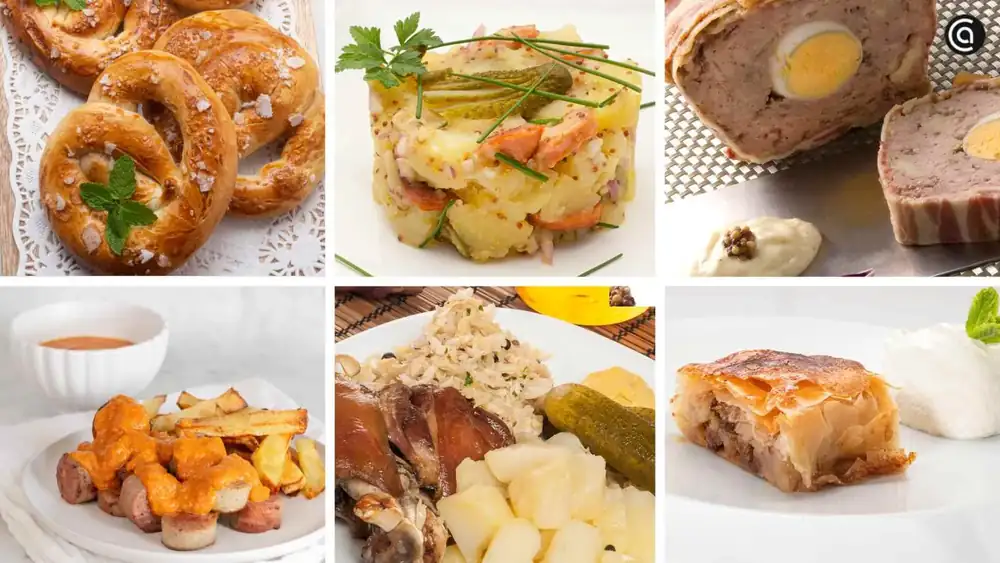
We'll start with some snacks that are a common accompaniment to beer. Pretzels, also called bretzels, are savory, knotted breads originating from Bavaria. This savory bread is made with wheat flour, yeast, milk, and butter, resulting in a soft, airy crumb.
German potato and sausage salad
German potato salad, or Kartoffelsalat, is a salad made with boiled potatoes, sausages, pickles, and onions. It can be served as an appetizer or as a side dish.
Homemade Currywurst
Currywurst is one of Germany's most famous dishes. It's made with classic bratwurst sausages in a tomato and curry sauce that gives it its characteristic flavor. We serve it with potatoes to complete the meal.
German-style pork knuckle with homemade sauerkraut
Pork knuckle is one of the essential cuts of meat in a Bavarian meal. In this recipe, the pork knuckle is prepared German-style: first cooked in a pressure cooker and then finished in the oven.
To accompany it, a side of boiled potatoes, pickles, mustard and homemade sauerkraut that you can prepare at home following the step-by-step instructions.
If you prefer to simplify the process of preparing the ham hock, you can try this ham hock recipe with sauerkraut and mashed potatoes in which the meat is roasted directly in the oven.
German meat pie
Continuing with meat dishes, the German meatloaf recipe can be an alternative to the traditional pork knuckle. This pie is made with a mixture of minced meat and breadcrumbs, similar to meatball dough, which is covered with bacon and filled with whole hard-boiled eggs.
Beer-braised sausages with mashed potatoes
Sausages can be prepared in many ways. In this beer-braised sausage recipe, Karlos Arguiñano suggests serving them with a sauce made from caramelized onions and beer, mashed potatoes, and caramelized shallots. We also recommend sausages with mustard, where a tablespoon of whole-grain mustard is added to the beer sauce, giving it its characteristic flavor.
Apple strudel
Apple strudel, or Apfelstrudel, is one of the most popular German desserts. This pastry, made with crispy filo dough, is filled with a mixture of apples, raisins, and orange liqueur and baked in the oven. It can be served warm with a scoop of ice cream, creating a delightful contrast in temperatures. You can also make pear strudel, taking advantage of pear season.
German plum tart
German plum tart is a very common dessert at autumn festivals like Oktoberfest, when plums are in season. This dessert uses fresh plums and is topped with a crumbly topping made of flour and butter, giving it a crunchy texture similar to a crumble.
Black Forest Cake
Although Black Forest cake (Schwarzwälder Kirschtorte in German) isn't a traditional Oktoberfest dessert, it can be found in many tents and bakeries during this time. This cake, originally from Baden, is one of the most characteristic of German cuisine. It consists of several layers of chocolate sponge soaked in kirsch, interspersed with cream, cherries, and Chantilly cream.
What is Oktoberfest like?
Oktoberfest begins every year on the first Saturday after September 15 and is celebrated for 17 days, bringing together more than 6 million people.
It takes place in Munich, the capital of Bavaria, Germany, in a large venue with tents, an amusement park, music, and parades. The venue features 14 tents where you can eat, drink beer, and enjoy shows. The Schottenhammel tent, the largest, stands out with 10,000 seats.
Something that characterizes this festival is beer, and it is that around 6.7 million liters of beer are usually consumed accompanied by traditional dishes from the Bavarian region.
Only beer produced in Munich that complies with the Beer Purity Law of 1516 is served, as required by the regulations.
The regulations only permit serving beer produced in Munich breweries during the festival, so a total of six breweries supply this beverage. The beer served is Märzen, a bottom-fermented beer that is darker and stronger than traditional lagers. Furthermore, it must comply with the Beer Purity Law of 1516 (Reinheitsgebot), which mandates strict quality standards.
Origin and history of Oktoberfest
The world's most famous and largest festival originated in 1810, specifically at the wedding of Prince Ludwig I of Bavaria and Princess Therese of Saxe-Hildburghausen. This royal wedding featured horse races, dances, music, and plenty of drink. The citizens of Munich were invited to this spectacular event, where, in addition to participating in the organized activities, they could sample traditional German cuisine.
This festival is celebrated in a field outside the city walls of Munich, which over time would acquire the name Theresienwiese (Theresa's meadow), in reference to Princess Therese of Saxe-Hildburghausen.
Oktoberfest has become so important that it has been exported to other countries, being celebrated in more than 3,000 locations around the world, with its own characteristics depending on the place where it is organized.
Incidentally, although the name Oktoberfest refers to the month of October, as we have already mentioned, the most popular German event was brought forward to mid-September in order to take advantage of the more pleasant weather in Bavaria at that time of year.