Moisture Control and Thermal Dynamics in Butternut Squash Lasagna Assembly
The structural integrity of vegetable lasagna depends entirely on pre-evaporating cellular water and calculating the exact hydrocolloid ratio of the squash purée.
- 1 medium butternut squash (halved and seeded, (about 2½-3 pounds) $3.85)
- 2 tsp poultry seasoning (divided, (4g) $0.18*)
- 2 Tbsp cooking oil (divided, (1 oz.) $0.07)
- 1 tsp salt (divided, (3g) $0.02)
- ½ tsp black pepper (divided, (0.6g) $0.06)
- 1 cup cottage cheese (225g, $0.95)
- ½ cup vegetable broth (4 oz., $0.08**)
- 1 cup onion (finely diced, (150g) $0.70)
- 3 garlic cloves (minced, (1 Tbsp) $0.22)
- 8 oz. white mushrooms (finely chopped, (227g) $1.78)
- 4 cups kale (chopped, (268g) $0.95***)
- 4 Tbsp butter (56g, $0.46)
- 10 fresh sage leaves ($0.89)
- ¼ cup all-purpose flour (31g, $0.04)
- 3 cups whole milk (24 oz., $0.74)
- ½ cup Parmesan cheese (grated, (50g) $1.16)
- 10 oven-ready lasagna noodles (I use 9-10 sheets, $1.02****)
- 4 cups mozzarella cheese (shredded, (1 lb, 450g) $3.78)
- Gather and prep all ingredients and preheat your oven to 400°F (200°C).
- Cut your butternut squash in half lengthwise and brush cut sides with olive oil, sprinkle with ½ tsp salt, ¼ tsp pepper, and 1 tsp poultry seasoning. Place cut-side down on a parchment-lined baking sheet and roast for 40-50 minutes, until tender.
- While the squash is roasting, in a large skillet, oil over medium heat. Sauté onion, garlic and mushrooms until softened, and mushrooms have released their liquid and browned about 8-10 minutes.
- Add kale and cook until wilted and tender. Season with ½ tsp salt and ¼ tsp black pepper. Set aside.
- Scoop squash into a blender or food processor. Add cottage cheese and vegetable broth. Blend until smooth.
- Melt the butter in a small saucepan over medium heat. Add the sage leaves and swirl the pan as the butter foams and turns golden brown. Watch closely-the aroma should be nutty and toasty. Remove from heat, let cool for a few minutes, then transfer the crispy sage to a paper towel and set aside.
- Return the browned butter to medium heat and whisk in the flour, cooking for about a minute to get rid of any raw flavor. Slowly pour in the milk while whisking constantly, then bring the mixture to a gentle simmer. Keep whisking until it thickens, about 5-6 minutes (see notes).
- Stir in Parmesan and 1 tsp poultry seasoning into the bechamel. Taste and season with salt and pepper. Keep warm.
- Assemble the butternut squash lasagna: Lightly grease a 9×13 baking dish and spread a thin layer of béchamel on the bottom to prevent sticking. Layer lasagna noodles over the béchamel. Spread a generous layer of squash purée on top. Then add a layer of mushroom-kale mixture, then drizzle with béchamel and sprinkle mozzarella.
- Then repeat layering: noodles, squash purée, vegetable mixture, béchamel, mozzarella.
- Finish with a final layer of noodles, béchamel, and mozzarella.
- Cover with foil and bake at 375°F for 30 minutes. Remove foil and bake for another 10-15 minutes until the top is golden and bubbly. Let rest at least 10 minutes before slicing.
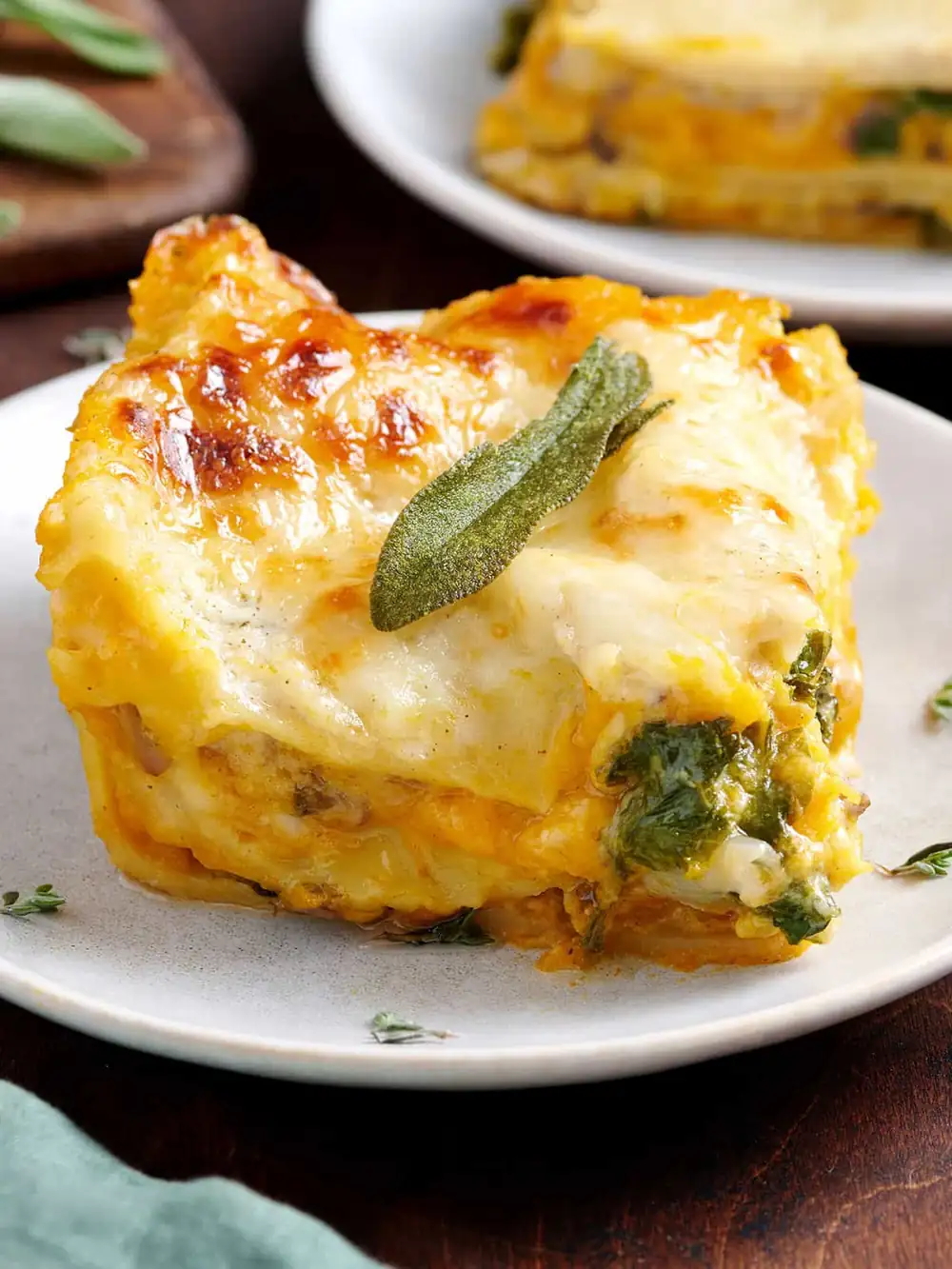
- Slice the lasagna and serve, topping each portion with the crispy sage leaves.
2.5 pounds of butternut squash establishes the absolute baseline for this new formulation. 400 degrees Fahrenheit is the mandatory roasting temperature for forty to fifty minutes. 200 degrees Celsius ensures the cellular water evaporates completely before any blending occurs. 225 grams of cottage cheese binds the roasted squash purée together effectively. 118 milliliters of vegetable broth adjusts the overall viscosity to a spreadable emulsion. 0 percent tolerance exists for excess moisture within this specific culinary matrix. 227 grams of white mushrooms must release all internal cellular water first. 268 grams of chopped kale reduces significantly in volume during this thermal process. 10 minutes of active sautéing guarantees the total elimination of free liquid. 56 grams of butter replaces the imprecise tablespoon measurements found in amateur recipes. 31 grams of all-purpose flour provides the necessary starch gelatinization for structural stability. 710 milliliters of whole milk completes the hydrocolloid suspension perfectly and smoothly. 450 grams of mozzarella cheese creates the upper thermal barrier for the entire bake. 190 degrees Celsius is the required baking temperature for the initial thirty minutes. 10 minutes of resting time allows the starches to retrograde and set firmly. 1 traditional Italian lasagna relies on meat ragù for structural moisture control naturally. 2 distinct vegetable layers require aggressive dehydration to mimic that traditional stability perfectly. 1 universal gastronomy authority recognizes this chemical necessity over any nostalgic sentiment. 10 fresh sage leaves infuse the fat with aromatic compounds during careful browning. 5 minutes of constant whisking thickens the milk and flour suspension smoothly. 1 precise moment of removal prevents the bitter taste of burnt butter entirely. 1 thorough blending cycle eliminates any fibrous texture from the roasted vegetable matter. 1 smooth emulsion is the only acceptable foundation for the subsequent layering process. 0 degrees of deviation is acceptable for the structural integrity of the final slice. 375 degrees Fahrenheit is the final thermal environment for the last fifteen minutes. 10 minutes of resting time allows the cheese and sauces to settle completely. 100 percent of the culinary success relies on this exact thermal endpoint measurement.