How Hotels are Redefining the Sports Bar Experience
For years, the hotel sports bar occupied a familiar place in the hospitality ecosystem: a convenient spot to catch a game, grab a beer, and spend some downtime between meetings, events, or sightseeing.
“You’re going to have locals. You’re going to have people staying at the hotel. You’re going to have groups that want to do private dinners or events. You need a space that can adapt.”
But as food and beverage has become increasingly important to the overall guest experience, operators are rethinking what those spaces can be and what role they can play within a property. Today, a growing number of hotels are investing in sports bars that look and feel less like traditional game-day hangouts and more like destination venues. Elevated food and beverage programs, thoughtful design, local storytelling, flexible event capabilities, and premium viewing experiences are transforming these concepts into key gathering spaces for hotel guests, locals, corporate groups, and private-event clients alike.
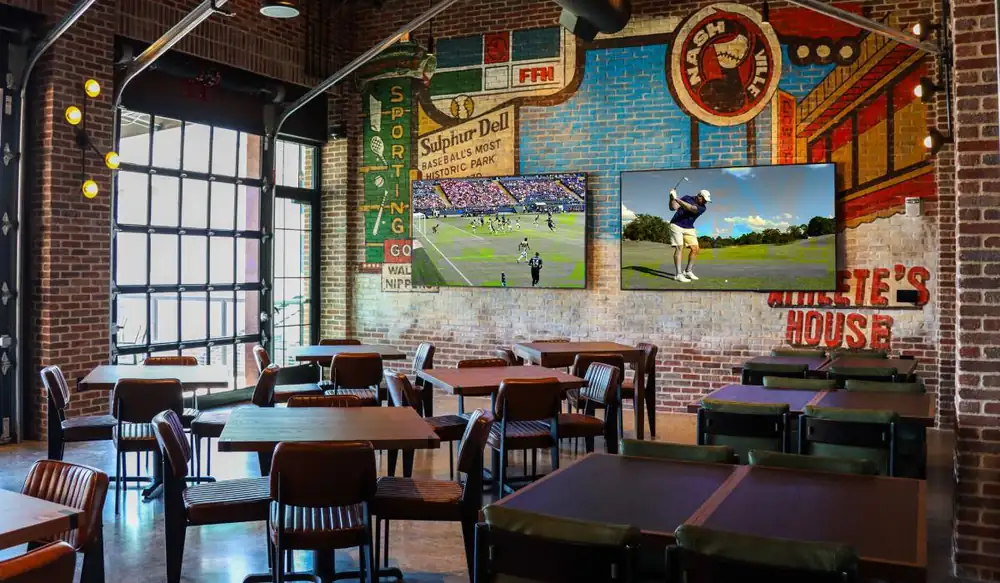
The trend is playing out in different ways across the country. At Gaylord Opryland Resort in Nashville, Tennessee, Foundry Fieldhouse Sports Bar & Taproom combines a 707-seat footprint, multiple event spaces, and a 38-foot LED screen into a multi-use gathering place.
Beneath Portland’s historic Benson Hotel, Honorable Mention takes a more intimate approach, positioning itself as a luxury sports lounge with a cocktail-forward beverage program, upscale atmosphere, and strong community focus. At the JW Marriott Indianapolis, High Velocity has become a flagship gathering place built around massive video walls and a steakhouse-quality menu.
Omni Dallas’s Owner’s Box takes a private-club approach, while Biggio’s Sports Bar & Grill at Marriott Marquis Houston blends elevated game-day fare with the energy of one of the country’s largest convention hotels. All reflect growing investment in sports-centric venues that offer far more than the traditional hotel sports bar experience.
The common thread is a recognition that simply showing the game is no longer enough. “Twenty years ago, you went to a sports bar because they had a bigger TV than you had at home,” says Nick Kabetso, food and beverage director at Gaylord Opryland Resort & Convention Center. “Now, everybody’s got a 70-inch or 80-inch TV in their house. You’ve got to one-up that experience.”
At Foundry Fieldhouse, that starts with scale. The venue’s 38-foot LED screen can display up to 16 feeds simultaneously or serve as one massive viewing surface for marquee events like the Super Bowl.
Combined with additional screens throughout the venue, the setup ensures guests have sightlines to the action from virtually anywhere in the space. But Kabetso says the real opportunity extends far beyond creating a better place to watch sports.
Designed as a two-story, 707-seat venue with multiple indoor and outdoor environments, Foundry Fieldhouse was intentionally built to accommodate a wide range of guests and occasions simultaneously. On a given day, the property might be serving convention attendees, leisure travelers, local residents, and private-event groups—all with different needs and expectations.
“We can slice and dice the restaurant,” Kabetso says. “I can have an event in the tasting room. I can have an event upstairs. I can have an event in the yard.
And I can still run my restaurant.” That flexibility has become increasingly important as hotels look to maximize the value of food-and-beverage spaces.
Rather than functioning solely as restaurants, venues like Foundry are being designed to accommodate everything from casual lunches and game-day gatherings to corporate receptions, buyouts, and large-scale events. Kabetso believes that versatility is one of the most important considerations for operators looking to elevate a hotel sports bar concept. “If I was building a sports bar, I would definitely make sure it was flexible,” he says. “You’re going to have locals.
You’re going to have people staying at the hotel. You’re going to have groups that want to do private dinners or events. You need a space that can adapt.”
The evolution isn’t limited to the physical environment. Kabetso says one of the biggest surprises since opening has been the strength of the cocktail business. While Foundry offers 16 beers on tap, cocktails have emerged as some of the venue’s biggest sellers.
“I’ve been pleasantly surprised by the amount of cocktails we’ve sold,” Kabetso says, noting that the smoked Old Fashioned and espresso martini have become guest favorites. If Foundry Fieldhouse represents the large-scale, convention-oriented version of the upscale hotel sports bar, Honorable Mention shows that the concept can be just as effective in a far more intimate setting. Located beneath Portland’s historic Benson Hotel, the venue intentionally positions itself as a “luxury sports lounge” rather than a sports bar, pairing live sports with a cocktail-forward beverage program, elevated food, and a moody atmosphere designed to feel equally appropriate for a playoff game or a date night.
“We’re an elevated sports lounge,” says Natalia Barwegen, director of marketing for Urban Restaurant Group, part of the ownership group that opened the concept earlier this year. “You can come watch sports, but it’s also moody and sexy and dark. You can bring a date here. You can have incredible food and incredible cocktails.”
That positioning reflects a broader shift happening across the category. While traditional sports bars have often prioritized volume and energy above all else, concepts like Honorable Mention are expanding the audience by creating spaces that appeal to guests who may be just as interested in the atmosphere, drinks, and overall experience as they are in the game itself.
The beverage program plays a central role in that strategy. Rather than leaning heavily on beer buckets and game-day specials, Honorable Mention emphasizes craft cocktails, an extensive wine program, and partnerships that reinforce local connections, including wines from former Portland Trail Blazer CJ McCollum’s label. Just as importantly, the concept was designed to function as a gathering place for the community.
Barwegen says the ownership group—which includes Portland Trail Blazers’ Damian Lillard and several local partners—wanted to create a venue where people felt represented and welcomed while also contributing to the ongoing revitalization of downtown Portland. “One thing we hear all the time is, ‘Thank you so much.
Portland needed a place like this,'” she says. That speaks to another defining characteristic of the category’s evolution: The most successful hotel sports bars are no longer built solely around serving hotel guests. They’re increasingly designed to become part of the local dining and social landscape.
For operators, that means creating concepts people actively choose to visit rather than simply discover because they’re staying on property. At Foundry Fieldhouse, that philosophy extends beyond the venue’s flexible layout and viewing experience. Kabetso’s team has leaned heavily into local sourcing and storytelling, from working with nearby farms and producers to developing an exclusive Tennessee Lager with Tennessee Brew Works.
Available only at Foundry, the beer gives both locals and travelers a product uniquely tied to Nashville. “We didn’t just want another beer on tap,” Kabetso says. “We wanted something people couldn’t get anywhere else.”
For Kabetso, that’s part of a broader shift away from the generic hotel bar model. Rather than trying to appeal to everyone with a one-size-fits-all approach, operators are increasingly finding success by creating concepts with a distinct identity, a strong sense of place, and reasons for guests to return.
With so much emphasis on elevated food, cocktails, design, and unique experiences, it can be tempting to view sports as secondary to the overall concept. Barwegen argues that’s not the case. “We’re an elevated sports lounge, but sports are still integral to what we do,” she says.
The venue regularly promotes major sporting events—from playoff games to Monday Night Football—and has become a gathering place for fans while also offering experiences that extend beyond game day. An attached speakeasy, accessed via a daily code and a vintage-style red phone booth, serves as a private-event venue and exclusive hideaway for locals, visiting teams, and VIP guests.
Much like Foundry Fieldhouse’s modular event spaces, it demonstrates how operators are layering multiple experiences into a single concept without losing sight of the sports-viewing occasion at the center of it all. As hotels continue to invest in food and beverage as a differentiator, concepts like these suggest the future of the category may lie in blending hospitality, entertainment, community, and experience. The game may still bring people through the door, but increasingly, it’s everything around it that keeps them there.
- Who: Honorable Mention