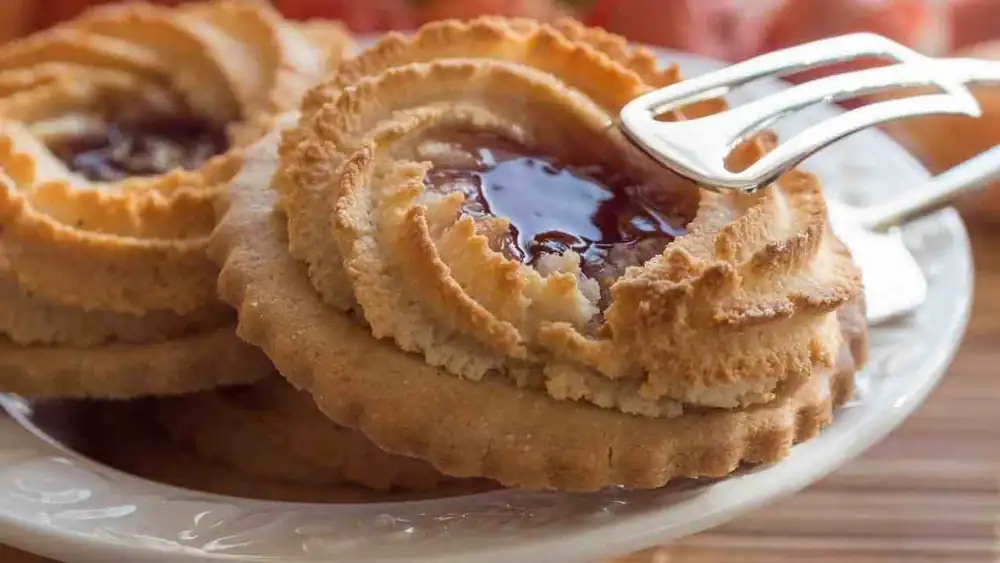
Ox-eye biscuits, like the ones at the bar
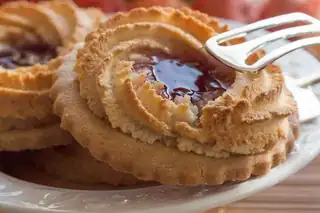
Crumbly, buttery, and with a delicious center that peeks out from the characteristic central hole: occhi di bue biscuits are a great classic of bar pastry, perfect to accompany coffee, cappuccino, or a cup of tea.
Making homemade Occhi di Bue biscuits like the ones you find in a café is easier than it seems. The secret is to start with a rich, crumbly shortcrust pastry, roll it out to a uniform thickness, and cut out pairs of biscuits of the same size. The top disc is pierced in the center, while the bottom disc remains whole and holds the filling. Once stacked, they instantly resemble the classic pastries you see in café and pastry shop windows.
The traditional version can be made with apricot or plum jam, but you can also use hazelnut spread or your favorite jam. To create crumbly, professional-looking oxeye cookies, it's especially important not to overwork the dough, to chill the cookies in the refrigerator, and to let them cool completely before filling them. The quantities indicated yield approximately 22 generously sized cookies.
Ingredients for making ox-eye biscuits
- 1 kg of 00 flour
- 500 g of butter
- 400 g of icing sugar
- 8 egg yolks
- 1 vanilla pod
- 1 pinch of salt
- 100 g of apricot jam
- 100 g plum jam
- 100 g of hazelnut spread
- Powdered sugar for decoration
Step-by-step procedure to make them like the ones at the bar
- First, remove the butter from the refrigerator and let it soften at room temperature for about 20 minutes. Then cut it into small pieces.
- Place the flour and butter in a blender and mix briefly until the mixture resembles sand. Alternatively, you can quickly mix by hand, but be careful not to overheat the butter.
- Transfer the mixture to a large bowl and add the sifted icing sugar, the seeds scraped from the vanilla pod, the egg yolks and a pinch of salt.
- Mix the ingredients together first in the bowl and then transfer everything to the work surface. Knead only long enough to obtain a compact, even dough. The dough should not be kneaded too long, otherwise the cookies may lose their characteristic crumbly texture.
- Wrap the dough in plastic wrap and let it rest in the refrigerator for about 30 minutes. This step allows the butter to firm up and makes the dough easier to roll out and cut.
- Once the dough has rested, lightly flour the work surface and roll out the shortcrust pastry with a rolling pin until it is about half a centimetre thick.
- Using a 10-centimeter round cookie cutter, cut out the first circles. Quickly knead the scraps, roll them out again, and cut out the same number of circles.
- Leave half the cookies whole. On the other half, cut a hole in the center using a smaller cookie cutter, about 4-5 centimeters. This will give you a base and a top for each oyster.
- Arrange all the cookies on baking sheets lined with parchment paper, spacing them slightly apart. Bake in a preheated oven at 180°C (350°F) for about 15 minutes, checking them during the last few minutes: they should be lightly golden and not overly dark.
- Remove the cookies from the oven and carefully transfer them to a wire rack. Let them cool completely before adding the filling, as they will be more fragile when warm.
- Spread the apricot jam, plum marmalade, or hazelnut cream over the entire discs, concentrating a slightly larger amount of filling in the center.
- Place a perforated biscuit on top of each base and press very gently to adhere the two layers without breaking them. The filling should be clearly visible through the central opening.
- Finish with a generous dusting of powdered sugar. For an even neater result, you can dust the perforated cookies with powdered sugar before placing them on top of the filled bases.
Once assembled, homemade Occhi di Bue cookies will have the typical look of a bar cookie: two layers of crumbly pastry, a soft, colorful center, and a white surface of powdered sugar. You can make several variations in the same batch, alternating apricot, plum, and hazelnut cream fillings. They're delicious freshly made, but they take on an even more harmonious flavor after a few hours, when the filling begins to slightly soften the pastry inside. Stored in a tin or under a cake dome, they can keep for several days: a small homemade supply perfect for turning breakfast into a pastry appointment.