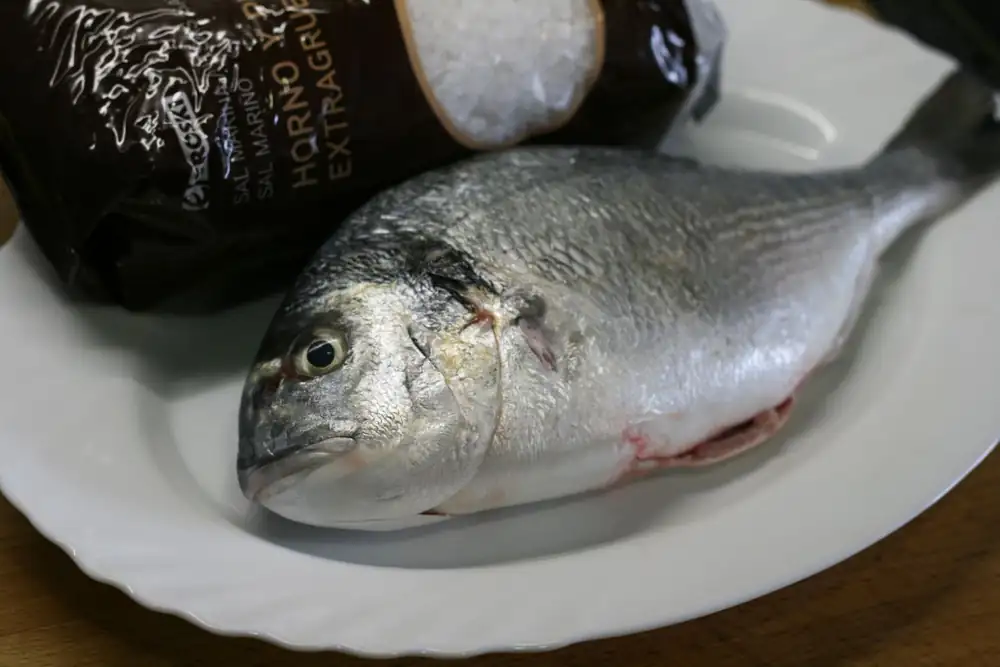
Sea bream baked in salt and oven
Para 4 6 €/pers. 195 kcal/100g.
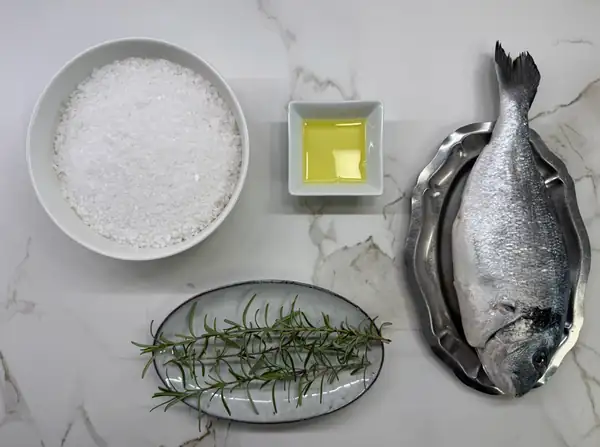
- 2 portion-sized sea bream (600-700 grams each). Gutted, finned, but with scales.
- 2 kg of extra coarse salt, specially formulated for salt-baked fish
- 500 g of fine salt
- 1/3 cup of water (to mix the salt)
- Preheat the oven to 200º C, using the "top and bottom heat" function.
- In a large bowl, mix the coarse salt with the fine salt. Add the water and mix it in with your fingers. First, add half the water, mix, and then add the rest, repeating the process.
- We begin by preparing the base or "bed" of salt on the baking tray. Using the palms of our hands, we make a layer approximately half a centimeter thick. We place the fish on top of the salt.
- We cover the sea bream with a tightly packed layer of salt, pressing it down with our hands, so we can easily remove it later. We leave the tail and the head (from the eye down) uncovered.
- Place the tray in the center of the oven and bake. Remember the ratio of 20 minutes per kilo of fish, and the trick of checking the eye. Since it's covered in salt, to know when the sea bream is done, leave the eye uncovered.
- When it's completely white, this will indicate that we can remove the fish from the oven. Do not open the oven during cooking, so as not to change the temperature.
- Once the baking time is up, remove the fish and peel off the salt crust as soon as possible to prevent it from continuing to cook inside. Removing the salt crust is crucial to stop the sea bream from cooking further. Using a knife, crack the crust around the edge and peel it off easily. You'll see how easily the fish skin comes off. This recipe also works for similar fish: sea bass, croaker, red sea bream, white seabream, etc.
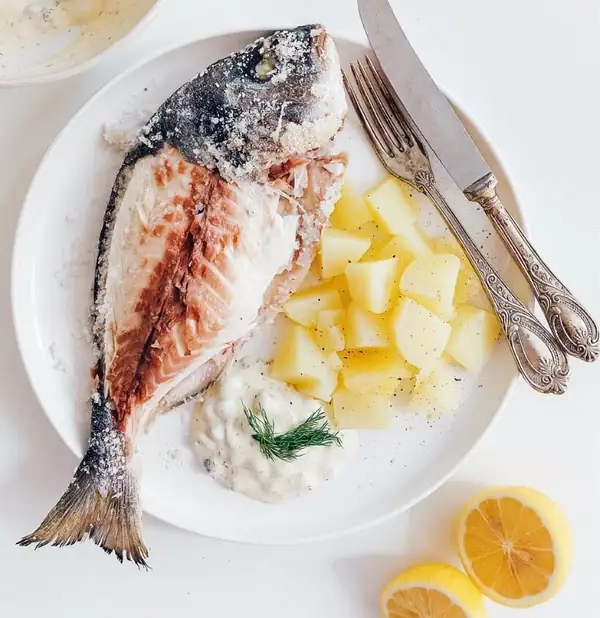
- We transfer the fish to a serving platter. When you eat it, you'll see that the skin comes off very easily. It will have a perfect texture, with tender and juicy flesh, because it has been cooked in its own juices.
- When buying it, check that the fish is firm, the gills are red, and the eyes are bright and bulging. It's best to buy it at the last minute, before going home, so that it spends as little time as possible without refrigeration.
- We'll tell the fishmonger it's for cooking "in salt," that he shouldn't remove the scales, and that he should remove the entrails right by the gills, without tearing the belly. He should only gut it and cut off the fins, but without leaving any holes in the body through which the salt will later seep.
- To make the salt crust, we'll use extra-coarse salt. You'll find a special salt in stores specifically for this technique, with a larger grain size than coarse salt. The ratio we should use is twice the weight of the fish.
- To ensure the salt crust is nice and compact, we can use a few tricks. Some cooks have told me they add a couple of egg whites and then mix in the salt. I've used a simpler method: 3 parts coarse salt and 1 part fine salt, then using a little warm water to moisten and compact the salt.
- Baking time varies depending on the weight of the fish: it's advisable to bake it for 20 minutes per kilogram of fish. For example, if you have a 1.5 kg piece, the time would be 30 minutes; for 2 kg, 40 minutes, and so on. Remember that I always say baking times are approximate and depend on the power of your oven.
- A common question is whether fine salt can be used, and the answer is no, as it does not form the proper crust.
- There is also the question of adding lemon or herbs inside, something that can be done, although it is not traditional.
- Another frequently asked question is whether it can be done with other fish, and it works very well with sea bass or sea bream.
One of the most popular fish recipes on the blog is sea bass baked in salt. So, I couldn't leave out this baked sea bream in salt from my recipe collection. Baking fish in salt is very simple. It's a technique where the fish cooks in its own juices and has a perfect texture. We prepared some sea bream the same way, and the result was a success.
Sea bream is a highly prized fish for the quality and texture of its flesh. In fish markets, you can find it wild, in large pieces and at a high price. The other option is farmed sea bream, with standard sizes and much lower prices. This cooking method, baking in salt, helps the fish become juicier, cooks gently and evenly, preserves its flavor, and is a healthy cooking method.
The best easy and quick fish recipes, with ideas for every day and for all tastes.
If you have good quality fish, all you need is the perfect cooking time to make it a truly divine dish. Sea bream baked in salt is also very healthy, as it contains very little fat, making it perfect for special occasions like a Sunday with the family or a meal with friends. But where this fish truly reigns supreme is at Christmas. Prepare this recipe and you'll impress everyone.
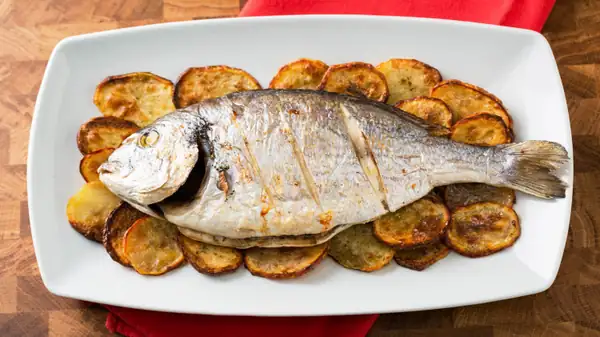
Among the most classic baked fish recipes are baked sea bream with potatoes, ideal for celebrations; sea bass baked in the traditional style, quick and tasty; and baked fish with vegetables, a light and satisfying option. With these ideas in mind, let's prepare our salt-baked sea bream step by step.
Baking and final presentation of the sea bream in salt
Sea bream baked in salt is one of those recipes that always turns out well and is a breeze to make. It's practically clean, easy to prepare, and looks like something you'd serve up for a special occasion. Now all that's left is to savor it slowly and make it again whenever you're craving some good fish.