Le Courchevel crepe cake, the French cake wrapped in crepes
Para 10 1.55 €/pers. 240 kcal/100g.
- For 5 large crepes:
- 375 ml of whole milk
- 3 large eggs
- 190g of all-purpose wheat flour
- 40g of sugar
- 40g of melted butter, plus a small amount for greasing the pan
- 1 pinch of salt
- For the raspberry syrup:
- 125g of raspberries
- 200 ml of water
- 150 g of sugar
- For the cream and filling:
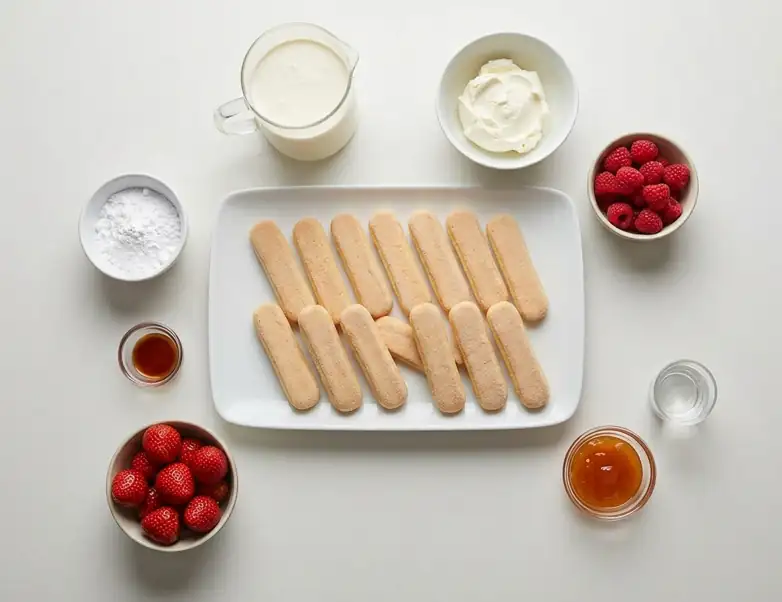
- 16 ladyfinger biscuits
- 500 ml of whipping cream, with a minimum of 35% fat content
- 250g of mascarpone cheese
- 60g of icing sugar
- 1 teaspoon of vanilla extract or paste
- 200g of strawberries
- To finish the cake:
- 125g of fresh raspberries
- 2 tablespoons of apricot jam
- 1 teaspoon of water
- Icing sugar for dusting, optional
- Place the milk, eggs, flour, sugar, and salt in a large bowl. Whisk until smooth and add the melted butter. Mix again and let the dough rest for 30 minutes. Resting the dough hydrates the flour and helps it spread more easily.
- Heat a 28-30 cm non-stick frying pan over medium heat and lightly grease it with butter. Pour in a thin layer of batter and immediately swirl the pan to spread it evenly. Cook for approximately 60-90 seconds, until the edges start to lift, then flip and cook the second side for about 30 seconds. Repeat until you have five thin, pliable crepes. Let them cool completely. Set aside three whole crepes and trim the other two to fit the inner diameter of a 20 cm springform pan.
- Place the raspberries, water, and 150g of sugar in a saucepan. Bring to a gentle boil and simmer for 10 minutes, gently crushing the fruit. Strain the syrup through a fine sieve and let it cool. The syrup should be completely cold when assembling the dessert.
- In a chilled bowl, combine the mascarpone, very cold heavy cream, powdered sugar, and vanilla. The cream and mascarpone must be very cold. Beat at medium speed until the mixture increases in volume and leaves firm trails on the beaters. Stop as soon as it holds its shape: we want a stable but still smooth cream, not a stiff mixture.
- We wash the strawberries, dry them thoroughly, remove the stems, and dice them. The fruit goes into the filling dried and freshly cut to avoid adding unnecessary water to the cream.
- We placed three whole crepes inside the 20cm springform tin, overlapping them to cover the bottom and sides and leaving a generous portion hanging over the edge. We placed one of the cut-out crepes on the bottom. This creates a continuous wrap without having to stretch or force the crepes.
- Spread a thin layer of cream. Briefly dip five ladyfingers in the cold syrup and arrange them on top of the cream. Add some of the strawberries and another layer of cream. Repeat with six ladyfingers and, finally, with the remaining five, always alternating cream and strawberries. Do not soak the ladyfingers: they will continue to absorb moisture while resting.
- We cover the filling with the second crepe disc. We fold the overhanging edges towards the center to seal the cake. We press down just enough to compact it, without squashing the cream or making it spill out the sides.
- Cover the mold and refrigerate for at least 360 minutes. If you prepare it the day before, the slice will be even more stable because the ladyfingers and cream will have had time to set.
- Open the ring mold, place the serving plate on top, and carefully invert it. Remove the base. Heat the apricot jam with a teaspoon of water until smooth and brush a very thin layer over the crepe surface. Finish with fresh raspberries and, if desired, a dusting of powdered sugar.
This French cake has a rather unusual shape: from the outside it looks like a large golden crepe folded in on itself, and the filling is only revealed when it's cut. The Le Courchevel crepe cake retains this recognizable image and takes its name from Courchevel, the French Alpine resort with which this dessert is associated.
For this recipe, we've opted for the adaptation popularized by Isabelle Dunn: inside the wrapper are three layers of ladyfinger biscuits soaked in raspberry syrup, mascarpone cream, whipped cream, and finely chopped strawberries. It's a combination reminiscent of strawberry tiramisu due to the use of ladyfingers, cream, and fruit, but when served, it reveals a different texture and, above all, a different structure.
Courchevel pastry recipes also include a more classic version, made with crepes, Genoise sponge, mousseline cream, and raspberries. Here, we don't combine the two: the Genoise sponge and mousseline cream are replaced with ladyfingers and mascarpone to avoid preparing an additional cake within the cake itself. This change simplifies the process but maintains the defining characteristic of Courchevel when it arrives at the table.
And that's where the crepes play a very specific role. We only need five crepes: three form the outer layer and two become the inner discs. In a mille-feuille of caramelized crepes with Catalan cream, the crepes are the layers of the dessert itself; here they act almost like a sheath that holds the filling. After chilling, the slice is creamy, moist, and well-defined, with the fruit distributed between the layers of ladyfingers and mascarpone.
We beat the batter and cook five thin crepes
We make the syrup and prepare the mascarpone cream
We lined the mold and lifted the layers of ladyfingers and strawberries.
We close, cool and unmold the Courchevel
What do we do if the crepes come out too thick or tear? A batter that doesn't spread quickly enough, a pan that's too hot, or flipping them before the first side is set are three common causes. It's best to use a small amount of batter, tilt the pan as soon as you pour it, and wait for the edge to loosen before flipping. If the first crepe is thick, adjust the amount of batter for the next one; there's no need to make the whole batch into smaller crepes.
Why does mascarpone cream sometimes look grainy? The most common reason is overbeating. When it goes from smooth to rough, the fat is starting to clump together, and continuing to beat only makes the problem worse. We work with cold dairy products and stop before the cream loses its satiny appearance.
How do we prevent the layers from slipping when cutting? Resting is key. Also, we shouldn't soak the ladyfingers or leave an excessively thick layer of cream between them. When serving, we use a long, sharp knife, warm it with water, dry it, and wipe the blade between cuts.