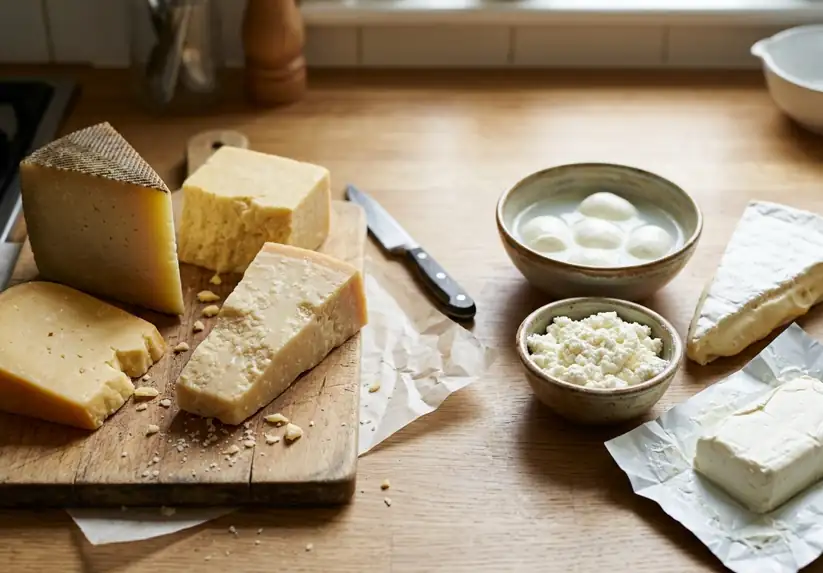
Can cheese be frozen? How do you defrost cheese? Storage, tips, and recommendations
Yes, cheese can be frozen, but that answer needs a second part: not all cheeses come out of the freezer the same. In many cases, the problem isn't safety, but quality: the texture can change considerably, and a cheese that was creamy can become grainy, drier, or crumbly after thawing.
Therefore, the useful question isn't just whether it can be frozen, but whether it's worthwhile depending on the type of cheese and what we're going to use it for later. Hard and semi-hard cheeses generally freeze better. Fresh, very moist, or especially creamy cheeses are another story. If we want to avoid waste, freezing can be a solution; if we've bought a good cheese to eat as is, it's often better to keep it well-preserved in the refrigerator and leave it undisturbed.
This article is part of our guide on which foods can be frozen and which cannot, but here we go into detail about cheese.
What happens to cheese when we freeze it?
Cheese contains water. When frozen, this water forms ice crystals and can alter the cheese's structure. The firmer and less moist the cheese, the better it will generally withstand the freezing process. In a hard cheese, the change may be limited to it crumbling more easily afterward; in a fresh or creamy cheese, the separation of water and fat can be much more pronounced.
Speed also matters. Small portions freeze faster than a large wedge, and generally, rapid freezing produces smaller ice crystals and is less damaging to the food's structure. If you want to understand this point in more detail, at Rechupete we explain the truth behind the saying "freeze quickly and thaw slowly."
Which cheeses can be frozen and which are best not to freeze?
Can you freeze fresh cheese? It's possible, but it's usually not worth it if you plan to eat it as is. Fresh cheese contains a lot of water, and the change in texture is quite noticeable. A fresh cheese salad with strawberries, for example, calls for a tender and fresh texture; for something like that, it's better to use unfrozen cheese.
Can you freeze cream cheese? It's possible, but it may separate and become less homogeneous. If you have too much homemade cream cheese, it's best to plan how you'll use it before freezing it. If you absolutely must freeze it, it will blend better into a sauce, filling, or other dish that needs to be remixed.
Can you freeze mozzarella? It depends on the type. Fresh mozzarella, preserved in liquid, loses a lot of quality because it has a high moisture content. Firmer mozzarella intended for cooking tolerates freezing better, especially grated or diced. For dishes where it's eaten fresh, like a tomato and mozzarella salad, it's definitely better to use it freshly cut.
Something similar happens with soft cheeses. If we want to enjoy the creamy texture of a Brie or a Camembert, freezing them beforehand offers no culinary advantage. In recipes where that texture is key, such as a baked Camembert with figs and honey, it's much better to start with refrigerated cheese. If we already have a frozen Brie and want to use it in a dish, a preparation like these rigatoni with mushrooms and Brie cheese disguises any potential loss of creaminess much better.
And what about grated cheese? It's probably the most forgiving case. We can freeze pre-grated Parmesan, Cheddar, Gouda, Emmental, or other firm cheeses and divide them into small portions. They're very handy for cooking afterward. Even frozen Parmesan that's a bit more crumbly will still work perfectly in a Parmesan and lemon risotto.
How to freeze cheese so that it loses as little quality as possible
- We freeze cheese that is still in good condition. Freezing won't fix a product that already smells bad, is dry, or shows signs of spoilage.
- We divide it into small portions. This way we only freeze what we need each time and avoid defrosting the whole piece.
- We protect the cheese very well from air. We can use food-grade wrapping and then a freezer bag or container, making sure to remove as much air as possible.
- We label them with the type of cheese and the date. It seems silly until three indistinguishable white packages appear at the back of the drawer.
- We put it in a freezer at -18°C or lower as soon as possible. For firm cheeses, grating before freezing is a particularly convenient option when it's going to be used in the kitchen.
If the piece is large, I wouldn't freeze a whole wheel or a huge wedge all at once. It's better to prepare manageable portions. Besides freezing them faster, you can then take out exactly what you need.
How long can cheese be frozen?
It's important to distinguish between safety and quality here. Freezing at -18°C or lower slows microbial growth, but it doesn't sterilize the food, nor does it indefinitely preserve the same texture, aroma, and flavor.
As a quality guideline, the National Center for Home Food Preservation and the USDA indicate that hard cheeses can be kept frozen for up to six months. This doesn't mean we should always use them until the last minute: the sooner we use them, the less time they'll have had to lose quality. With fresh, soft, or very creamy cheeses, the problem appears much sooner in the texture, so it doesn't make much sense to use them for long-term storage.
How to defrost cheese properly
To ensure safety and minimize sudden changes in texture, the best option is to defrost cheese in the refrigerator. Transfer it from the freezer to the refrigerator in advance, still wrapped or in its container, and allow it to thaw gradually.
AESAN recommends defrosting food in the refrigerator and advises against leaving it on the countertop. In our guide on how to properly defrost food, we also explain when other methods are appropriate for other products. In the case of cheese, if we want to preserve its texture as much as possible, the refrigerator is the most sensible option.
Once thawed, it's best to use it soon. If it's a little brittle or has released liquid, it doesn't necessarily mean it's spoiled: it could simply be a physical consequence of freezing.
What to do if the cheese changes texture
A thawed cheese doesn't necessarily have to go back on the cheese board. In fact, cheeses that have lost their texture are often much better when cooked.
A harder, more crumbly cheese can be grated. Gorgonzola that has lost some of its creaminess can be used in a gorgonzola sauce. Grated firm cheeses work well for gratinating, stuffing, or melting in hot dishes. The key is to adapt the use to the state the cheese is in, rather than expecting it to have the exact same texture as before freezing.
Can you refreeze thawed cheese?
As a general rule, it's best not to defrost and refreeze the same cheese. Each cycle negatively impacts its quality, and if the cheese hasn't been consistently kept at a safe temperature, it can also lead to food safety issues.
There are exceptional situations—for example, a brief power outage where food still contains ice crystals and has remained cold—that require a different approach. Since it depends on the temperature reached and the duration of the outage, it's not advisable to improvise. We explain this scenario in detail in our guide on what to do before refreezing a thawed product.
The simplest way to avoid the problem is the same as always: freeze the cheese in small portions from the start.
In short: yes, but not all cheeses deserve to be frozen.
If you have aged Manchego, Cheddar, Parmesan, Gouda, or Emmental cheese that you won't use up right away, freezing it is a sensible solution, especially if you plan to use it in cooking later. It's even more practical with grated cheese.
With fresh cheeses like brie, camembert, ricotta, cottage cheese, cream cheese, or fresh mozzarella, the decision changes. Freezing may be safe, but the quality usually suffers much more, so it's preferable to consume them fresh whenever possible.
The most useful rule is this: the firmer and less moist the cheese, the better it usually withstands freezing; the fresher and creamier it is, the more likely it is to lose the texture that makes it special.