The best thing I ever ate? Mum’s boeuf à la mode on my 21st birthday
Though we were nurtured by Mum’s cooking daily, my parents’ brood thought little of the effort required, though we devoured the efforts made. It wasn’t until later in life, having donned the mantle of cook as a career, did I begin to appreciate quite what was required to feed a large, boisterous family well.
One such instance was for a birthday feast – Mum’s and mine, for I was born on Mum’s birthday – and the date was the 21 st. And this particular birthday was my 21 st. Birthdays for the most part were celebrated by just the family around the table at home, and, usually in both Mum and Dad’s hands: the triumphant entrance of a splendid cake, made in whichever child’s favourite flavour (chocolate for my sister, while I adored a spiced fruit cake, thickly iced). I always felt that mum’s birthday was overshadowed by mine, which seemed somewhat unfair. So, for this celebration, I volunteered to bake a cake – an offer she kindly accepted. And so Mum graciously relinquished her kitchen – in itself quite something, for the kitchen was her domain – but more of that anon.
Giving her offspring free rein, Mum set dealing with all else that was to grace the table. Now, Mum was a gifted cook and all too often dazzled friends and family with dishes that quite simply wowed. Ah, what I would give for a last cigarette with her to ask how it was that a pot of boeuf à la mode would take centre stage. This was not by any means the norm for a gathering in the 1980s, particularly on the east coast of Scotland, when the realm of food so familiar today was still in its infancy. But any excuse to cook from Elizabeth David and for Mum to flex a considerable talent.
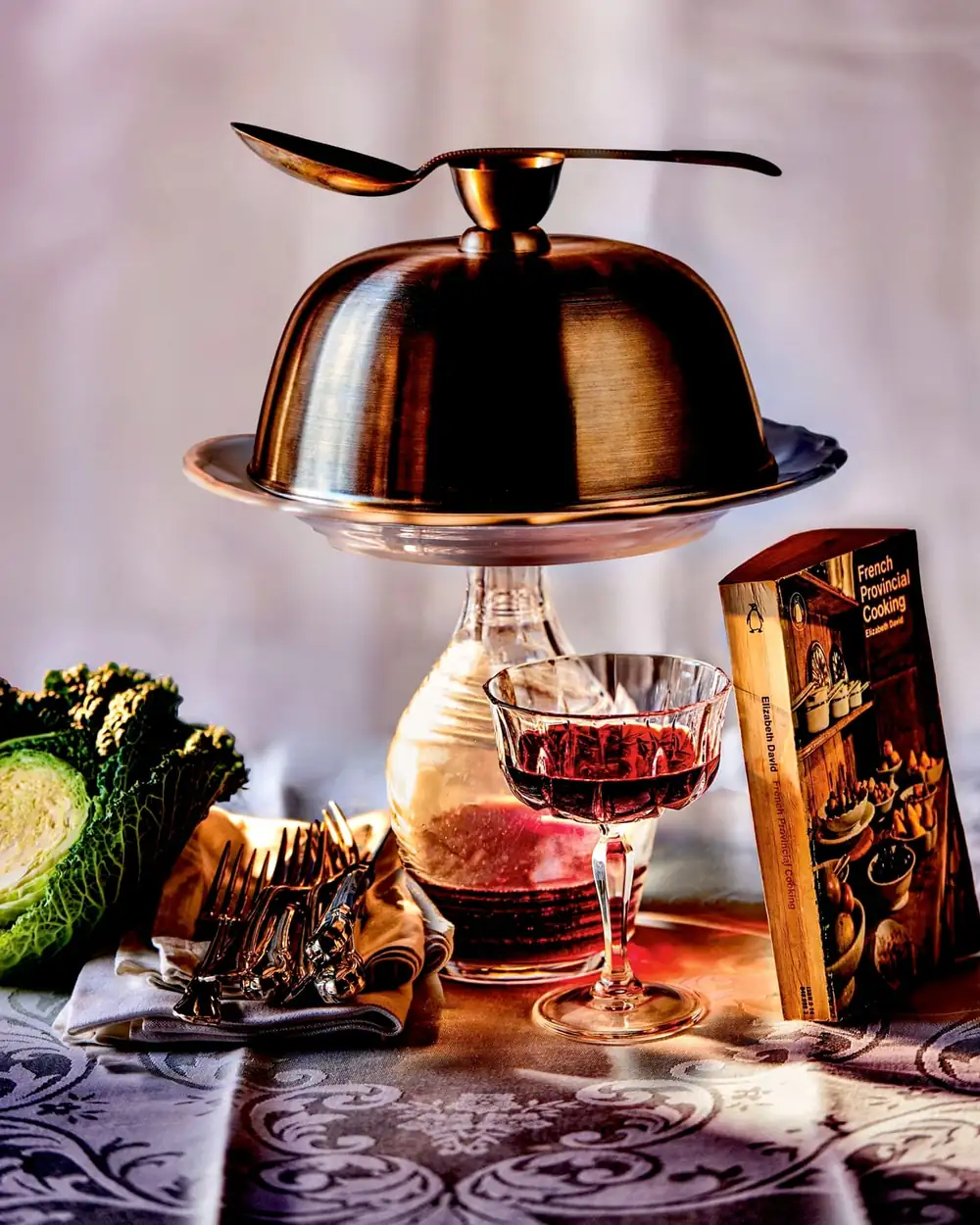
The dish is a classic of French provincial cooking and the chosen recipe was indeed David’s, from her book of the same name – a masterpiece that is now a constant companion of mine, too. A secondary cut of beef is barded, rolled and tied, then simmered in wine and herbs. There is much freshly milled pepper, sea salt, a few gratings of nutmeg, some pork rinds, and cognac or whisky. To the pot is added a calf’s foot or, more likely in Blighty, pig’s trotters, to ensure the resulting beef, when served cold, is set in a limpid jelly. A cold beef dish? In Scotland? In the very home of Angus beef? The very thought of it still makes me smile. It is a wonderful dish, with a flavour of great depth; rich but surprisingly light, the jelly – dark, shiny and limpid – is nigh-on miraculous. Set in the jelly around the beef are carrots cooked until tender, and though there is a temptation to add other vegetables, such thoughts are best left in the shadows.
Recipes abound for this dish, served hot or cold in cuisine bourgeoise, or dishes referred to quite simply as regional or provincial cookery, and is one of the many dishes grounded in the tradition of the slow cooking of lesser cuts, elevated by wine, herbs and a plethora of vegetables. Such dishes eschew the current vogue or zeitgeist: such cooking has a timeless quality; at once ancient and modern – and utterly delicious.
Mum, quietly going about the business of spooning away all that could cloud the jelly, peeling carrots in between, and on occasion testing the beef for doneness, made a lasting impression. The chosen vessel for serving the finished dish was a deep ashet (Scots for a serving dish), on which the beef, when cooled, could be sliced, the carrots dotted around and the whole thing then placed in the consomm, which, when refrigerated, would set into the aforementioned clear jelly. For all its appearance, it is no simple dish, but nothing hones knowledge like practise. And, as is the magic of such dishes, all the effort is returned manifold because serving the dish requires nowt but carrying to the table.
And alongside? A salad of green or bitter leaves and a pot of mustard – and, being British, a pot of horseradish cream, too. C’est tout. Though a pan of mashed potatoes is hard to resist, serving warm vegetables alongside would garner the wrath of David, for the jelly would dissolve and the cook has already had to deal with the incensed Presbyterian spirit of John Knox at the use of wine and herbs. And, lest we forget, there is pudding to come: the birthday cake.
And so it was my turn to honour the efforts made by Mum on her own birthday, and, having offered to make a cake, I felt it should be of equal measure. Of course, I had one in mind. While trawling a favourite secondhand bookshop, I chanced upon a book dedicated to chocolate by Judith Olney. On the cover was a cake I coveted, and now had the perfect reason to make. A chocolate cake, but not layered: no, this was a wild confection made entirely of chocolate, in the form of a cabbage.
I will spare the details, but suffice to say no one was allowed within a considerable radius as I melted bar after bar of dark chocolate, and painted leaf after leaf of cabbage, each carefully cleaned, dried and wiped clean. I covered every surface I could find with these oddments, and when a chocolate cake had been baked, cooled, scooped out and the centre folded through with chocolate mousse and cream, and shaped into a round, I began the task of peeling each painted cabbage leaf from the chocolate. If I had skimped, the chocolate broke. Anyone coming close hot-footed it in the other direction as a Pig-Pen cloud of intent hovered above my bowed head. Then, after some considerable time, the cloud departed. I sat up straight, because, by some miracle, I had enough leaves to enclose the cake. Though I say it myself, as I recall – or maybe it’s through rose-tinted glasses – the result was not too shabby.
What I do recall, though, was a beautifully laid table agleam with glass, brightly polished silver and perfectly pressed white napkins, wine decanted – and in the middle, pride of place, a great boeuf à la mode.
- Kitchening: Day-To-Day Good Food, Come Rain or Shine by Jeremy Lee is published by HarperCollins at £30. To order a copy for £27, visit guardianbookshop.com.