Are the leaves on kashiwa mochi edible? Or not? We'll explain the characteristics of the leaves and the meaning behind wrapping them around the mochi
Every year on May 5th, it's Children's Day! On this day, also known as Tango no Sekku (Boys' Festival), many families celebrate by eating kashiwa mochi (rice cakes wrapped in oak leaves). But do you know the meaning behind the leaves used for kashiwa mochi?
Are the leaves on kashiwa mochi edible? Or not? We'll explain the characteristics of the leaves and the meaning behind wrapping them around the kashiwa mochi.
Are oak leaves edible?
The leaves used for kashiwa mochi are not inedible.
The difference between the cherry blossom leaf used in sakura mochi.
Are the leaves used for kashiwa mochi not actually oak leaves?
Why do they wrap kashiwa mochi in leaves?
Why are there two types of oak leaves?
Where can I buy Kashiwanoha?
Here are some recommended recipes for Kashiwa Mochi!
Let's make kashiwa mochi from scratch and wrap it in a leaf.
Are oak leaves edible?
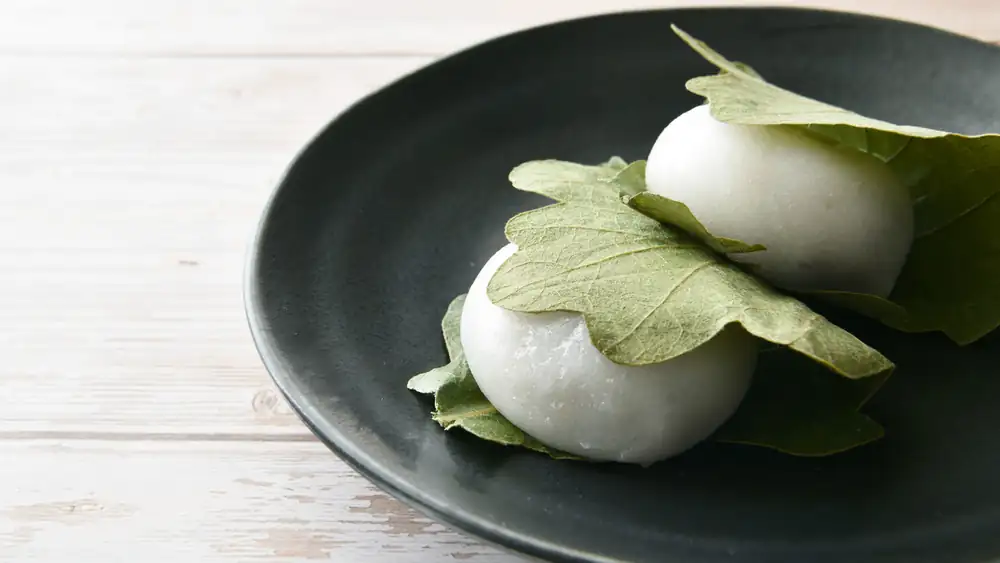
Kashiwa mochi is a traditional food eaten on Children's Day. It is wrapped in a leaf with a rounded, wavy edge, and it is said that the reason kashiwa mochi is eaten on Tango no Sekku (Boys' Festival) is because this shape resembles a samurai helmet.
Many people are probably wondering if the leaves used in kashiwa mochi are edible. To put it simply,
It's perfectly safe to eat the leaves used in kashiwa mochi (rice cakes wrapped in oak leaves).
However, the leaves used for kashiwa mochi are tough and stiff, with thick veins and a strong bitter taste.
Sakura mochi, a familiar spring Japanese confection, is often enjoyed by those who eat the leaves as well. Most of the cherry leaves used in sakura mochi are thin and salted, so depending on your preference, you can enjoy eating them together with the mochi.
However, the oak leaves are thick and difficult to eat, and they are not pickled in salt or anything like that. They don't taste particularly good either, so eating them is generally not recommended. Eating them together can also interfere with the flavor of the red bean paste and mochi, so it's best to just enjoy the aroma.
You might think that the leaves used for kashiwa mochi are "oak leaves," but this varies by region. Let's take a quick look below.
Kashiwanoha (Northern Kanto and Chubu regions)
Because oak trees grow naturally in relatively cold climates, oak leaves are used in the Chubu and Kanto regions and areas further north.
Smilax china (Kansai to western Japan)
In contrast, in the Kansai region and areas further west where oak trees are less common, it seems that the round leaves of plants such as "Smilax china" and "Smilax china" are used instead.
In the past, kashiwa mochi (rice cakes wrapped in oak leaves) were made using fresh oak leaves. However, thanks to advancements in preservation techniques and improved distribution networks, kashiwa mochi made with oak leaves are now sold throughout Japan. In some regions, however, the round leaves of plants like Smilax china or Smilax china are traditionally used.
The history of kashiwa mochi is said to have begun in the Edo period, but why is it wrapped in a leaf? There seem to be several reasons for this, so let's take a look at each of them below.
superstition
May 5th, now known as Children's Day, is also known as Tango no Sekku. This is one of the five seasonal festivals, and is a celebration in which prayers are offered for the health and growth of boys in particular. It was designated as an important day by the Tokugawa shogunate during the Edo period.
It seems that kashiwa mochi (rice cakes wrapped in oak leaves) began to be eaten around this time, and there is a reason for this based on the characteristics of the oak tree. Oak trees retain their leaves even in winter, and only shed them when new buds appear. Therefore, given the historical context of the time, when people wished for "heirs" and "prosperity of descendants," oak leaves were considered auspicious, and rice cakes filled with sweet bean paste were wrapped in oak leaves.
To prevent bacterial growth and drying
The fragrant component "eugenol" in oak leaves has antibacterial and preservative properties. It is said that people in the past wrapped mochi (rice cakes) in oak leaves because it prevented the growth of bacteria, thus making them last longer.
Furthermore, mochi hardens when it dries out, and since there was no plastic wrap like there is today, it is said that wrapping it in oak leaves also served the purpose of retaining moisture and preventing it from drying out.
The leaves used to wrap kashiwa mochi come in both green and brown, and there's an interesting reason for this. Let's take a look below.
Was the Tango no Sekku festival originally held in early June?
The Tango no Sekku festival was originally celebrated according to the lunar calendar, around the beginning of June in the modern calendar. Oak trees are in their fresh green season during the early summer when the weather starts to get hotter. Therefore, back when the festival was celebrated according to the lunar calendar, mochi (rice cakes) were wrapped in green oak leaves.
On May 5th in the new calendar, the oak leaves are still small.
However, with the rise of foreign cultures in the Meiji era and the adoption of the Gregorian calendar in Japan, all events were moved forward by a month. Of course, the Tango no Sekku festival also changed from early June to May 5th, but at that time the oak leaves were still growing and not yet large enough to wrap the mochi.
Use the oak leaves that were harvested the previous year.
The kashiwa mochi makers came up with the idea of "steaming and sterilizing the oak leaves harvested the previous year, then drying and preserving them." Steaming inevitably turns the leaves brown, but thanks to this method, even after the change to the Gregorian calendar, kashiwa mochi wrapped in oak leaves can still be made and eaten for the Boys' Festival.
Thanks to technological advancements in recent years, it's now possible to preserve oak leaves while they're still green, but some shops still use brown leaves. So that's why there are two different leaf colors.
Where can I buy Kashiwanoha?
Kashiwanoha can be purchased at confectionery supply stores, department store food sections, and online shops. It also seems to be available in supermarkets near red bean paste products as Children's Day approaches.
They are basically sold in vacuum-sealed packs after being salted. Using them is very easy; simply remove the oak leaves from the pack and soak them in water to remove the salt. The soaking time varies depending on the manufacturer, so please follow the instructions on the package.
Finally, here are four recommended kashiwa mochi recipes. You can buy kashiwa mochi at Japanese confectionery shops and supermarkets, but you can actually make it at home quite easily! Homemade kashiwa mochi made with love is sure to be appreciated not only for Children's Day but also as an everyday snack. Please give it a try!
Easy homemade kashiwa mochi for Children's Day!
How about this recipe that focuses on the mochi dough? Carefully heating it in a steamer will result in a moist and soft dough. While daifuku requires completely wrapping the bean paste, kashiwa mochi only requires rolling out the dough and folding it, so it seems easy to make.
Easy and delicious homemade sesame paste kashiwa mochi
Here's an easy recipe for kashiwa mochi that doesn't require a steamer. The sesame paste filling, made by mixing strained bean paste with ground black sesame seeds, has a fragrant and elegant flavor! The dough can be easily made in the microwave, making this a recipe that even first-timers can try.
Easy Miso Anko Kashiwa Mochi (rice cake wrapped in oak leaf with miso paste) made in the microwave
While kashiwa mochi (rice cakes wrapped in oak leaves) are typically filled with red bean paste (tsubuan or koshian), some regions use miso paste. Miso-filled kashiwa mochi is mainly found in eastern Japan and Kyoto. The sweet and salty flavor is addictive! It's recommended to lightly color the dough pink to make it easier to distinguish from those filled with red bean paste.
Kashiwa mochi that looks like a strawberry daifuku
This kashiwa mochi is like a strawberry daifuku, with a strawberry placed on top of the sweet bean paste and wrapped in mochi. The sweet and sour taste of the strawberry, enveloped in the sweet bean paste, is a perfect accent! It's also nice that simply adding a strawberry makes it look cute and festive.
This time, we introduced the characteristics of the kashiwa mochi leaves and the meaning behind wrapping them. Since kashiwa mochi leaves can be easily purchased online, we recommend trying to make kashiwa mochi at home. This year for Children's Day, it might be fun to make kashiwa mochi at home and talk about the kashiwa leaves we've discussed while eating them!