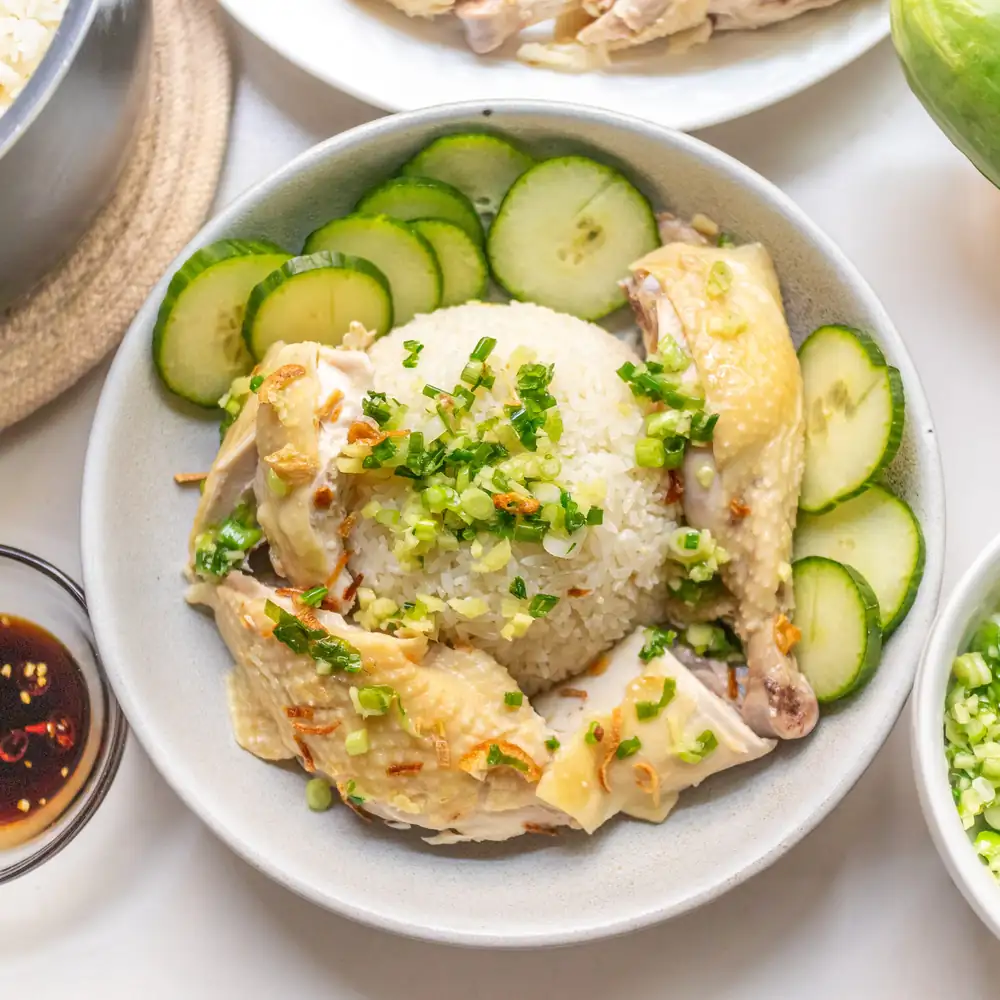
Hainanese Chicken Rice (Cơm Gà Hải Nam)
Hainanese Chicken Rice, or Com Ga Hai Nam, may seem like a plain dish, but don’t let it fool you.
- 1 whole free-range chicken (about 2.5 lbs)
- 3 quarts water
- 1 tablespoon and 1/8 teaspoon salt (divided)
- 1 teaspoon and 1/8 teaspoon sugar (divided)
- 1 teaspoon and 1/8 teaspoon MSG (divided)
- 1/2 cup sliced green onions/scallions (about 8 small sprigs)
- 1/2 cup finely minced ginger (about 4-inch piece, divided)
- 3 cups long grain rice
- 1/4 cup neutral oil
- Vietnamese Ginger Fish Sauce (optional)
- Fried shallots (optional)
- Light soy sauce and red chili peppers (optional)
- Rub the chicken inside and out with 1 tablespoon coarse sea salt then rinse, drain and pat dry with paper towels (optional). Using kitchen shears or a sharp knife, remove the chicken fat at the bottom end of the chicken and toes (if any). Tuck the legs back into the cavity.
- Peel the ginger with a metal spoon. Cut ginger into thin circles across the grain then slice thin. Mince into fine pieces. Remove the root ends of the green onions. Thinly slice the remaining green part. Keep both the ginger peel and green onion root ends for the chicken stock.
- Place the whole chicken breast-side up in a large pot and add enough water to cover it, about 3 quarts. It’s fine if the chicken breasts stick out slightly. Add the ginger peels, scallion root ends, salt, sugar, and MSG if using. Crank up heat to high to quickly bring the pot to a boil then lower to a gentle simmer. This should take about 8 minutes. Cook, uncovered, for 30 minutes, flipping the chicken halfway through to ensure even cooking. After 30 minutes, turn off the heat and cover the pot with a lid. Let the chicken poach in the residual heat for 15 minutes.
- Remove the chicken and immediately transfer it to an ice water bath for 10 minutes. Remove the ginger peels and scallion root ends from the stock and set it aside for the rice later. Take the chicken out of the ice water bath and pat it dry with paper towels.
- Use a large meat cleaver to chop the chicken into bite-sized bone-in pieces. Transfer the pieces to a serving bowl and garnish with fried shallots (optional).
- Rinse the rice until water runs clears, drain completely dry and set aside. Add chicken fat to a large skillet and heat over medium-high until it renders into a small pool of oil. Remove and discard the solid pieces if desired, or leave them in. Add minced ginger (about 1/4 cup) and pan fry the ginger in the rendered oil until fragrant (about 1 minute). Add cleaned rice. Gently toss around so all the grains are nicely toasted with a very light golden color (about 10 minutes).
- Transfer the toasted rice to a rice cooker. Add 3-3/4 cups of chicken stock into the rice cooker. Cook on the plain rice setting on the rice cooker (about 30 minutes).
- Heat up a small pan with neutral oil until smoking (about 4 minutes). Slowly and carefully pour the hot oil over the scallion and ginger. Add the remaining ginger (1/4 cup) and thinly sliced green onions to a heat-proof bowl. Add a pinch each (1/8 teaspoon) of salt, sugar and MSG (optional). Mix until combined.
- For a pretty presentation, add rice into a small bowl and flip it onto a plate. Add sliced chicken and ginger-scallion sauce. You can also serve with thinly sliced cucumber and optional soy sauce or chili peppers on the side for further tableside customization.
This dish is packed with flavor. It uses a lot of ginger and green onions, so if you have ginger and green onions to use up, this is the recipe for you.
Hainanese chicken rice is a popular dish across Asia, with roots tracing back to Hainan, China. The popularity of Hainanese chicken rice also spans Southeast Asia and it is considered the national dish of Singapore.
In fact, I first learned about Hainanese Chicken Rice while watching Anthony Bourdain on No Reservations during the Singapore episode.
Singapore is not in my near future just yet so that means making Hainanese chicken rice at home.
What is Hainanese Chicken Rice?
Hainanese chicken rice consists of juicy, tender poached chicken and fragrant ginger rice, served with a green ginger-scallion sauce. It’s also typically accompanied by soy sauce and a red chili sauce.
In Vietnamese cuisine, this popular dish is known as Cơm Gà Hải Nam or simply, Cơm Gà.
The main difference lies in the sauce. Vietnamese cơm gà is often paired with a ginger fish sauce instead of the traditional sauces enjoyed in Hainan or Singapore.
Aside from this variation, everything else remains essentially the same.
What Makes It Unique?
Here are the top reasons Hainanese chicken rice is so popular and why you’ll love it too:
- Silky Poached Chicken: The chicken is gently poached, then shocked in an ice bath to gelatinize the skin, making it incredibly silky.
- Fragrant Rice: Rice is toasted with rendered chicken fat (from the chicken) and fresh ginger. The poaching broth is used as a flavorful base to cook the rice. Yes, we are building lots of flavor here.
- Sauces: Traditionally served with three sauces: a green ginger-scallion sauce, a red chili sauce, and a dark colored soy sauce. If you are looking for the Vietnamese version, pair the chicken with ginger fish sauce (nước mắm gừng instead. No need to make all the sauces. Pick and choose your favorites.
- Chicken: A whole chicken is traditionally used for a flavorful stock. Free-range chicken is preferred for the most authentic choice. Free-range or “walking chicken” (gà đi bộ) provides firm and chewy texture which is loved by many Vietnamese. However, feel free to use any chicken of your choice or a variety of chicken parts, such as bone-in thighs and drumsticks.
- Rice: Jasmine rice, which is a type of long-grain white rice, is used in this dish.
- Seasonings: Salt, granulated white cane sugar, and MSG. If you prefer not to use MSG, simply omit it. For seasoning, I use fine-ground sea salt. If you’re like me and wash your chicken, I recommend using coarse-ground sea salt to rub the chicken skin. This helps remove any surface residue that might cause a strong poultry smell and leaves the skin clean and pristine.
- Green onions and ginger: These are the essential aromatics. The ginger and green onion scrapes are used to make the chicken stock, while the main part is used in the ginger-scallion green sauce.
- Light soy sauce and red chili peppers: Optional accompaniments that you can add at tableside for additional flavor.
- Vietnamese Ginger Fish Sauce: If you like the Vietnamese version, check out my ginger fish sauce recipe.
- Vegetables: Optional if you want a more balance meal. Cucumber slices are the go-to vegetable that adds a fresh crunch to complete the meal. If you prefer cooked vegetables, consider blanched bok choy. Use some of the delicious chicken stock to blanch it to the desired tenderness.
I’m whole using a whole free-range chicken from the Asian grocery store which comes with head, feet, toes and all. So a little prep is needed.
If you aren’t one to clean or wash chicken for fear of spreading bacteria, skip the first step and proceed to trimming the fat.
Rub the chicken inside and out with 1 tablespoon coarse sea salt then rinse clean. Pat dry with paper towels.
Using kitchen shears or a sharp knife, remove the chicken fat at the bottom end of the chicken. Set aside.
Remove toes (if any).
Tuck the legs back into the cavity.
Peel the ginger with a metal spoon for best results. Keep the ginger peel for the chicken stock. Cut ginger into thin circles across the grain then slice thin. Mince into fine pieces.
Remove the root ends of the green onions. Keep these root ends for the chicken stock as well. Thinly slice the remaining green part. Set aside.
Place the chicken breast-side up in a large pot and add enough water to cover it, about 3 quarts. It’s fine if the chicken breasts stick out slightly.
Add the ginger peels, scallion root ends, salt, sugar, and MSG if using.
Crank up heat to high to quickly bring the pot to a boil then lower to a gentle simmer. This should take about 8 minutes.
Poach the chicken, uncovered, for 30 minutes, flipping the chicken halfway through to ensure even cooking. Remember, this is a small free-range chicken (about 2.5 lbs) so 30 minutes is really all you need.
After 30 minutes, turn off the heat and cover the pot with a lid. Let the chicken poach in the residual heat for 15 minutes.
Carefully remove the chicken and immediately transfer it to an ice water bath for 10 minutes. This step ensures the chicken skin remains silky, the signature texture of Hainanese and other Asian-style poached chicken.
Take the chicken out of the ice water bath and pat it dry with paper towels.