Fool-Proof Poached Eggs Recipe
Poached eggs are healthy, delicious, and yet surprisingly tricky to make properly. For such a simple concept — eggs cooked in water (sans shells, otherwise they'd be soft-boiled) — why are they so darn hard to get right?
“whites. She also advises that you strain the eggs before cooking as this will again reduce the moisture content. If you do so, she says,”
Dalton does, however, have a few more eggs-pert poaching tips to avoid common egg-poaching mistakes. For one thing, she says to use fresh eggs as ones that are older have more water in them, something that she says leads to "wispy" whites. She also advises that you strain the eggs before cooking as this will again reduce the moisture content. If you do so, she says, "You should find that your poached eggs will be firm and hold their shape."
You'll only need 2 ingredients (plus water) for these poached eggs
You know what they say, in order to make poached eggs, you've got to break a few eggs. As this is a recipe for a single egg, that's all you're going to need, although you will also be using water for cooking as well as some vinegar to add to the water. The plain white distilled kind is fine, although if you don't mind pouring more expensive vinegar down the drain, any kind will do.
You might want to gather up the necessary kitchen tools, now, too. In addition to a pot to boil the water, you'll need the aforementioned strainer (a fine mesh one) plus a whisk and a slotted spoon. If you have any ramekins to hand, you can put one of these to use, as well. No ramekins? A mug will do just fine. As to what you're using it for, Dalton says putting the egg into such a container before sliding it into the water "helps the cooking process and keeps the poached eggs perfect."
Strain the egg
Crack the egg open, then decant it into a strainer. Be gentle here as you want the egg to remain intact, and the straining is just to eliminate any excess drops of water. After straining the egg, slide it into a ramekin or cup.
Boil the water
Boil the water, then, when it is boiling, add the vinegar and stir it in. Take a whisk and swirl the water into a vortex, being careful not to splash yourself with any hot water. Boiling water burns are no yolking matter! (Eggs-cuse us, we couldn't resist.)
Poach the egg
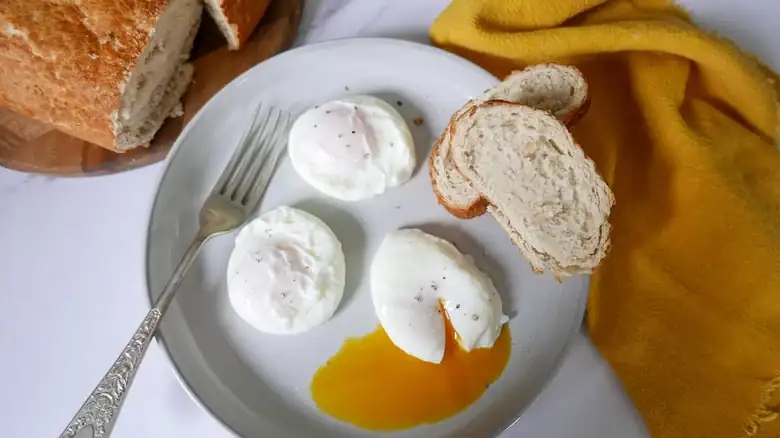
Slide that egg into the water vortex, then let it cook (stop whisking!) for 3 minutes. At this point, take a slotted spoon and remove the egg from the water. Use a paper towel to blot the wet egg and dry it off a bit, since otherwise you may wind up with soggy toast. Dalton says, "Just season [the eggs] with some black pepper and salt and they're perfect," but also suggests serving them with toast or bread, on salads, and/or accompanied by bacon, sausage, smoked salmon, or avocados.
Dalton also points out that poached eggs can be made ahead of time, but advises putting each just-poached egg into an ice water bath to stop the cooking. The egg can be refrigerated and then reheated for 30 seconds in simmering water to make an eggs-cellent second-day meal.