Two guys brought a real neighborhood pizzeria to Paris
In Paris, pizza has become a universal language. It's spoken everywhere, in a thousand different accents, often very correct, almost always technical. But you rarely find a pizzeria that doesn't seem "thought out," designed, and meticulously crafted.
The simplicity of La Vittoria pizzeria
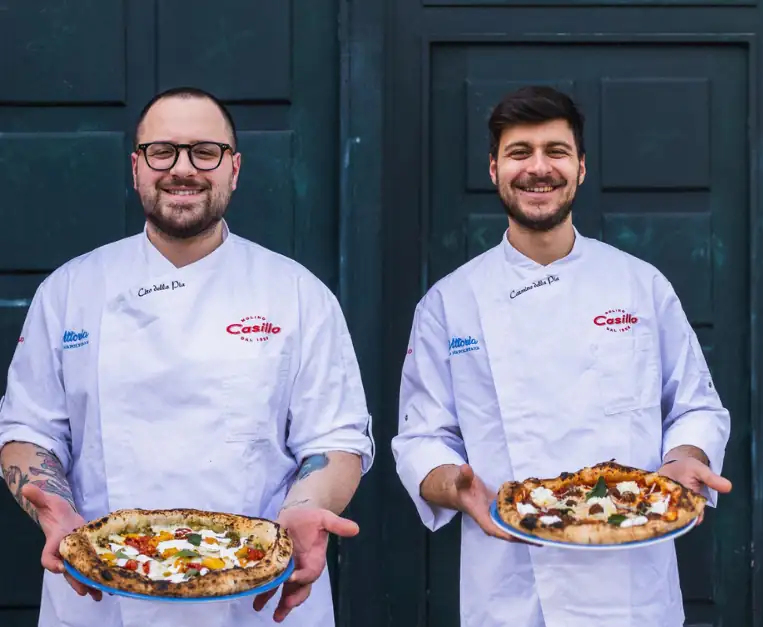
We're in the Marais, one of the city's liveliest, most touristy, and culturally diverse neighborhoods. Inside, however, the atmosphere is that of a family-run pizzeria: minimal frills, warm tones (too much so, the photos you take here won't be very Instagrammable), a nonstop oven, and above all, the feeling of having arrived in a place where pizza is a daily occurrence. La Vittoria is run by brothers Ciro and Carmine Della Pia, Neapolitans who grew up in the restaurant business and arrived in Paris following the classic story of many Italian families abroad. Their mother, Vittoria, is always with them, and she signs the name of the place but, more importantly, embodies its spirit.
You don't come here to "try a Neapolitan pizza in Paris," but to eat pizza like you'd eat it down the street in Naples. And that's a substantial difference. There's no forced Italian aesthetic, no artificial nostalgia, no stage presence. The walls are adorned with numerous references to the city of origin and, above all, to the team of the day, with its two recent championship titles, but it's not tacky: it feels more like walking into a kid's bedroom than into a proper restaurant. The atmosphere is domestic: it's a neighborhood pizzeria transplanted to another city.
How to eat at Carmine and Ciro Della Pia
From a technical standpoint, the approach is solid and deliberate. The dough is distinctly Neapolitan, matured for 48 hours and highly hydrated, never below 70%, and in some cases even higher. The flours are high-quality, and the baking takes place in a gas oven at around 350 degrees, with heat management designed to create a light crust, dry on the outside and soft on the inside.
The result is a pizza that wouldn't be out of place in Campania. In fact, it has everything it takes to be considered an excellent contemporary pizza: airy dough, regular air pockets, clean flavor, and no heaviness. But it never loses its connection to tradition.
The choice of ingredients follows the same logic. Everything that truly matters comes from Italy: San Marzano tomatoes, fiordilatte, DOP buffalo mozzarella, Parmigiano Reggiano, Italian extra virgin olive oil. They don't even make it a statement of principle, but a practical necessity: certain flavors can't be replicated; they simply carry them with them.
La Bufalina is a good starting point for understanding the restaurant's philosophy: tomato, dairy, basil, and olive oil. Nothing else. A clean, linear pizza that thrives on the balance of ingredients. But the true signature dish is the La Vittoria pizza, dedicated to the chef's mother. A direct homage to the Neapolitan Sunday: slow-cooked ragù, fried meatballs, fiordilatte cheese, buffalo ricotta, parmesan, and basil. It's a pizza that speaks of family cooking more than a menu, a laid table more than a menu.
The same goes for the Salsicce e friarielli, another monument to Neapolitan gastronomy: a perfectly executed pizza, with a variety of textures and a depth of flavor. Also worth trying are the Diavola and the Capricciosa: pizzas with cured meats are a good test of the quality of the ingredients used, and here they deliver.
There's more to it than just pizza
Alongside the pizzas, there's a small selection of Campanian cuisine: baked pasta, pasta with tomato sauce, salads with buffalo mozzarella, desserts like pastiera, and during special periods, you'll find tortano, casatiello, and other Neapolitan holiday delicacies.
The most interesting thing, however, remains the human atmosphere. In a city like Paris, where the restaurant industry is almost frigid in its perfection, La Vittoria works because it's imperfect in the right way. There's confusion, there's noise, there's the mother speaking to the customers in Neapolitan, there's the oven dictating the pace. It's a living pizzeria, not a format.
And this is probably its deepest value. La Vittoria isn't a "Neapolitan pizza abroad," but a Neapolitan pizzeria that's simply found in Paris but could be found in Bagnoli, Secondigliano, or Nocera. Without adaptations, without obvious compromises, without the need to explain too much.