Palazuelos: a walled town in the Alcarria region
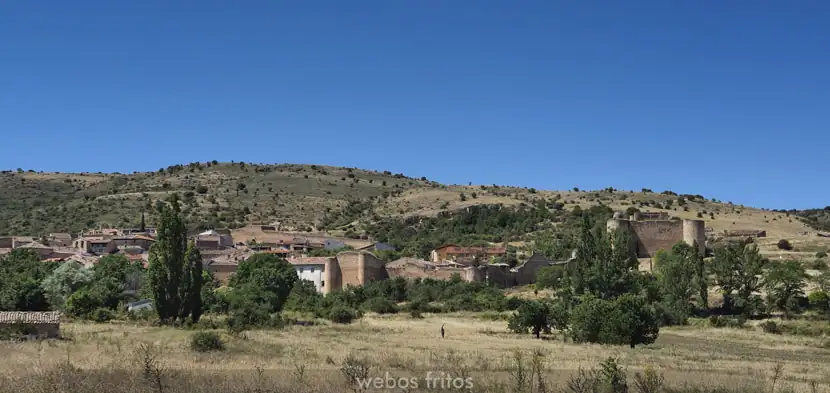
On our Sunday getaways we were very keen to visit Palazuelos, a hamlet in Sigüenza, which we had marked as one of the few medieval sites that are preserved intact in Spain: its walls remain standing almost in their entirety.
Palazuelos, Sigüenza, Guadalajara
We began to enjoy the town by taking a stroll along the outside of the walls. We were wearing comfortable shoes, and our search for views led us down the path to the cemetery—magnificent!
On the way back, before entering the town through the Puerta del Cercao gate, we had a close look at the castle, which is currently privately owned and therefore not open to the public. It was commissioned by Don Íñigo López de Mendoza, the first Marquis of Santillana, around 1454.
We had already researched the town using the map and backpack app and knew that the walls were built in the 15th century, starting from the castle, with small, unhewn stones, forming long sections between towers and turrets. They are about two kilometers long, and you'll be surprised to see how well preserved they are. The coats of arms of the Mendoza and Valencia families, lords of the town throughout its history, can still be seen on the gates.
Once inside the walls, we enjoyed a leisurely stroll through the village streets. There are many stone houses, specifically built of red sandstone, typical of this entire area of the Iberian System, from Sigüenza to the Upper Tagus. We admired the large, rectangular Plaza Mayor, which slopes gently to the northwest. In the center, a raised platform houses the pillory, the larger version of the whipping post used in towns that had the jurisdiction to judge and condemn to death before the Constitution of 1812. The one in Palazuelos still has its iron bars attached to the top.
We continued our walk towards the Church of San Juan Bautista, which dates from the 16th century and was built on the site of an earlier 12th-century church, of which only the doorway facing the square remains. On the southwest side of the square is the priest's house, and to the northeast, the church slopes down to become part of the street and, further down, to house the Fountain of the Seven Spouts, a charming spot. Beyond that, we peered through the Gate of the Fountain, also known as the Gate of the Vega, the only one that isn't angled—the locals told us they believe it has always been that way—and saw the covered washhouse attached to the city wall.
We finished our visit by walking along the outside of the walls, exiting through the Puerta de la Villa (Town Gate), and re-entering through the Puerta del Monte (Mountain Gate). Given our love for bread, we couldn't resist stopping at the oven, which had been out of use for many years and was restored by José Luis de la Fuente Soria in 2018. Although it's closed, you can visit: the key is hanging on the door, and there's a pencil and paper if you'd like to sign it. Interesting.
The castle and the walled complex of Palazuelos were declared a Historical-Artistic Monument by decree of June 15, 1951.
Carabias
We had some time before heading home, so we went to Carabias, another hamlet in the municipality of Sigüenza, to see its Romanesque church of El Salvador. It's a simple and beautiful church, preserving its 13th-century medieval structure in the remains of its floor plan, its southern portal, and its east-facing apse; the rest are later additions or renovations. It immediately reminded us of the church in Saúca, just a few kilometers away.
Are
Your kitchen with
Our suppliers offer you special advantages. Being a web user means a guaranteed gift….