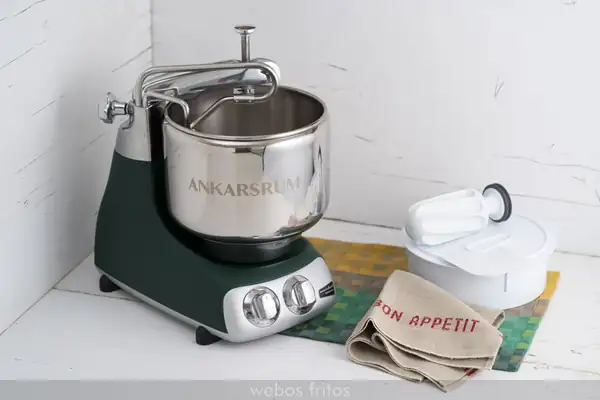
Three bread recipes using the same dough in an Ankarsrum mixer
One of the most important characteristics of the
Ingredients · Servings 6
- 930 g water
- 30g fresh baker's yeast (—or 10g dried baker's yeast—)
- 1500 g bread flour (—or strong flour—)
- 30 g of salt
Method · 3 h
- Assemble the roller as shown in the video.
- Put the water and crumbled yeast in the bowl of your Ankarsrum mixer and program for 1 minute at low speed.
- Add the flour and knead at low speed for 5 minutes. Add the salt a couple of minutes before the end of the cycle—don't forget, it's very easy! After this time, secure the rolling pin in the center of the bowl and stop the machine for 5 minutes. Then, knead for another 5 minutes until the dough is ready.
- Turn the dough out onto the counter and shape it into a ball. Then, shape it into a long, thick loaf and divide it into three pieces. Shape each piece into a ball, prepare three bowls, lightly grease them with extra virgin olive oil, and let the dough balls rest in them, covered with plastic wrap, for 1 hour.
- With these three doughs, we're going to make three loaves of bread. I'll explain how to shape each loaf separately: a sandwich loaf, an oil loaf, and a round loaf. But keep in mind that the order changes during baking, and we'll bake the oil loaf last.
- After that time, place one of the doughs on the counter, take one of the edges and bring it to the center, as you see in the video, take the opposite edge and bring it to the center as well, and close the sides as if it were a package. Make another fold and close the ends again.
- Place the seeds you want on a plate, turn your dough out onto the plate, on the side opposite the seam, press lightly so the seeds adhere, place it in the mold for its second rise and cover it with plastic wrap. Let it rise for one hour.
- Preheat the oven to 220ºC. After the rising time, lower the temperature to 200ºC and bake for approximately 30 minutes.
- Place the dough on the countertop, put a little oil on your hands, gently stretch the dough and place it in a rectangular mold previously greased with extra virgin olive oil.
- Cover it with plastic wrap. Let it rise for an hour outside the kitchen, in a slightly cooler room. You can even put it in the refrigerator for the last 15 minutes to slow down this second rise while the other loaves bake.
- Heads up! This is the moment when you have to shape and bake the loaf.
- When the loaf is already baked and the loaf has about 10 minutes left to complete its 45 minutes in the oven, take the oil bread dough out of the fridge, pour a good amount of oil over it and insert your fingers into the surface.
- When you take the loaf out of the oven, bake your olive oil bread at 200ºC for approximately 35 minutes, until it has a nice golden color.
- Remove your dough from the bowl to the counter, pinching the edges towards the center as you seal. Turn the dough over and let it rest for 1 hour covered with a floured cloth.
- After an hour, score your dough with a cutter, just before putting it in the oven, not before.
- Preheat the oven to 220ºC. Bake your loaf for 5 minutes at 220ºC and then for another 30 minutes at 200ºC, using the top and bottom heating elements. After this time, remove it to a wire rack to cool.
Three bread recipes using the same dough in an Ankarsrum mixer
At the table
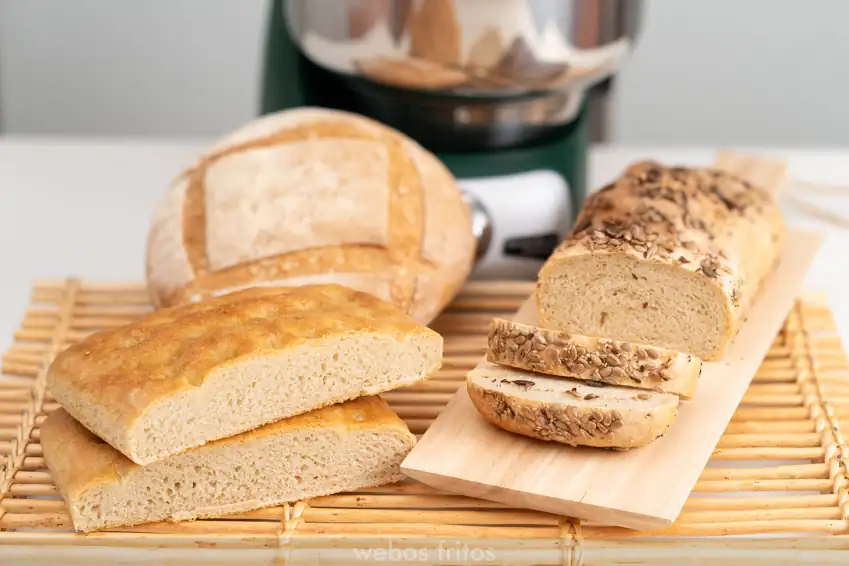
Three loaves of bread
Sliced bread with sunflower seeds
Olive oil bread