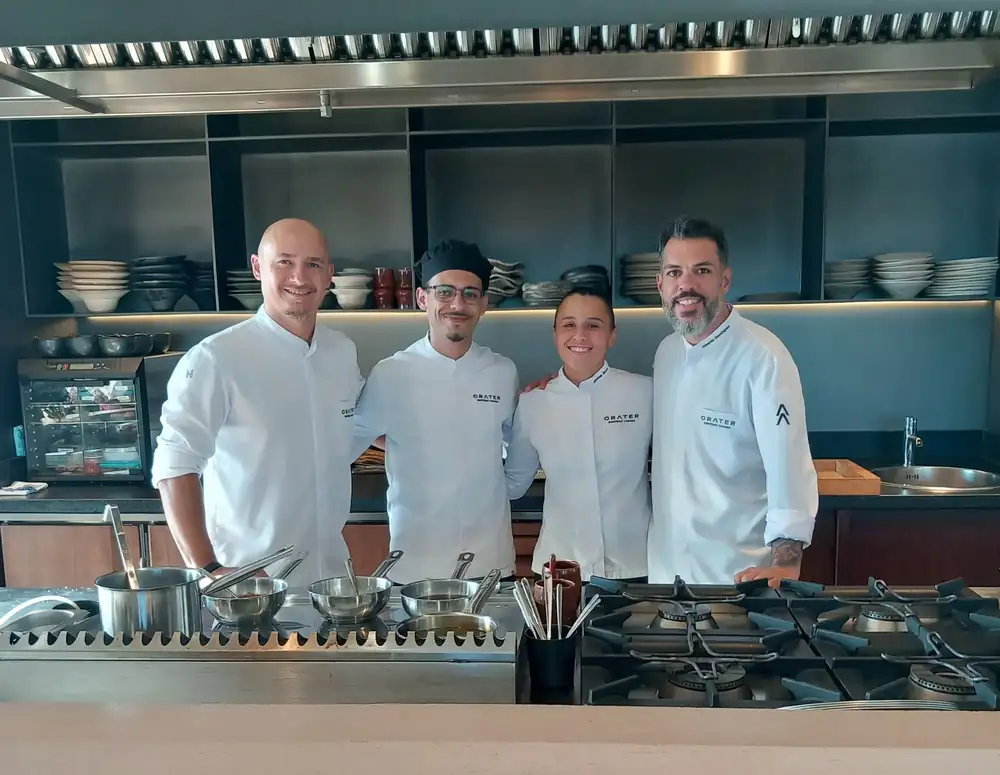
Crater aims to be an interpretation center for Canarian cuisine
Amidst the silence of white lines, exposed concrete, and immense glass walls that open onto the infinite blue, surrounded by exquisite landscaping, lies Cráter, a restaurant that embodies Canarian identity.
Domínguez and his entire team have spent weeks on La Palma, known as the "Beautiful Island," researching and working with the Agrobiodiversity Center on unusual varieties such as pelón wheat, so named because it lacks ground cover, making it very unproductive; butter beans; rye; and tomatoes. They have created a 15-course menu called "The Dance of the Dwarfs." And here a brief digression is necessary. In 2025, La Palma is celebrating its most anticipated quinquennial festivities, which, after the pandemic, have been extended from five to ten years. The festival in honor of Our Lady of the Snows is a blend of religion, folklore, and popular culture, culminating in the "Dance of the Dwarfs," a festival in which 24 figures dressed in robes pass through a booth, magically transforming into dwarfs and parading to the rhythm of a polka, to the astonishment of young and old alike.
The July breeze becomes light, the afternoon light slowly travels across the horizon opposite the port of Los Cristianos and behind us the Roque Ayo, when the head waiter, Estalin Cando, an Ecuadorian seasoned at the best tables of half the world, offers us the last bottle of the Listán Blanco Vidonia 2023 (DO Valle de La Orotava), a fresh, fruity white wine, with a slight salinity and very well balanced… And let the dancing begin!
The first course, the cardinal points: a four-piece puzzle representing La Palma. The south, Fuencaliente, with a mini brioche of chorizo “perro” (a type of sobrasada) typical of the grape harvest; the west, Garafía and its almond tradition, transformed into a delicious trompe l'oeil; the north, the Gallegos area with a yam profiterole topped with salt cod; and the east, Punta Llana, with its cheeses, in this case from Barbusanos, nestled between thin biscuits. All accompanied by homemade mead made with a plant called corazoncillo.
Zulay's bread from La Palma is a dreamy, fluffy, and crispy treat, made with local wheat and rye. It's accompanied by goat's butter and another butter infused with the aroma of almond shell, leading into the La Gala tomato. Young Byan displays an enormous jar of fermented tomatoes for this delightful, luminous, and festive creation: a tomato sorbet that captures fig oil and pearls of pickled tomato.
"Escachón" is a dish made from leftover potatoes, cheese, mojo sauce, and gofio (toasted cornmeal)... traditionally served with fruit. It might seem like a tough combination for someone unfamiliar with gofio, but Eduardo brilliantly synthesizes it into a finely crafted "escachón" accompanied by a fermented Listán Prieta grape.
A basket overflowing with sun-dried corn cobs fills the room with color, taking center stage in an ode to the island's most emblematic stew: caldo millo (corn soup). Silky smooth, it's topped with delicate cubes of cured mackerel, pickled chayote, and finished with grated roe, adding a touch of sparkle. And, from the so-called "beautiful island," its famous peppercorns, the essential base of mojo rojo (red mojo sauce), are a must. Presented in sun-dried strings, they come in three varieties: pickled, oxidized, and aged, alongside pristine slices of bigeye tuna belly (Thunnus obesus). An exquisite harmony of fish and mojo, with a subtle smoky aftertaste.
Eduardo's picadillo soup (beef and chicken) is distilled into a creamy croquette, touched with cured egg yolk and cured beef from La Palma, served with a bowl of the clear, flavorful, and comforting broth. Moving on to the spoon... The malted wheat stew is a rich and alluring reduction, nestled between a beef royal and a gofio butter foam. Pure elegance.
The stew of butter beans and salted moray eel is a polyphonic and primal bite that pulls us from the sea to the land in a kind of subtlety that transports us to the deepest north of the island. And in a single flight, we cross the island from end to end, to arrive in Fuencaliente with its black grouper stew, in its own pil-pil sauce, Marcila potatoes, green peppercorn sabayon, seaweed, and limpet garum that lends it the aroma of a subtle sea breeze.
In the Canary Islands, there are four goat breeds: the two from northern and southern Tenerife, the Majorera (Fuerteventura), and the Palmera. The traditional goat stew arrives wrapped in a very thin slice of pork jowl, served on its own demi-glace and topped with slivered almonds. These are bites of pure indulgence, bursting with flavor, and perfectly complemented by a steamed goat's milk bread, essential for dipping and mopping up the sauce.
The Canarian Academy of Language has registered the word "borrallera": "A grill where potatoes, sweet potatoes, etc. are prepared over the embers of a small bonfire made in a hollow in the ground" (used in La Palma). It should be added that this was done to accompany pork. The sweet potato, with its demi-glace made from its skin, is a delicacy, and in another bite, the crispy pork terrine with salted bacon purée is a delicate interpretation of the original.
La Palma vs sweet world
Canarians, in general, have a sweet tooth—a real sweet tooth. Whether it's the climate or something else, this is exponentially amplified in La Palma. Their traditional desserts—bienmesabe (almond, cinnamon, egg), Príncipe Alberto (eggs, almond, and chocolate), rapadura (honey, gofio, almond)—are explosions of sugar, twisted to the extreme. The young pastry chef Micaela Taroco contorts them into delicate reminders of that caramelized reality. Like the goat's milk kefir, a cloud of cheese, and a sorbet of pineapple roasted in a traditional Canarian oven—fresh and luminous.
And in a triple somersault comes the union of chocolate and red mojo sauce, in what they call 'chocomojo', with gofio cream, biscuit coulis, and tedera mead (from a wild plant). A grand finale to an immersive dream that we sealed with a naturally sweet 2011 late-harvest wine from Bodegas Teneguía (Fuencaliente, La Palma) to unravel the petit fours hidden in the dwarf's hat (we got number 3): pickled banana tart; bienmesabe; malpaís (black rock and salt); and Príncipe Alberto.
Very gastronomic villas
In just four months since its opening, Corales Villas continues to follow the culinary DNA instilled by Fernando Turnés, director of Barceló on the island and of the Hotel Royal Hideaway Corales Resort (El Rincón de Juan Carlos, San Hô, and Il Bocconcino). Therefore, before heading to Cráter, it's worth stopping by Materia Elemental Bar, where the award-winning mixologist Jonathan Mesa has free rein to experiment with the four elements: earth, fire, sea, and air, using them to create his signature cocktails, starting with classics like the Negroni or the Pisco Sour.
And if we extend our stay, we must enjoy the rest of the hotel's offerings, which are managed by executive chef Alejandro Garrido (formerly of Haydée), such as Materia Pool Bar with its crispy Iberian croquettes; the rich homemade tuna belly salad with organic tomatoes; a delicious steak tartare of matured sirloin, piparras peppers and cured egg yolk; or an impeccable Molino Roca rice with 15-day aged sea bass.
Crater – Canarian Identity
Address: Royal Hideaway Corales Villas C. Alcojora, s/n,, Adeje, Canary Islands.