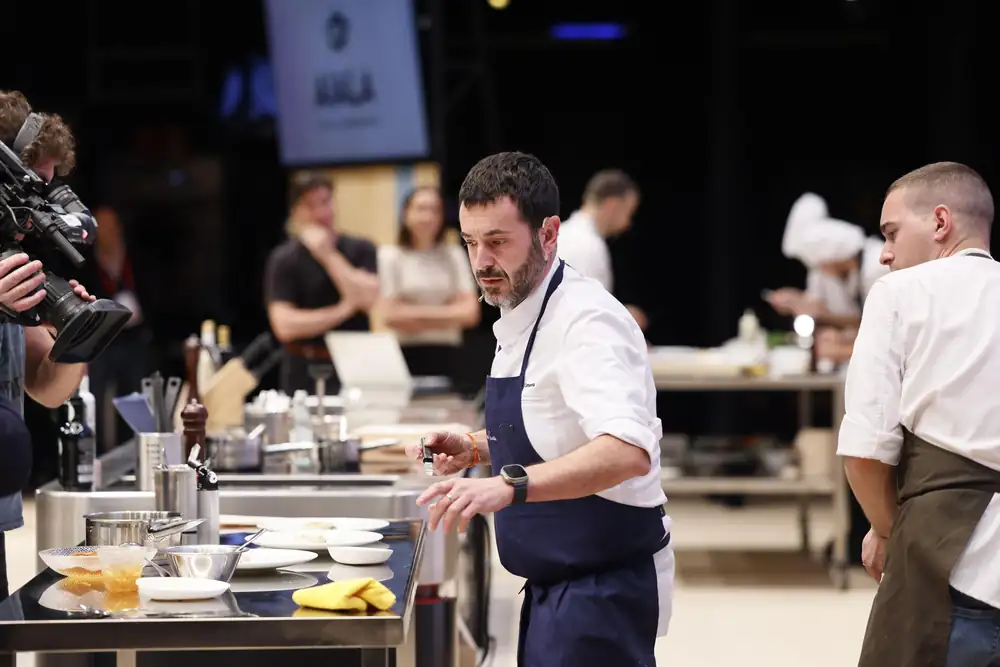
Ricard Camarena beats AI
AI can provide solutions, but it lacks a soul. Ricard Camarena, however, brought a soul to his dishes, according to the jury who tasted them.
On one side was Ricard Camarena, from Valencia, one of the most brilliant chefs of our time, accustomed to improvising dishes at other gastronomic congresses, making use of the local ingredients available to him. On the other was ChatGPT, assisted by scientists Eneko Axpe and Laia Badal and chef Daniel Barrionuevo, whose role was limited to executing the instructions dictated by the artificial intelligence.
While the Valencian chef relied on his experience, sensitivity, and skill—all difficult to quantify—the machine had instant access to the vast amount of gastronomic content published online. This “unprecedented” experiment yielded a reassuring result, as the jury's verdict revealed that artificial intelligence is not yet capable of surpassing human creativity. “His dishes lack soul; they are correct, but they don't move you,” said José Carlos Capel, Joan Roca, and Manuel Villanueva. They had tasted the menu without knowing which team each dish belonged to, but they quickly recognized Camarena's free-flowing style, his meticulous preparation, and his desire to extract the maximum flavor from each ingredient.
The details of the duel had been established just 24 hours before, through a procedure that left a great deal to chance. For the starters, the audience selected five ingredients—potatoes, oysters, figs, albacore tuna, and chestnuts—which could be seasoned with a range of pantry staples such as oil, vinegar, salt, and pepper. For the main course, both contestants had to start with hake and incorporate two techniques, also chosen by the audience: salt curing and grilling. For dessert, they had to reinterpret carrot cake. The initial conclusion is that Camarena made things much more difficult for himself than the machine, but the result was well worth the effort.
The artificial intelligence presented impressive dishes, worthy of a top restaurant menu, but they failed to move the experts, at least not as much as the Valencian chef, who could cook the bonito head to the extreme in oyster water to obtain a potent gel, rich in collagen, or cure hake in anchovy brine. It is these moments of madness, this human capacity to forgo shortcuts, even to allow for error, that the machine is incapable of imitating, at least for now. In its defense, we must say that there was a tie in the dessert category, but only because none of the deconstructed dishes presented convinced the jury.
A new way of cooking is born
Eneko Axpe may have lost the challenge to Camarena, but he could earn millions with the invention he presented minutes later alongside chef Julen Baz of Garena in Biscay, a device poised to revolutionize the way we cook, even at home, and reduce CO2 emissions in the process. The idea came to him during a walk through the Dima farmhouse where Baz cooks, at a meeting with young creatives. Axpe—who, despite holding a doctorate in Physics, is one of the most interesting figures in contemporary gastronomy—was captivated by a statue of a Basque farmer, cleanly sliced from top to bottom by a lightning strike. “What if we cooked with an electrical discharge similar to that of lightning?”
Working with electronics expert Jon Sola, Axpe and Baz have devised a system of two overlapping plates, "but instead of heating a heating element like traditional griddles, the food itself acts as the heating element," they explain. With this system, they can cook a steak to perfection in just over 10 seconds, while also drastically reducing emissions.
The equivalent amount of carbon dioxide released when cooking one steak on the barbecue can be used to prepare 29 steaks on a griddle, and—get this—4,500 with this revolutionary system that the three young men from Biscay quickly patented. Andoni Luis Aduriz was tasked with testing the effects: “This is what culinary conferences are for; what frustrates me is that I didn't think of it myself.”
Bar claim
And amidst all the technology in the Kursaal auditorium, the First Forum of Taverns and Tavern Keepers celebrated these people and places. The charismatic Sacha Hormaechea, chef and heart and soul of Sacha, Botillería y Fogón, received the San Sebastián Gastronomika Master Tavern Keeper Award. “All good tavern keepers are like you in some way, but you're unlike any other. Thank you, Sacha, for being such an inspiration to us,” said Benjamín Lana, CEO of Vocento Gastronomía, as he presented the award, which Sacha dedicated “to my fellow true tavern keepers and, in general, to everyone for whom the bar is a cornerstone of their lives.”
The day's theme focused on analyzing the current situation and challenges of different types of taverns. Establishments renowned for their products were represented by Paco Martín, from Bar FM in Granada, famous for its seafood; César Álvarez, from A Fuchela, a temple of Galician-style octopus in O Carballiño; and Carlos Castelló, from Piripi in Alicante, one of the bars with the largest and best variety of tapas on the Levantine coast. In this sector of bars based on the excellence of their raw materials, the main concern is the increase in prices of products like shellfish and fish, and the resulting scarcity. "We used to bring in enormous langoustines. Now we have to settle for smaller ones, but what I can't do at FM today is not have prawns, baby squid, and dried octopus, which are our signature dishes," confessed the Granada native.
Gastronomic taverns were also discussed. The format was analyzed by Ricard Camarena, representing his Bar X and Central Bar (Valencia); José Álvarez, chef of La Costa and La Barra de José Álvarez (El Ejido); Nacho Solana, of the restaurant La Solana and the bar La Bien Aparecida, in Ampuero (Cantabria); and Gorka Txapartegi, of the restaurant Alameda and Taberna del Alameda. In all cases, the chefs combine Michelin-starred restaurants with more popular formats that allow them to "stay connected with the local public," in Solana's words; "offer quality bites that are more affordable and fun," according to José Álvarez; or "please a clientele that wouldn't connect with fine dining," in Txapartegi's words.
The day concluded with a discussion by Sacha Hormaechea, Juanjo López of La Tasquita (Madrid), Pepe Solla of Casa Solla, and Edorta Lamo of Arrea!, who spoke about "Restaurants with a Tavern Soul." They agreed that the human touch and the desire to establish direct communication with the customer are what define these types of businesses. Sacha Hormaechea invited the many bar and tavern owners who filled the room to participate, and the conversation turned into an emotional, heartfelt, and nostalgic ode to bars. "Places disappear because we stop going. If we feel that these establishments are a part of us, we must support them," Hormaechea urged. Juanjo López also called for institutional support through administrative measures that would ensure their survival.
Competitions
Gastronomika loves competitions, and so does its audience. The Russian salad prize went to Alen Tarrío of Pampín Bar (Santiago de Compostela) – you can read all the details here – and the fish soup prize went to A Coruña thanks to chef José Manuel Mallón of Remollo, for his creation with hake and pollock thickened with mussels and including toasted brandy, toasted pomace brandy, seaweed, and Cea bread.