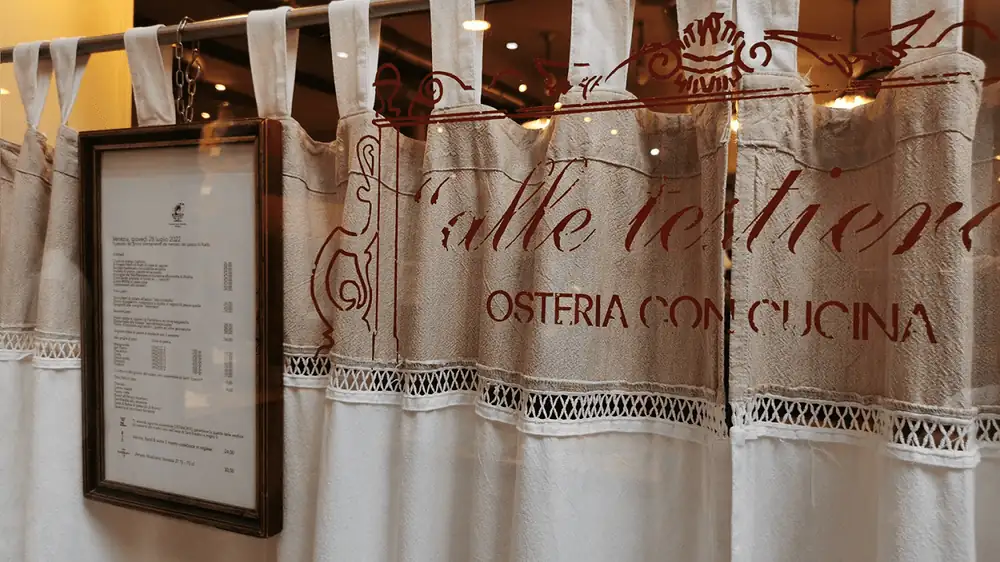
Osteria Alle Testiere, Venice, review: a tiny certainty
The latest to sing the praises of Venice's Osteria alle Testiere was the Guardian, which cited Luca Di Vita and Bruno Gavagnin's restaurant in an article published in February dedicated to "50 things we love in the food world right now." Before the Guardian, however, other publications—both foreign and Italian—had covered the tiny Venetian address, located just steps from Campo Santa Maria Formosa
The history of the place
In 1993, Bruno and Luca, both with solid experience in the restaurant world, decided to take over an old restaurant: the idea was to create a place where they could combine their professionalism and talents. The previous sign read "Da Mario," but from the clearing of objects and furniture found during the restoration, which uncovered old headboards, the name with a capital letter was born; the 1930s headboards were given a new lease of life, becoming bottle holders. While it's certainly tempting to think that the calle's legacy played a role in the establishment's fate (historical documents dating back to the late 16th century and descriptions from the mid-18th century testify that the calle housed a magazen or a bastion, which in the city's colorful denomination represented various variations of establishments used for the sale of wine), it's more concrete to look at the perseverance with which, over the course of thirty years, a certain work and a certain style—never abandoned and a stylistic signature, one might say—have built a well-deserved reputation.
Le Testiere's strength, and what appears to be its disadvantage, is its size: in Venice, upon closer inspection, small spaces are a constant, and when applied to the restaurant, this becomes a daily struggle with environments more akin to Artemio's apartment in "The Country Boy" than professional kitchens. While in any other context, the concept of "small is beautiful" and "intimate atmosphere" can be appealing, in this case, navigating a space of just a few square meters becomes an acrobatic exercise. Let's just say that Le Testiere found itself confronted with an extreme take on small, reaching for the minuscule, but turning it to its advantage, making it a distinctive feature and defining element of the menu itself. The impossibility of stocking large quantities of goods has, in fact, meant that the kitchen has truly become a manifesto in honor of the much-vaunted "market availability" elsewhere: the spaces shape the menu, to the undoubted delight of the customers' palates.
The solidity of Le Testiere, which has brought it fame and success, is due to one of those rare combinations where the dining room and kitchen complement each other, perfectly attuned to one another. Just as Bruno's cuisine seeks to showcase the Venetian region, transcending banality and showcasing its best side, incorporating historical and cultural references, so too does the dining room, which in Luca's hands becomes a place of conviviality and immediate trust, yet manages to avoid both the risk of overstepping the bounds of the relationship with the diner (that is, the forced friendliness, elsewhere drawn out in caricature and buffoonery, is absent here) and the risk of turning the maître d' into a know-it-all actor displaying his skills. Balance and elegance, in short, are the hallmarks and inspire both the dishes (which never involve extreme choices, whether in flavor or pairings) and the management of the restaurant. It's no coincidence that the clientele is almost evenly split between locals and foreigners. Among the latter, however, a sort of natural selection takes place, combining curiosity, an appreciation for food, and a cultural level. This isn't snobbery, however: in the long and exhausting debate that periodically resurfaces regarding the quality and level of tourism in Venice, the enjoyment of the city, and its "consumption," it's safe to say that Testiere's clientele is exactly what Venice desires and what the city deserves. In closing, but as a detail that helps understand the character of the two partners, it's worth mentioning the spirit of collaboration that characterizes their relationships with colleagues, which isn't a given: a spirit that also led to their participation in the Osti in Orto project, which we've mentioned several times.
The place
About ten tables, twenty seats, seven to eight people between the dining room and kitchen. That's the gist of it. A broader look leads one to notice the details: the carefully maintained Venetian flooring, the wooden tables and chairs, the place settings, the striking inlaid counter that immediately appears upon entering, the headboards hanging on the walls, the intelligent lighting, and finally, a collection of newspaper articles on the walls, arranged without showiness and presented in a slideshow fashion. The atmosphere is that of a refined trattoria, with an identity that, while some might consider timeless compared to contemporary offerings, is instead—precisely because it is independent and superior to fashions and trends—paradoxically quite contemporary. What is offered and what is found at Le Testiere is nothing more than substance and quality, food, wine, and hospitality. Frills, both in the furnishings and in the kitchen, are completely absent. Given the size, finding a seat is obviously quite a challenge: the advice is to book early. The practice – now widespread in the city – of operating on a double shift (7pm or 9.30pm) nevertheless allows for a certain margin.
The paper and the plates
Testiere's menu is a blend of contemporary and historical, a blend of everyday purchases at the Rialto fish market and a culture inspired by Venetian cookbooks. The menu changes almost daily and finds its ideal setting in the lagoon: fish, vegetables, and lagoon herbs. It also includes trips outside the region (especially to the south) for traditional Italian products. The rest is done by the kitchen staff, who use ingredients sparingly, without overdoing it, ensuring that the flavors are clean, elegant, and distinctive, transforming simplicity into refinement while simultaneously avoiding repetition and banality. The appetizers (€22-28) are a testament to the world of seafood, including raw fish, steamed mixed fish, creamed fish, historical reminiscences (cassopipa), octopus salad, and indulgent dishes like anchovies and burrata. The first courses (€24) manage to encapsulate everything in three options: spaghetti, fresh stuffed pasta, and gnocchi. Main courses (from €28) feature grilled meats, paired with aromatic herbs and spices, and Mediterranean influences. Desserts (€9) round out the menu: in addition to the ever-present tiramisu, panna cotta, and zabaglione (here served as a semifreddo), it's refreshing to see crema rosada (a dessert more often read than tasted, given its rarity and historicity), regional specialties (tenerina and bonet, here served with Amaro Nostrano, made with herbs from the lagoon), and clever uses of pistachios. The wine list exudes research and care: authenticity, craftsmanship, and a connection to the region are the guiding principles.
The tasting begins with grilled scallops with artichoke stock: just two ingredients for a dish that combines the full flavor and buttery texture of the scallop—to which the grill lends even greater elegance—with the softness of the artichoke, here in the stock version, adding a hint of bitterness. A drizzle of oil and some sprouts are all that's needed. We continue with lobster gnocchi Buranella-style: small in size to avoid vulgarity, soft and with the distinct flavor not only of potato but also of homemade. The gnocchi are here ennobled by the lobster, sumptuous in its sweetness, and colored in character by a hint of tomato in the sauce. The addition of spices arrives at the end, providing a welcome boost for the next bite. A taste of prawns alla busara: usually tried in a version that resembles a combination of separate ingredients (shellfish plus tomato sauce), this version reveals careful attention to detail and skill, allowing you to discover not only a dish tied to the history of the Northeast (origins disputed between Trieste and Venice: perhaps the use of the term "lagoon dish" helps us escape the dead end) but also the value of spices, here in full force, with chili pepper and cinnamon stealing the show. Clarifications about the quality of the shellfish are unnecessary. Polenta and flavorful vegetables round out the dish. A grand finale with pistachio flour cake: elsewhere overexposed and used liberally, here Bronte's green gold finds its true dimension, not too sweet, in the soft cake batter. A scoop of gelato to match.
Rumor has it that next year, to celebrate their thirtieth anniversary, the chefs will offer a street food version of themselves. A journey around Europe, to pay homage to the customers who have flocked to the small space on Calle del Mondo Novo over the years. We recommend keeping an eye on Luca and Bruno's movements. If you can't book in Venice, you can console yourself with stops abroad.
Opinion
In just a handful of square meters (22, to be precise), this tiny Venetian restaurant reveals a grandeur that makes it one of the city's best and most established references. This merit is equally divided between the kitchen (predominantly local ingredients, a study of tradition, top-quality ingredients, and meticulous execution) and the dining room (courteous, competent service that truly captures the essence of conviviality).
PRO
- Dishes with a limited number of ingredients where cheating is impossible.
AGAINST
- Very small dimensions