Venissa Restaurant Review: What's Venice's Green Star Like?
It's significant that to get to Venissa, a Michelin-starred restaurant—and a green star—led by Chiara Pavan and Francesco Brutto, time is part of the "experience," as those in the know like to say.
There are probably no other starred restaurants that can be reached in the same way and it is particularly ironic (in the Pirandellian sense) to observe the discrepancy in dress, on board line 12 – the only one that passes through here – between “normal” tourists and the customers who will cross the threshold of the resort: the Venetian vaporetti, however, are democratic and eliminate class differences, ensuring that those who eat a plate of bigoli in salsa or a slice of pizza in an osteria are squeezed on board exactly like those who will taste a dozen starred courses.
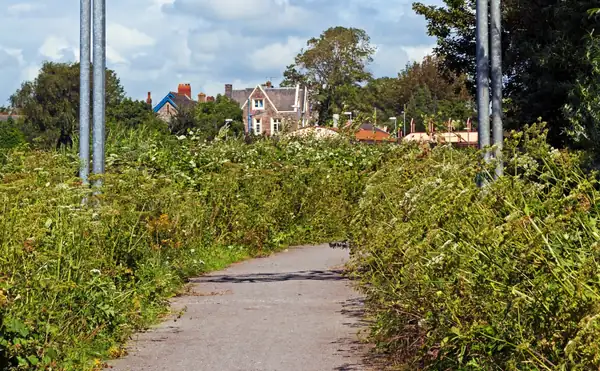
Once you arrive, even for those who are local, the impression is truly that of arriving in a place that, for better or worse (try coming here in winter), is a parenthesis.
The story
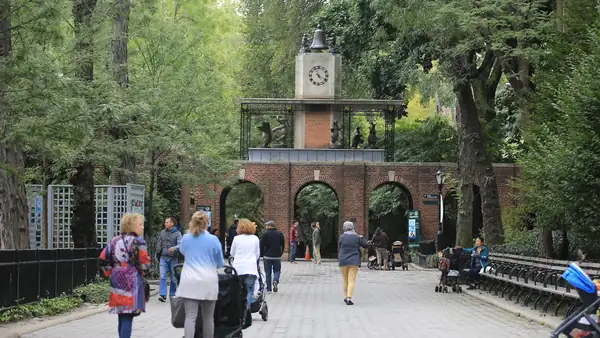
Much has been written about Venissa. For those unfamiliar with its history, here are some key facts: a wine resort, it offers two distinct culinary offerings: the Venissa Restaurant and the Osteria Contemporanea. The estate is located within a walled vineyard open to the public, dating back to the Middle Ages and featuring a 14th-century bell tower. The renovation, revitalization of the vineyard, and creation of a dual dining space were overseen by Gianluca Bisol, a renowned Prosecco producer. In 2006, he planted a vineyard that led to the revitalization and cultivation of the Dorona grape (a native variety) and the creation of Venissa, the true flagship of the winery. In addition to the vineyard, the estate also includes a vegetable garden, managed both by the restaurant and by a group of retired people from Burano, well-versed in agricultural practices and knowledge of the land. In the kitchen, picking up the baton from Paola Budel and Antonia Klugmann is now the couple – in life and in work – formed by Chiara Pavan and Francesco Brutto, the first from Verona, the second from Treviso.
The kitchen
As a programmatic statement, Pavan and Brutto define theirs as "environmental cuisine," an adjective that lends itself to various levels of interpretation: the dishes, first and foremost, obviously describe the surrounding environment; then, equally obviously, there is the turning to the environment as a source of supply—the use of ingredients and raw materials eminently from the lagoon goes precisely in this direction—but then there are two further steps, one connected to the other: adopting a sensitivity to the surrounding context based on observation, respect, almost symbiosis, and then taking a further step, which leads to reflecting on the imprint one leaves on the territory. Just as in other contexts, cuisine is an introduction to a thought—we deliberately avoid using the term "philosophy," which is starting to show its age in the gastronomic context—so too here it is first and foremost a reflection on the contemporary and therefore on the future of the lagoon ecosystem. Almost a constantly evolving laboratory, Venissa offers a privileged vantage point from which to observe the lagoon and its transformations, attempting to stem the weakening of an already compromised balance or at least raise awareness.
This also explains certain choices: using primarily plant-based and alternative proteins, excluding meat, and focusing on certain types of fish. The overall impression is that the menu's "green" orientation only partially reflects trends and fashions: if foraging, restaurants with vegetable gardens, and sustainable and resilient menus are now essential, here the idea of learning from local farmers' traditions and giving ingredients a different purpose that goes beyond the rationale of recycling waste is evident.
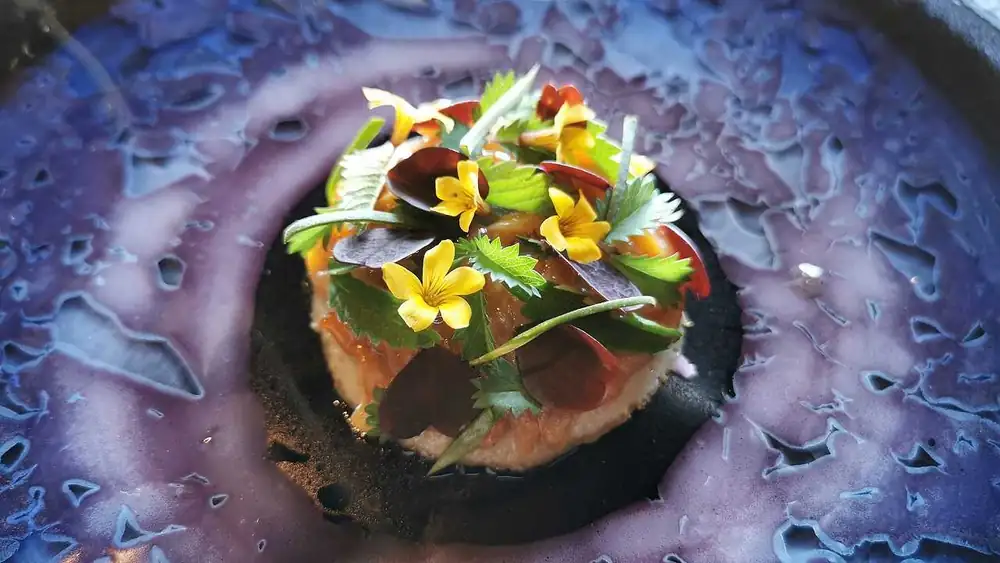
The perception is that the deepest and broadest perspective, in terms of analysis, experimentation, and yield, is on vegetables: from the most classic and comforting dishes to the most innovative, everything contributes to an overall sense of research and pleasure, leaving behind the mere desire to amaze. Wild herbs, cultivated herbs, typical lagoon vegetables, edible flowers, and greens: everything creates a unique and coherent experience, from amuse bouche to desserts.
With meat out of the way, the fish is a lesson in environmental science, entrusting crustaceans, mollusks, and gastropods with the task of explaining the impact of alien and invasive species on the lagoon ecosystem, and then charging those in the kitchen with the role of facilitating diners with how to reduce or contain that impact. The reasoning works almost completely: while species like the blue crab or the venomous rapana are highly enjoyable, a single concern remains—the only one throughout the entire tasting experience—about the use of a specimen (anadara inaequivalvis) that remains unpalatable despite the obvious intent and effort to present it at its best. However, we owe this mollusk, and the dish that featured it, a great debt of gratitude: for forcing those who sit at the table (at Venissa or anywhere else) to seek (and perhaps demand?) that pleasantness, sensory and gustatory pleasure, not be forced to abdicate their role in favor of a reflection—correct and dutiful, of course—on the fate of the world. This isn't mere hedonism, disengagement, or a "let him who wants to be happy be it": it's about recognizing, after much effort, pleasure's rightful place as a tool for knowledge, reflection, and commitment.
The environment
The 2023 season sees a spatial revolution, or rather a reversal: the restaurant moves to the former Osteria, and vice versa. The interior design, materials, lighting, and furnishings continue the gastronomic narrative, playing on colors and nuances that recall natural elements: wood and ceramics narrate the raw materials, and tableware and dishes play on modernity and minimal lines, on the one hand, and reclaimed materials, on the other. The service is excellent and timely in its task of explaining the menu.
The menu and the dishes
There are two tasting menus: a seven-course menu for €150 and a ten-course menu for €17. Among the welcome dishes that open the shorter menu, the ones that deserve special mention are the small folder with lagoon herbs (including glasswort and salsola soda), almonds, and rosole cream—a perfect, almost hypnotic geometry, playing on the tones of bitterness, saltiness, and crunchiness—and the small boat with shell cream. While the anadara bivalvis (with fermented turnip and wild herbs) has already been mentioned, a dish worth the trip is the fried wild chard, stuffed with chard and pickled artichoke plants. A brilliant hand, one that manages not only to transform an agricultural task (shucking) into a dish, not only to make it desirable on the palate, but also to soothe the bitterness of the artichoke, which explodes in its purest essence in the mouth, aided by the crunchiness of the casing and the "curry" created by drying the estate's herbs. Gentle and feminine to the eye, soft on the palate, the blue crab is a nod to art nouveau and Botticelli, playing with the pinks, fuchsias, and purples of spring: the garnishing flowers are those of wisteria. A true signature dish is the mugwort ravioli, wild herbs, and pine nut lactokoji. No flaws for a dish so powerful in its delicacy: the clean and crisp flavor of the mugwort is enhanced by the flavored melted butter and complemented by the sweet and tart pine nuts. After the crab, alien species return with the “rapana venosa”, a predatory gastropod, served with kimchi and fermented bread: decidedly convincing both in terms of flavours and in its intent to draw attention to the theme.
The abandonment of meat has mirrored the challenge of restoring its textures and flavors through something else: here's a mock kebab in which delicious seitan and wild Jerusalem artichokes replace the meat, without nostalgia. Worthy of mention is the pita bread made with Anticamente flours (as well as the bread).
The desserts are perfectly in keeping with the theme, successfully embodying the tradition of French pastry making, interpreting its flavors through the world of plants and the lagoon. A touch of great skill is evident in a refined mint, spinach, and bay leaf ice cream soufflé, where the sugar is expertly measured so as not to overshadow the herbs, but rather to enhance them. Small patisserie in fine form, still in keeping with French tradition. A closing note worthy of a final note: where we increasingly see desserts that emphasize plant-based flavors with a heavy emphasis on acidity, here, on the contrary, the classic is reinterpreted with great sense.
Opinion
With one Michelin star and a Green Star, Venissa is a restaurant nestled in the Venice lagoon, on the island of Mazzorbo. The cuisine, led by Chiara Pavan and Francesco Brutto, respects the surrounding environment with great technique and refinement, drawing inspiration from it with a focus on plants but also, when it comes to fish, on climate change and its impact on the ecosystem. The overall vision, while embracing the "green" and sustainable trend, transcends, focusing on pleasure and flavor.