Antico Caffè Greco in Rome, review: a former glory without laurels
You could almost hear the Candel Waltz playing in the halls of the Antico Caffè Greco on the two occasions we visited this week. Now, comparing the Israelite Hospital to the Stockholm may seem bold, but the historic café on Via Condotti (Rome) undoubtedly resembled a sinking boat.
As usual, when it comes to throwing blind beatings, we forced ourselves to visit several places: a hearty breakfast and an aperitif, suspended between the disappointing and the unreasonable.
The story of Caffè Greco that met History
Before the dissolution, the life of Antico Caffè Greco began with a now mythological founding father, Nicola della Maddalena. It was indeed he, originally from Anatolia, who echoes the Greco in the name. In the second half of the 18th century, Turkey and Greece were closely linked. As the oldest café in Rome and among the oldest in Italy, the Greco has over the years become a hub for art and literature. Currently, it houses over 300 works of art depicting many of the illustrious guests who have graced these historic establishments over the centuries. Among the most frequent and illustrious patrons of the Via Condotti café were many Grand Tour figures, French, German, and English. It is said that Gogol himself wrote part of his masterpiece, Dead Souls, while sipping the coffee at the Greco.
The link between art and Greco is so close that the café itself was the subject of one of Renato Guttuso's most famous works, currently exhibited at the Prado in Madrid.
What the Antico Caffè Greco looks like today
If it weren't for the fact that it's not particularly honourable to mock someone who is dying, one might almost say that now, more than Goethe, one might see Federico Moccia at the tables of the Greco and who knows, maybe soon, in addition to comparing himself to Jack London, our Roman man of letters might come close to, say, Schopenhauer or Byron, for his marked sense of elegance.
Nonetheless, the setting is decidedly monumental and visually compelling, almost dazzling. History, red velvet, gold details, works of art. Then your gaze adjusts to the grandeur, and perhaps, if you're not of Central European origin (or if you're not a big fan of literature), you'll be a little disappointed by the worn seats or the fact that many rooms are covered with elegant burgundy trim, which enhances the museum-like feel but also the theatrical atmosphere during Lent.
Nor is there any greater cheer in the dessert windows just inside the entrance. Tired and uninspiring cakes, a limited variety of mini pastries and pastries in general, huge piles of sandwiches that, however, appear tempting and moist, at least to the eye, and, even worse, the leavened pastries that are truly almost dissuasive.
The menu and prices: how to eat and how to feel at Caffè Greco
Not for us, eager for a proper breakfast. A double coffee: espresso and Americano, or rather, diluted with hot water, served directly in a large cup. A blend specially created for the Greco, even sold pre-ground or in beans. We won't cry tears of joy, but we won't be tense either. Although we did detect a slight burnt aroma, especially in the espresso.
The croissant was more disheartening, filled on the spot so as not to ruin its supposed balance. We chose a custard, anemic and, to stay on the literary theme, almost like a quote from Gianni Rodari: tasteless, odorless!
But more than the cream, it was the (lack of) puff pastry that was most effective. Let's not go into detail, imago se satis, ostendit. The insults seem sweeter in Latin, but let's translate, the photo speaks for itself.
We're not doing particularly well when it comes to the gianduja ravioli, despite the maître d' ...
Back to the ravioli: let's not go back to that. Much better with the chicken salad sandwich: more than evenly filled, delicious, thanks in part to the generous amount of sauce, and a bit crunchy from the salad. In short: not bad. If we were mean, we'd say it doesn't take much to make it right, but we're not mean.
We're brave, and the joke will be fatal: let's have an aperitif. Economically, first of all, because to the €47 for breakfast, we add the €62 for the aperitif and because our intention was for the better, but we're in the Caporetto area.
Unspecified wineries, halting descriptions of the grape varieties; extensive, fairly well-structured cocktail list. We'll never know the provenance of our glass of Gewurztraminer.
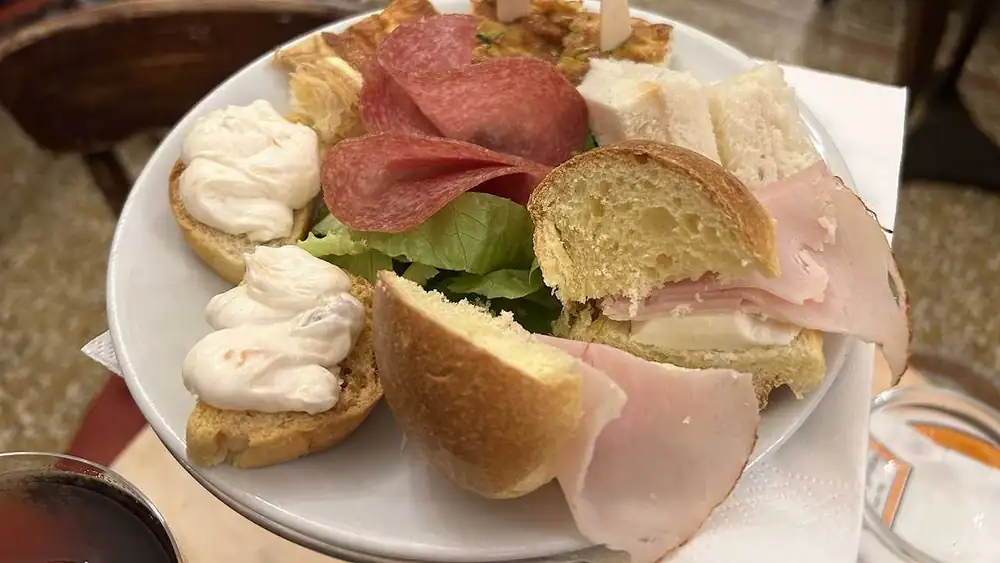
The food on the stand isn't as good as the prices would suggest: the omelette pieces are ugly, the cured meat unspeakable, the sandwich irritating, the tartine with flavored butter is, let's say, useless. It takes talent, even to be so persistent in its sloppiness. Even the pistachios aren't great.
We leave Caffè Greco with a bitterness perhaps even greater than that felt at Gambrinus, which has so disappointed us over the years. If the legal debacle continues, as it certainly seems likely, its swan song will have been nothing more than a sad groan.
Opinion
The Antico Caffè Greco in Rome, which has lived and made history, is today a bitter disappointment.
PRO
- Timeless and history-rich context.
- Multilingual staff
- Very clean bathrooms
AGAINST
- Very problematic croissant
- Bare and unattractive pastry shop window.
- Sloppy savory aperitif
- Glasses of wine with no details whatsoever.