Glam in Venice, review: luxury worth the price
What can be said that hasn't already been said about Glam, the two-Michelin-starred restaurant inside Palazzo Venart in Venice, a true gem within Enrico Bartolini's vast galaxy?
What could be new or original in reviewing the cuisine (and personality) of Donato Ascani, chef at the helm of one of Italy's finest restaurants? Since opening in 2016, the gastronomic—and, one might say, cultural—growth has been unceasing, and the impression one gets is of a project unfolding through a decidedly coherent narrative and style.
Glam Restaurant: the atmosphere
The Glam is located in Palazzo Venart, formerly Palazzo Bacchin delle Palme, which has undergone a highly refined restoration (wooden trabeations, Venetian floors, oriental-style paneling, and fine velvets, alongside Renaissance frescoes, marble fireplaces, and period furnishings) that has transformed it into a 5-star luxury hotel owned by the Taiwanese chain LDC. The jewel in the crown is the Glam Room: a small room recently renovated, abandoning the original silver and gold spatulas in favor of a jungle-like wall design. This room plays—in keeping with the rest of the stylistic and color choices—with neutral colors, ranging from brown to white, through sepia to beige. At the same time, it manages to convey refinement without falling into the banality of the interior design of mass-produced homes that adhere to the criteria of quiet luxury.
How to get to Glam
Between the two access options, it's difficult to say which offers the best view of the cuisine: while on the one hand, the waterway from the Grand Canal and through a splendid garden is certainly the most scenic—as well as being a reference to the past, when city palaces were accessed by water—on the other hand, walking down the narrow Calle Tron and seeing the other garden, revealed through a gate, the protagonist of which is a fragrant magnolia, is no less spectacular, allowing you to glimpse the Glam dining room from the windows.
The kitchen, the dishes and the room
A stint at Alma with Gualtiero Marchesi, then four years with Crippa at the Duomo in Alba, and a stint with Lopriore at Tre Cristi in Milan, finally meeting Enrico Bartolini: Donato Ascani's resume only partially reveals his talent, which, while widely recognized, here in Venice has translated not only into dishes that simultaneously reveal complexity of execution, purity of flavor, and intelligibility for both professionals and diners, but also draw from Venice and the lagoon another facet of an identity that seems almost exhausted, in some cases experiencing glories in the past and ending up retreating into itself.
This translates both into the ability to rewrite the history of certain classic recipes (such as the popular tramezzino and Venetian-style liver, which here become a refined morsel—even aesthetically—with marinated anchovies, olives, lemon, and persel on one side and an ancient seed wafer with liver on the other), giving them a new freshness, both in the use of "humble" ingredients (the most iconic dish, acquadelle in salsa, is born from the recovery of a fish usually discarded), and in the abandonment of a certain now stale narrative (spices and the city's past.
Here, the spices are present—an example is the ras el hanout in the cucumber soup—but they are neither overt nor theatrical. In short, Ascani has managed to give Venice a new narrative, avoiding repetition and platitudes. Added to this is a nod to his origins, a healthy dose of irony, blending high and low, ennobling innards and rendering them regal (as in the case of the conchiglioni and seafood offal), and a compositional finesse that not only obeys aesthetic canons but is capable of imbuing them with a content and substance that lasts a long time (the snow pea with pecorino, capetonde, and calamint is a prime example).
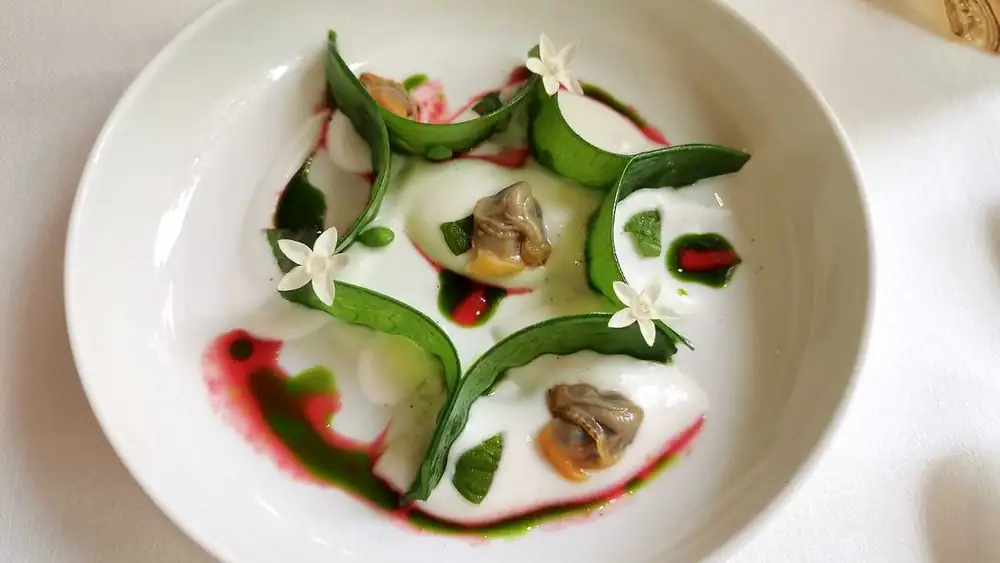
And while some dishes captivate the palate with their smooth textures and flavors (the sandwich with sea bass tartare and ponzu sauce, as well as spaghetti and risotto), Ascani also takes risks with carefully balanced bitter tones (the lagoon agretti, yuzu, and clams, or the cooked Chioggia radicchio, fennel flowers, and a sour sauce seasoned with mustard seeds and razor clams). Beyond the use of smoked ingredients, the use of vegetables is masterful, with the lagoon gardens becoming a garden of delights: the zucchini with sour sauce and herring caviar and the fried eggplant with sesame and basil are worthy of mention.
One could go on, finding not only confirmation of a masterful hand but also the ability to be amazed when you're convinced you've found the key. The menu (each card is unique, featuring drawings by a Venetian author and watercolorist, Luigi Divari), in a style that fully reflects Ascani's low profile and modesty, is a simple and concise list, eliminating articles and embarrassing possessive adjectives and keeping only the ingredients. There are two tasting options: "Art, Gardens and the Lagoon" (250 euros) and "Glam Classics" (280 euros), to which, in fact, an "Instinctive" is added, or à la carte.
Mention should be made of the dining room service, entrusted to the precision and sobriety of Davide Bravetti, and the cellar service, which features the uncommon skill of Ottavio Venditto, capable of navigating the selection of top names with ease, as well as breaking away from traditional food and wine pairings to offer tea, sake, or cocktails, while having fun, not overwhelming the customer but capturing their inclinations and aptitudes.
Opinion
With two Michelin stars inside Palazzo Venart in Venice, Glam restaurant—part of Enrico Bartolini's vast galaxy—under the guidance of chef Donato Ascani, represents one of the finest establishments not only in the lagoon but throughout Italy. The menu showcases the ability to capture the distinctive and less obvious features of the lagoon, combining them with influences that transcend local boundaries and extend beyond the national borders. The aesthetic focus is not merely a stylistic exercise, but rather a testament to the cuisine's ability to express itself on a gustatory and sensorial level, earning recognition and appreciation from both professionals and diners.
PRO
- Dishes accessible to all levels, gastronomical and cultural.