Strange People: freedom at the service of the territory
Sofía Sanz's dopamine rush kicks in on the Aragonese peaks she climbs in her free time, far from the vast dining room of Gente Rara. Even so, her attentiveness reveals a genuine enjoyment, and she manages the dining room with the same tenacity she displays when ascending mountain slopes.
He points to the bar surrounding the kitchen, the heart of the dining room, with its work stations where half a dozen young people bustle about. He also points to the rest of the space, formerly a mechanic's workshop, occupied by just four tables spaced far apart; the wine cellar, a watchful eye from above, with more than 500 wines carefully and curiously selected by sommelier Félix Artigas, one of the cornerstones of the team.
The couple met at the Panticosa spa restaurant, then under the guidance of Pedro Subijana. They spent time in Mallorca, at Mugaritz (almost by chance), and later as head chefs at the Barahonda winery in Yecla, Murcia, where they earned a Repsol Sun. It turns out that Aragonese longing does exist, so eight years later, with their daughter, they decided to return to Zaragoza and settle in the city they had once wanted to escape.
2020 seemed like the ideal year to open the restaurant they had envisioned. “The forecasts for the hospitality industry were fantastic, and we found this place we could afford. And well, we all know what happened then.” The pandemic hit us like a ton of bricks.
The storm had subsided, though clouds still lingered on the horizon, and the streets began to open up in this neighborhood just 10 minutes from the city center, a place that until very recently had been considered troubled. Today, it's filled with new buildings and shops like this one, or like the cooperative supermarket on the same street, which they use for their supplies. Their longing for Zaragoza transformed into an obsession with promoting Aragonese products, its traditional recipes, and even almost forgotten techniques like cooking with wax (a succulent red mullet cooked tableside using this method will be served soon) or in clay.
And then, the headlines
Within six months, they had earned a Repsol Sun. Within six months, they had a six-month waiting list. Within a year, a year-long one. “Daring to open during the pandemic helped us. We were on the news. The fact that it was difficult to get a reservation—we have a capacity of 115 people and only serve 20—may have influenced expectations,” the chef tries to explain. It's one of his obsessions: to meet those expectations without sacrificing the freedom they sought, the freedom that gives the restaurant its name.
Then came the star, “a dream, not a goal,” just like the possibility of a second star, which isn't a goal either: “We have enough to worry about just surviving each day.” He explains that soon reservations will only be accepted three months in advance, and that they'll be closing more nights so he can spend time with his daughter and continue improving working conditions for his staff. “The world has changed,” he says matter-of-factly, leaning on the bar as some of the 30 bites of Lunático, his latest extended tasting menu, parade before us.
Cristian is forty years old, but also a bit of a child at heart. That's perhaps why there's a mother's consommé on his menu. That's perhaps why, here and this season, we start with dessert.
The sweet side of the lunatic
A dark chocolate bonbon with lichen, a cannoli (actually crispy Jerusalem artichoke rind) filled with cream from the tuber, or a donut-shaped fritter stuffed with beef cheek are some of the appetizers served in the anteroom of Gente Rara, all of which, in both their appearance and flavor, belong to the world of pastry. A particularly striking and surprisingly delicate craquelin is made with sobrasada sausage from Latón de La Fueva pigs (purebred Alto Aragón) and Estrabilla goat cheese (from Huesca).
Once at the table, the journey of sugar in the blood continues. This is due to the experiments they are conducting on enzymatic degradation. The result of one of these experiments is a sweet popcorn gel spread on a fluffy brioche bun, originally intended for the dessert section. “Several ideas for working with Aragonese corn emerged from this experiment, and we wondered why we couldn't serve them from the start.”
A sign at the entrance warns: “This is a journey of contradictory logic, without order or chronology.” Some of these ideas include a stimulating corn gazpacho cocktail or a less interesting corn Magnum skewered on a twig of the kind used to play with ants. This fixation on glucose also coincides with the addition of young Aaron Melero to the team, trained at the sadly defunct Espai Sucre in Barcelona. In fact, the influence of Jordi Butrón is evident in this first part of the menu, which transforms the restaurant into a pastry shop.
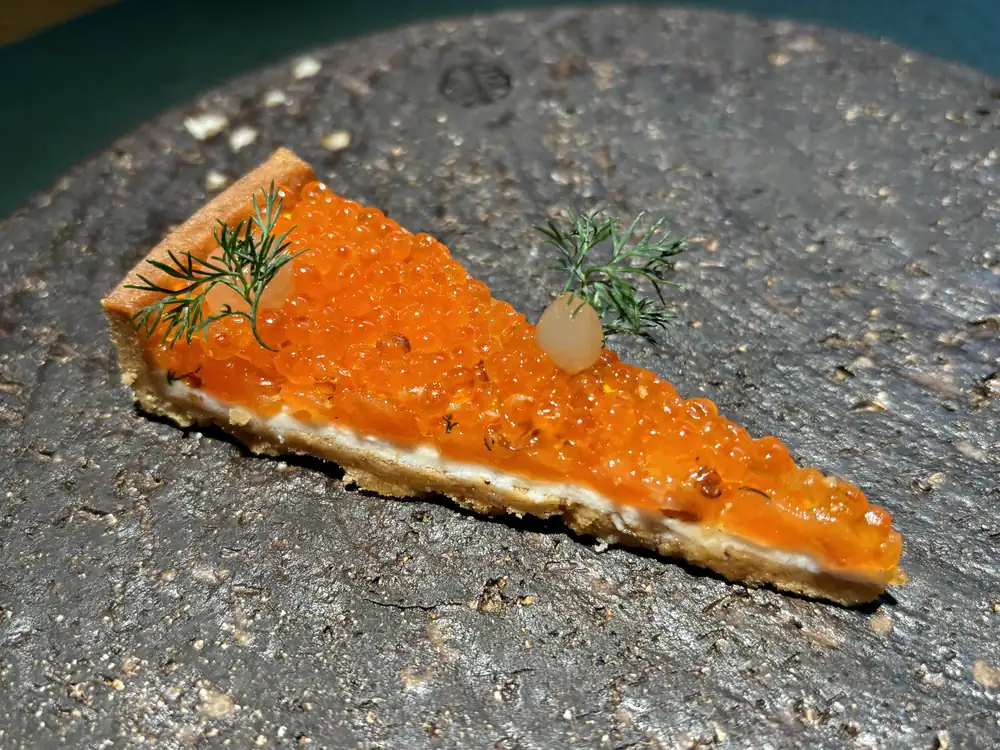
There's a second one. After an aristocratic trout tartare (an 'r' to reconcile two worlds) with its roe, the scoreboard resets to zero.
The palate, somewhat saturated with the sugary dominance, applauds a traditional selection of cured meats made in-house—again, experimentation and a superb dried lamb heart—which opens the door for Lunático to reveal its second personality. We move from artifice to nature. What follows is Aragonese tradition placed at the service of Cristian and Sofía's free-spirited cuisine.
Lunatic, part two
Next up are some (somewhat flat) white beans from Muniesa with a hake pil-pil sauce, clams, and borage, just like the traditional rice dish. This dish was introduced "to help the producer, who only has two hectares of this crop. They are a product of the future because they require little water." Also on the menu is an oyster with citrus escabeche, surprisingly served cold, or a lamb's tail on pumpkin pasta, all part of a simple and flavorful Aragonese stew that arrives as if we deserve it, even though we haven't lifted a finger in the fields.
From the skies of this land had already arrived a pigeon course in three elegant and sensitive versions, born from the memory of the bars in the Huesca village where the chef's family lived. A cut of pigeon leg stuffed with its own innards, an anchovy on a bed of butter (inspired by the one at Cenador de Amós, a welcome reference) which is actually a small breast of the bird cured in anchovy juice and closely resembles them in saltiness and texture, and a delicate tartare made from the remaining pigeon meat, following his policy of using every part of the bird. It is accompanied by a small glass of Terry brandy, bottled in the 1970s, which the grandparents never missed after mornings spent hunting.
They confess that a certain baroque style in their presentations stems from “wanting to break away from what’s fashionable” and that there’s always a veiled critique in their dishes. That’s why the minimalist presentation of squid veil, white as its flavor, barely warmed, is so disconcerting. The trick is that it’s followed by the same mollusk, prepared with the same ingredients in a more delicate version. Another duality. “Here it’s about choosing whether you’re more of an Ángel León fan or an Arzak fan,” he jokes. “We’re not criticizing something we haven’t done ourselves,” he adds, “we’re against many things, but we also go against ourselves to avoid stagnation.” And, at the table, Arzak wins hands down.
Cook and cook again
The team's fresh approach doesn't detract from their professionalism. Furthermore, they know exactly what they want to convey to the diner and how they want to do it. Although Gente Rara's philosophy is "to do whatever we feel like," they never forget the person sitting down to eat. In fact, Palacio collaborated with mixologist Borja Insa on the development of the sensory table, an artificial intelligence tool that analyzes diners' emotions after tasting certain dishes based on their presentation.
Every member of the team, whether from the front of house or the kitchen, puts their knowledge into practice as they approach the bar. This is also true of Artigas, whose wine pairing is an experience in itself (costing the same as the tasting menu, €110), conceived as a journey of grapes through different regions. Thus, each course is accompanied by three glasses of wine, one always from Aragon, allowing diners to compare the effects of soil, climate, and winemaking methods on the wines. There's plenty of Chardonnay and Garnacha, just like in the land they cultivate. Small productions, vintages with a long history, and wines from different continents come together in a friendly match, complemented by fermented beverages such as juniper beer or kombucha with coffee, lemon, and clove.
The pastry shop seems far away when an obscene cheese cart arrives and the desserts return in a space-time loop.
They're called Gente Rara (Strange People), but they're just dedicated workers committed to their craft, their team, their community, and their customers. Is that name, along with Lunatic, a catch-all to justify everything in their kitchen? Does it matter? Sometimes narratives narrow the path of cooking, and labels overwhelm a diner who just wants to eat well. “We like to experiment and learn; otherwise, we'd get bored. But our motto is 'cook and cook again.' We like freedom, although for us, flavor always comes first.”