"Milk is never the same
A rhythmic "pop"
The metal butter churn rotates gently on its axis. Inside: 1,500 liters of cream. After about half an hour, the sounds in the small butter production area of the cheese dairy change: In addition to the quiet rotation of the churn, a rhythmic "plop" can now be heard. "The butter hitting the metal," explains Cédric Spielhofer. "The rotations cause the fat globules in the cream to burst, separating the liquid part, the buttermilk." What remains is butter.
Completely dye-free
Anyone traveling from the Swiss Plateau to "Fromages Spielhofer" will find themselves immersed in the rolling hills of the Bernese Jura. The village of St. Imier lies at 820 meters above sea level, surrounded by forests. "No wonder our butter is a purely natural product, right?" asks Cédric Spielhofer with a cheerful wink. "For example, we don't use any coloring at all," adds Florian Spielhofer. This is why the brothers' "Bernese Jura Mountain Butter" has a yellowish hue in summer and a white color in winter.
Cows graze on flowers.
The reason for the seasonal variation in the butter is the milk that Cédric and Florian Spielhofer use: silage-free mountain milk. "The cows have to be on pasture for at least 120 days a year," says Cédric Spielhofer. His dairy sets this requirement for its approximately 60 suppliers in the region. "On the summer meadows, the animals find flowers and thus ingest carotene – which gives the butter its yellow color." Indeed, carotene is otherwise found primarily in carrots.
Less fat and protein in winter
Natural cow husbandry and feeding practices directly influence the final product – including cheese. "Many of our varieties are also yellowish when produced in summer and taste of the herbs the cows eat," explains Florian Spielhofer. "The texture is also finer." This is because the fresh grass the cows consume in summer results in milk with a higher fat and protein content than in the winter months. During this time, the approximately 1,200 cows that produce cheese for Spielhofer primarily eat hay.
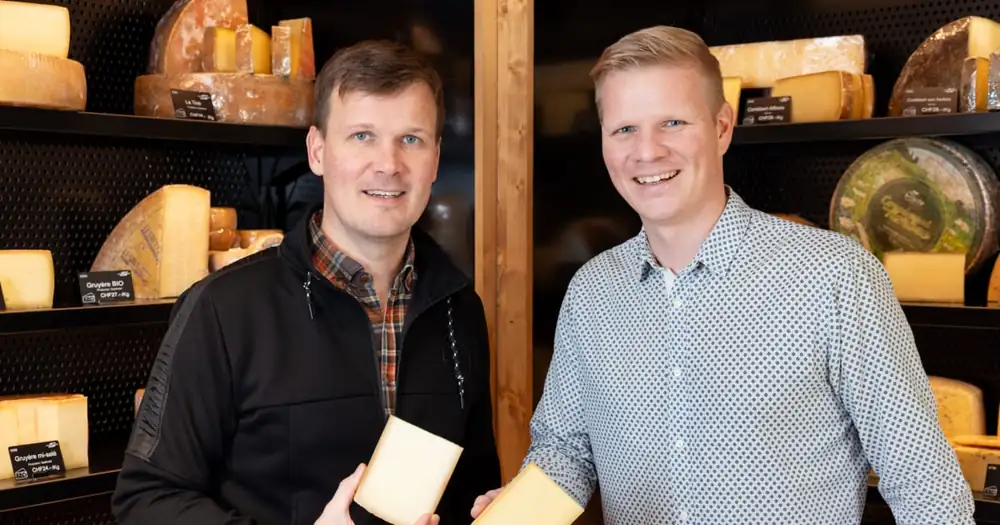
Fromages Spielhofer, headquartered in St. Imier (BE), produces butter, yogurt, and around 30 varieties of cheese from raw mountain milk. Their flagship product is Tête de Moine AOP. In addition to natural ingredients, the dairy relies on traditional craftsmanship – 70 percent of the operation is done by hand. Cédric (36) and Florian (39) Spielhofer have been running their father's dairy since 2019 and employ around 85 people.
"Many of our cheeses are also yellowish when they are produced in the summer."
Seasonal fluctuations – diverse aromas
The somewhat monotonous winter diet has its reason: Fromages Spielhofer produces only raw milk cheese. Therefore, it's crucial that their four-legged producers are fed without fermented feed – silage. "Otherwise, the milk contains butyric acid bacteria from the feed," explains Cédric Spielhofer. The main risk: a loss of cheese quality. However, silage is also a good source of energy for the cows in winter. With silage-free milk, the seasonal variations in milk composition are therefore particularly pronounced. The Spielhofer brothers see this as a positive: "That's precisely what's so wonderful about our milk – it's never the same. This gives us the opportunity to produce products with a wide range of flavors."
Standardize milk specifications
The Spielhofers' credo: their products should be as close as possible to milk as it naturally is. However, this isn't possible with all products, for example, Tête de Moine or Gruyère AOP. "There are strict specifications we have to adhere to," explains Florian Spielhofer. For Gruyère, for instance, the milk must have a fat content of 3.4% year-round. "For these products, we standardize the milk." This means: "If the fat content is too high, we skim off the cream." Conversely, a fat content that is too low could theoretically be corrected by adding cream. "But according to the specifications, this is forbidden, especially for Gruyère," says Cédric Spielhofer. "Fortunately, milk very rarely contains less than 3.4% fat."
Compensate for quality losses
But the Spielhofer brothers also make adjustments to their own products. "Because the quality always has to be right," says Cédric Spielhofer. "For example, it's unacceptable for the yogurt not to set in winter – that happens when the milk has too low a protein content." To correct the protein content, the Spielhofers simply add skimmed milk powder to the milk. Butter production also varies slightly depending on the season. "Otherwise, consumers would have to accept a reduction in spreadability in winter," explains Florian Spielhofer. To avoid this, the high saturated fat content and long fat chains in the winter milk are broken down through a special temperature control process. "We also knead the butter longer in winter – the longer we knead it, the more spreadable it becomes."
A butter churn from the 1960s
To ensure good control over the butter quality, Spielhofer relies on traditional production methods: "We only process a small amount of cream at a time, using a butter churn from the 1960s," explains Cédric Spielhofer. The dairy produces 500 kilos of butter per hour this way. "With more efficient techniques, it would perhaps be three tons," compares Florian Spielhofer. "But that's why our butter tastes so particularly milky and fresh."
Pure nature – that's what Spielhofer focuses on, not just with its products: "For example, we're driving forward sustainable packaging," says Cédric Spielhofer. To this end, the cheese dairy collaborates with a company that upcycles plastic from the ocean. "In our new cheese dairy in the neighboring village of Sonvilier, we also produce virtually CO2-neutrally and are 90% energy self-sufficient," adds Florian Spielhofer. To heat the milk or curd, the brothers utilize the waste heat from cheese production and generate additional heat energy using heat pumps. The electricity to operate the heat pumps comes from solar panels on the roof. "We don't need gas or heating oil."