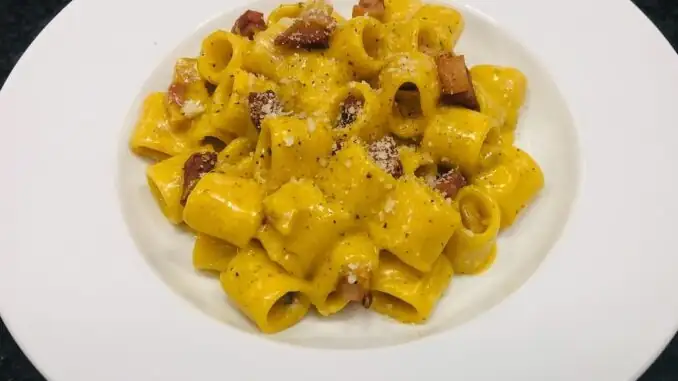
Carbonara without secrets, the game of true or false to understand
Playing a true-or-false game about carbonara is risky. Because we are a nation of saints, navigators, and carbonara experts. Everyone thinks they know everything and have the truth in their pocket. In reality, many things are historically controversial, others are certainly false.
Carbonara is a centuries-old tradition. False. There are no documents or citations that place the birth of carbonara before the Second World War.
Carbonara was invented by the Romans. False. There's no certainty on the subject, but it's highly likely that carbonara originated from the happy encounter between American soldiers in World War II and the Italian population, from Lazio or Abruzzo. They gave it the K ration, meaning freeze-dried eggs and bacon; we served it with cheese and pasta.
The first recipe was published in Italy in the 1950s. False. The first recipe appears in 1952, incredibly, in an American food guide for an area of Chicago: Vittles and Vice: An Extraordinary Guide to What's Cooking on Chicago's Near North Side. The author, Patricia Bronte, offers the recipe for carbonara, which is the signature dish of Armando's, a restaurant owned by two Italians (Tuscans).
The first recipe in Cucina Italiana included garlic, Gruyère, and cream. False. The first recipe published in Italy, the one in Cucina Italiana from 1954, included garlic, Gruyère, and pancetta, but no cream.
In her Roman cookbook, Il Piccolo Talismano della felicità (The Little Talisman of Happiness), 1950 edition, Ada Boni introduced carbonara for the first time. False. Ada Boni would only include carbonara in the following edition, in the 1960s. The first mention of carbonara dates back to 1950. True. An article from that year in La Stampa recounts the Festa de n0antri in Trastevere, honored by the presence of Pope Pacelli, and focuses on the trattorias, explaining that American officers would go from Ceseretto to Cisterna to eat spaghetti carbonara.
The first film reference is in Two Women, starring Sofia Loren. It's in "A Beautiful Presence Offered," from 1951. Aldo Fabrizi interviews Maria, aka Elsa Merlini, and asks her if she knows how to make spaghetti carbonara.
Trilussa loved carbonara. False. In Mario dell'Arco's 1951 book, Lunga vita di Trilussa, we read: "It's unlikely that our poet would attack spaghetti alla carbonara or alla carrettiera without having two forks as excellent as his in reserve. Faced with a steak, he seemed more inclined to improvise an epigram."
The first important literary citation is by Luigi Malerba. False. The first is by Alberto Moravia, in Racconti romani from 1954.
Carbonara was invented by a Bolognese. False. While the story told by the famous Bolognese chef Renato Gualandi is possibly true, the chef himself never used the name carbonara, and there is no evidence that he was the first to prepare it. Furthermore, the chef offered several versions, and some ingredients don't align with the known history of carbonara.
Carbonara has always been made with guanciale. False. It was introduced by the great chef Luigi Carnacina in 1960 in his book "La Grande Cucina." Previously, pancetta was used.
Only foreigners add cream to carbonara. False. In 1960, Carnacina used cream for the first time, and from then until the 1980s, it was regularly used in Roman carbonara. Then it disappeared and suffered a sort of damnatio memoriae.
Arcangelo Dandini doesn't use pepper in his carbonara. True. The Roman chef doesn't like it. Besides, nowhere does it say it must be used. There's no codified recipe, only a historically prevalent one. The Al Moro restaurant, one of the first to serve carbonara, still uses chili pepper.
As an alternative to guanciale, you can use smoked pancetta. False. More than false, it's better not: smoking creates too strong a flavor that doesn't pair well. If you don't want to use guanciale, you can use pancetta, as long as it's firm and well-cured. Curing makes the difference: between supermarket-bought guanciale and well-cured pancetta, the latter is far better.
The name carbonara derives from the Carboneria (Carbonara movement). False. The origin of the name is uncertain. There are many theories: the Carboneria, the color given by the pepper, the Sardinian city of Carbonia, the charcoal burners of Ciociaria, even the squid ink used in some early recipes.
Carbonara doesn't use egg whites. False. The recipes of the most respected chefs favor a greater amount of yolk, but don't completely exclude the egg white. Reducing the egg white prevents the excessive "omelette" effect.
The red color of the yolk depends on the chicken's breed. False. The breed affects the shell, while the diet influences the yolk's color. The color of the yolk depends on the pigments (particularly xanthophyll) the chicken ingests through its diet. If it eats a lot of alfalfa (alfalfa), the red will be more evident. Feeds high in beta-carotene are also very useful for intensifying the color. Some breeders enrich them with colorants such as capsanthin, found in paprika extracts, or canthaxanthin, found in some algae and bacteria, but also produced synthetically. These colorants, however, are permitted by law.
Carbonara is stirred over the heat. False. If there's one thing that's certain in this whole affair, it's that the egg should be kept well away from the heat. The savory zabaglione (egg, pecorino, and pepper) is stirred with warm guanciale.
Pecorino is used exclusively. False. Over the years, pecorino came later. It first appeared in 1966, in recipes by Zoppi and Santi Brera. And even now, it's often mixed with parmesan. The reason is simple: pecorino is very salty, so even if you don't add salt to the pasta, it risks becoming too salty. So a little parmesan "sweetens" the whole thing.
Only Pecorino Romano is used. False. 99 percent of pecorino is produced in Sardinia. Due to deliberately confusing legislation, the term "Pecorino Romano" can also be used for pecorino produced in Sardinia. To get the local version, you need to find the term "Pecorino Romano del Lazio." But it's not easy to find, because there are only a couple of producers left.