When gastronomy and opera meet: the story of Tournedos Rossini
Tournedos Rossini is one of the most famous classics of French haute cuisine: thick fillet of sirloin, foie gras, truffles and a rich sauce on a plate. At first glance, the dish is associated with luxury, but it is more than a dish made from rich ingredients.
A composer who was also at home at the table
Gioachino Rossini may be known primarily for his operatic writing, but in his later years he devoted at least as much attention to food and gastronomy. After retiring from active composition, he spent a significant portion of his time in Paris, where he became a central figure in the elite of his time. He was renowned for his refined taste, his hospitality, and for being both a consumer and a shaper of gastronomic trends.
Rossini, according to contemporary accounts, was actively involved in the creation of dishes, suggesting ingredients and methods of preparation, and even occasionally appearing in the kitchen to personally supervise the process. This kind of presence was considered unusual at the time and contributed to his name becoming a culinary epithet.
"Rossini" as a style
By the second half of the 19th century, the term “à la Rossini” had come to designate an entire style on menus. The common characteristic of such dishes was their rich, intense flavors and the use of luxurious ingredients. Foie gras and truffles became almost a permanent fixture, and meat dishes were complemented by concentrated, deeply flavored sauces. This phenomenon is particularly interesting from the perspective that Rossini was not a chef, but a composer. Yet he had such an impact on gastronomy that his name became a kind of quality marker. From today's perspective, this kind of “gastro-branding” seems surprisingly modern.
The birth of the dish – chefs and legends
The story of the origin of Tournedos Rossini involves the names of several notable chefs. Marie-Antoine Carême and Auguste Escoffier, who were key figures in French cuisine, are often mentioned. According to the most likely scenario, the dish was developed in the world of Parisian restaurants, under the direct or indirect influence of Rossini. A whole concept was born, which chefs implemented in various forms. There is also a well-known anecdote connected to the story: Rossini allegedly watched the chef in the kitchen, who did not look favorably on him and asked him to turn away. The composer's response - "turn your back on me" - became, according to legend, one of the explanations for the name tournedos. Although the authenticity of the story is questionable, it fits well with the myth built around the dish.
What's on the plate?
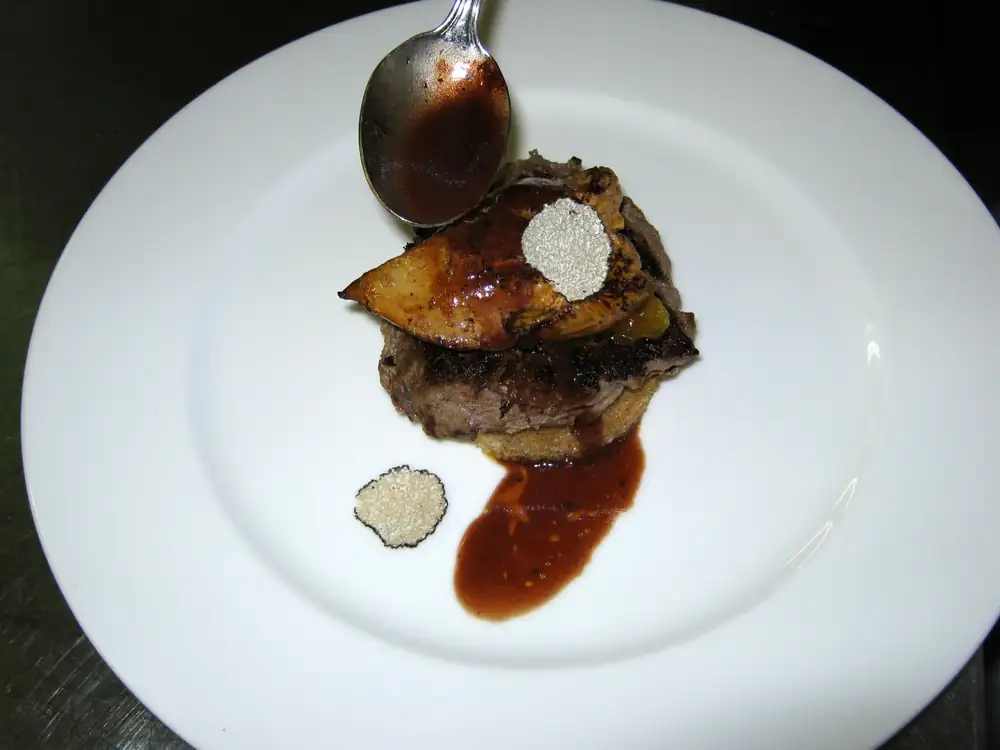
The structure of Tournedos Rossini may seem simple at first glance, but it is actually extremely deliberately constructed: thick fillet of sirloin, foie gras, truffles, a rich, usually Madeira-based sauce. It is often served on brioche or toasted bread, which soaks up the sauce and gives the dish texture. Every element of the dish is about concentration, every ingredient has weight and a role.
Luxury as a principle
One of the most important features of the Rossini tenderloin is that it has not become a widespread, simplified dish. While many classic dishes – such as Stroganoff or Chicken Kiev – have become part of everyday cuisines over time, Tournedos Rossini has remained in the world of fine dining. The reason for this is primarily to be found in the ingredients. Foie gras and truffles are elements that are inherently associated with luxury and are difficult to replace without the dish losing its character. Thus, the identity of the dish has become closely linked to this exclusivity.
From Paris to international menus
The dish became popular in the Parisian restaurant culture of the 19th century, and then spread through the international influence of French cuisine. It was long considered a staple of classic French menus, and it is still present today in restaurants that represent traditional haute cuisine. Although different interpretations have appeared over time, the basic structure of Tournedos Rossini has remained surprisingly stable, which distinguishes it from many other classics.
Today's interpretations
In modern cuisine, the Rossini tenderloin is often an inspiration. Chefs refine the proportions, lighten the sauce, or introduce new textures into the dish, but the basic idea – meat, foie gras, truffles – remains the same. This stability allows the dish to be both classic and contemporary.
Rossini, as performed by Keve Tóth at Casa Christa
The Rossini tenderloin also appears in the kitchen of Casa Christa, but in Tóth Keve's interpretation, the classic form is not simply repeated, but rather a thoughtful, contemporary approach is created. In the chef's recipe, the tenderloin is accompanied by sautéed duck liver, shiitake mushrooms and a port-based sauce, meaning that the classic Rossini structure remains recognizable, while a more modern, lighter direction is outlined in the details. The emphasis is also on proportions and technology. After the tenderloin is quickly seared at high temperatures, resting the meat is key, so it remains juicy and evenly cooked. The duck liver is prepared separately, for a short time, so that its texture retains its creaminess, while its outer surface becomes slightly crusty. The mushrooms add depth of flavor, and the port appears in the sauce, which brings the plate together and creates a counterbalance between the rich ingredients.