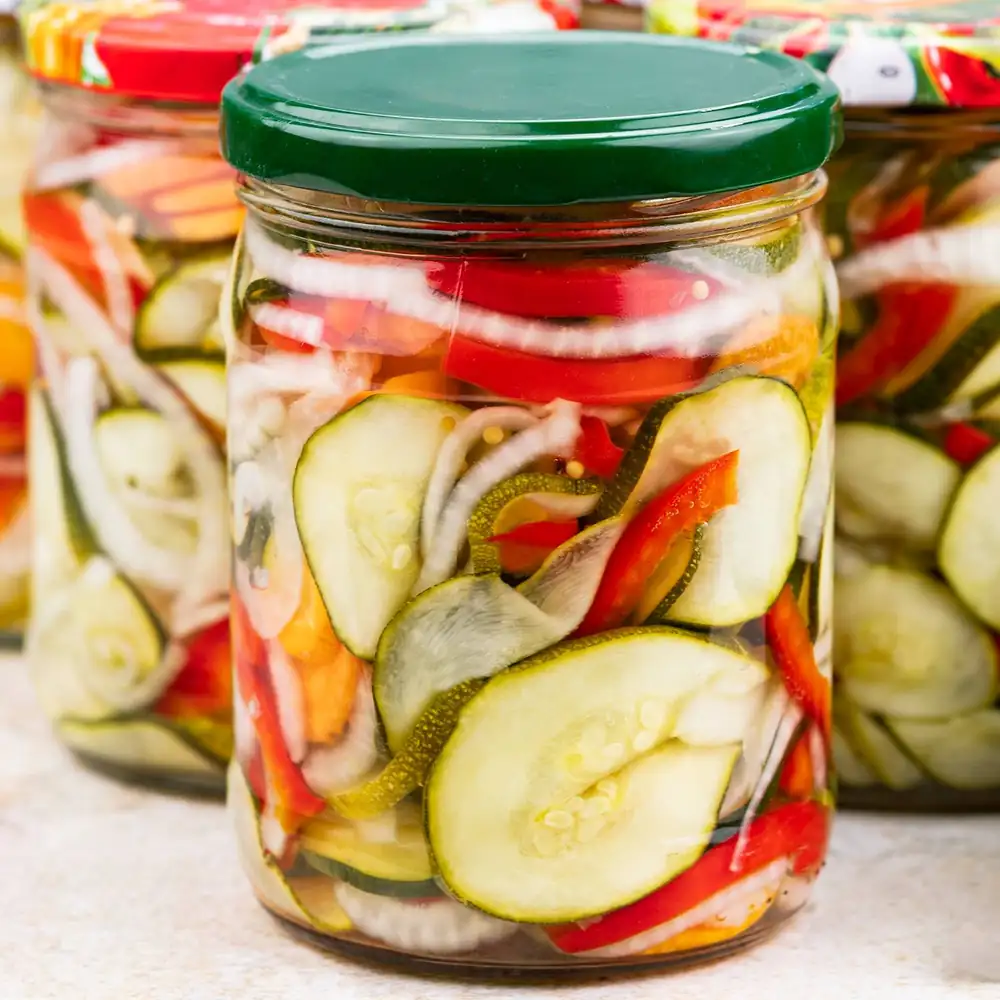
Zucchini salad for winter
Zucchini salad is a great winter vegetable salad to serve in jars. The recipe is simple and detailed enough for anyone to follow. This salad is perfect for more than just dinner.
- delicious even for sandwiches - recipe also for beginners - the description includes many tips and vegetable substitutes
- Preparation time: 1 hour Time of keeping zucchini in salt: 2 hours Jar pasteurization time: 20 minutes
- Number of servings: 8 jars of 600 ml
- Energy value 28 kcal
- Carbohydrates 6 g
- Including sugars 4 g
- Protein 1 g
- Fat 0 g
- Diet: gluten-free, low-sugar, low-calorie, low-fat, vegan, vegetarian.
- 2 kg of young zucchini - yellow or green
- about 500 g red peppers - 2 medium pieces
- about 500 g of onions - 4 small or 3 larger ones
- about 300 g carrots - 3 medium pieces (can be replaced with field cucumbers)
- 2 tablespoons of salt - for the chopped zucchini
- 4 glasses of water - 1 liter
- 1 cup of spirit vinegar 10% - 250 ml
- about 1/3 cup of sugar - 80 g
- a flat teaspoon of mustard or coriander seeds - can be omitted
- optionally additionally: a teaspoon of curry powder
Zucchini salad for winter
My glass holds 250 ml. For the given amount of ingredients, I used eight jars, each with a capacity of 600 ml.
Calories were calculated based on the ingredients I used. Therefore, this is an approximate calorie count based on the products I used in a given recipe. Vegetables were weighed before any peeling/preparation. I always provide the weight of the vegetables or fruit I use. However, you don't have to follow the gram guidelines. The weights are provided to help you understand the approximate amount needed to prepare a given dish.
Before preparing your zucchini salad for jars, I encourage you to read the entire post first. It includes some interesting tips on ingredients and their substitutes. You might want to add cucumbers to your salad or swap out red bell peppers for yellow.
Zucchini salad for winter recipe
Wash two kilograms of young zucchini thoroughly under cold, running water. Trim both ends off each zucchini. Slice the zucchini into slices about 1-2 mm thick. Place the sliced zucchini in a large bowl, then add two tablespoons of salt (I used regular salt, not flat, but not too heaping). Mix everything thoroughly, for example, with your hands, and knead firmly. Set the bowl aside in a cooler place for about two hours (up to four hours maximum). Stir the contents of the bowl occasionally to speed up the salt dissolution and the water release from the zucchini slices.
Tip: You can use both green and yellow zucchini. Feel free to mix them. Choose the youngest zucchini possible, with still tender skin and a core without ripe seeds. Along with the zucchini, you can also add about 300-500 grams of sliced field cucumbers + an additional flat tablespoon of salt. You can use the cucumbers as a substitute for carrots, or as an addition (in which case, increase the amount of brine slightly). Below is the sliced zucchini before adding salt.
Below are zucchini slices after two hours of soaking in salt.
While the zucchini is resting in the salt, prepare the remaining vegetables. Wash the vegetables thoroughly under cold, running water. Peel the carrots thoroughly and cut them into slices no thicker than 1 mm, to make them as thin as possible. You can also grate the carrots on a mandolin or medium-sized grater. Peel the onions (preferably sweet onions) and slice them as desired, for example, into rings no thicker than 5 mm. Core the peppers and cut them into shorter strips no wider than 7 mm.
Tip: You can easily swap the red bell pepper for any other bell pepper (orange, yellow, white, or green). You can reduce the carrots in favor of more bell peppers or onions, or swap the carrots for 300-500 grams of field cucumbers. Roughly peel the field cucumbers or don't peel them at all and cut off both ends. Slice the cucumbers into approximately 5 mm thick slices and add them to the bowl with the zucchini slices to allow them to release water and soften. If adding cucumbers to the bowl, add an additional level tablespoon of salt.
After about two hours, the zucchini slices will soften and release a lot of juice. Discard this juice—we won't use it in this recipe. You can even lightly squeeze the salt water from the zucchini. Add the remaining chopped vegetables (onion, carrot, and bell pepper) to the bowl with the zucchini slices. Mix all the vegetables very well. If you don't have a large bowl or pot, thoroughly wash the bowl in the sink, block it, and mix the mulch in it.
Prepare eight 600 ml jars or jars of other sizes. Their total capacity should be approximately 4800 ml. The jars should be perfectly clean, preferably sterilized with boiling water. The same applies to the lids. Use only undamaged jars and lids.
Divide the vegetable mixture evenly into each jar. For this salad, I pack the vegetables quite tightly into the jars. I fill the jars leaving about 3 cm of headspace. If you use fewer vegetables, you'll likely need more jars and more brine.
Prepare the brine. Pour four cups of water into a pot. Add about 1/3 cup of caster sugar, which is about 80 grams of sugar. Bring the water and sugar to a boil. Stir until all the sugar is dissolved. Next, add one cup of 10% spirit vinegar. Add a teaspoon of mustard seeds or coriander seeds (these can be omitted). In addition to, or as a substitute for, the seeds, you can also add a teaspoon of curry powder. Bring the brine to a boil and immediately pour it into jars.
Pour in enough brine to completely fill the spaces between the vegetables. However, leave a 1 cm gap from the rim. Try to pour in the seeds evenly. Don't rush to seal the jars, as there may be quite a few air bubbles between the vegetables. To eliminate these, I recommend gently rocking the jars, or even placing a thin wooden skewer in several places to help the brine reach every empty space. However, I find it best to press the brine-covered vegetables with the back of a tablespoon. After removing the air from the jars, you'll probably need to add a little more brine to cover any remaining air bubbles. Only then can you securely seal the jars.
Tip 1: You can also pour the cooled brine into the jars. The brine doesn't have to be hot. However, remember this when pasteurizing. Place the jars filled with the cool brine in a pot of still cold water, and then count the pasteurization time from the moment the water in the pot boils. When pasteurizing in the oven, place the jars in a cold chamber and count the pasteurization time from the moment the oven heats up to the set temperature.
Tip 2: You can also use a second method for filling the jars. First, pour the hot or cooled brine into the pot with all the vegetables. Mix thoroughly. Transfer the brined vegetables to the jars. Remember to divide the zucchini salad evenly among the jars, and pour the remaining liquid into the jars to completely cover the vegetables.
Before the zucchini salad can be stored in the wine cellar, it must be pasteurized. Place a cotton cloth or a new cloth diaper on the bottom of a wide pot. Arrange the jars side by side, but make sure they don't touch each other. Pour water up to a maximum of 3/5 of the jars' height. Turn the heat to medium and bring the water to a boil. Reduce the heat to low and pasteurize the jars for about 20 minutes. If you used a hot brine, place the jars in a pot of already hot water. Once they have cooled, you can move them to a cool, shaded, humidity-free place (a cool storage room or basement).
Tip: You can also pasteurize jars of zucchini salad in the oven. If the vegetables were poured with a hot brine, place the tightly sealed jars in an oven preheated to 110°C (240°F). Do not set the temperature higher than this to avoid damaging the rubber seals in the lids. Pasteurize the jars for about 20 minutes. The lid should be concave when pressed with a finger – it should not deform or bounce. If the vegetable salad was poured with a cooled brine, place it in a cold oven and only then preheat the oven to 110°C (240°F). The pasteurization time is counted from the time the oven reaches preheat, which is about 15 minutes.
Store jars in a cool, dark place for the winter. A cellar or cool storage room where the temperature doesn't exceed 15 degrees Celsius is best. Homemade zucchini salad in jars is ready to enjoy in just four days. It's best two weeks after making it.
This winter zucchini salad is perfect not only for sandwiches, but also for burgers, hot dogs, and kabobs. It's a great snack for meats and grilled dishes, or as part of a salad. It's one of the best winter salads and goes well with most Polish dinners.
See also my green tomato salad recipe.
Enjoy your meal.