Shortcrust pastry with plums and crumble
This plum and crumble shortbread cake is incredibly beautiful, super delicious, and exceptionally easy to bake. This recipe is perfect for weekends, parties, and special occasions.
- Preparation time: 30 minutes Cake cooling time: 1 hour Cake baking time: 1 hour 15 minutes
- Number of servings: 24-25 cm cake tin - about 2 kg In 100 g of cake:
- Energy value 306 kcal
- Carbohydrates 41 g
- Including sugars 18 g
- Protein 4 g Fats 14 g
- Diet: vegetarian.
- wheat flour (cake + semolina) 300 g cake + 100 g semolina
- 200 g vegetable butter or cube for baking
- egg yolks 3 egg yolks
- powdered sugar 100 g
- baking powder 1 flat teaspoon
- medium-sized, harder plums up to 1 kg
- cinnamon 8 g
- wheat cake flour 160 g - 1 cup
- 100 g vegetable butter or cube for baking
- powdered sugar 80 g
- vanilla sugar XXL sachet - approx. 40 g
Shortcrust pastry with plums and crumble
I used a 24 cm springform pan with removable sides, but a 25-26 cm springform pan, a 24 x 24 cm pan, or a 17 x 28 cm pan will also work. Before you start preparing the cake, I highly recommend reading the entire guide first to plan and optimize the next steps.
First, knead the shortcrust pastry. In a large bowl, place 400 grams of all-purpose flour, about 2.5 cups. I recommend combining 300 grams of all-purpose flour with 100 grams of all-purpose flour. Add three large egg yolks (you can use eggs straight from the refrigerator), for a total weight of about 65 grams. Add 200 grams of butter (or a plant-based baking cube), a whole cube, which I recommend cutting into smaller pieces with a knife (you can use butter straight from the refrigerator), 100 grams of powdered sugar, and a level teaspoon of baking powder. Finally, you can add a pinch of salt.
Knead the dough with your hands or with a mixer fitted with a dough hook. Try to work quickly. At first, the dough may seem too loose, but as you rub in the butter, it should come together into a firm ball. I prefer to knead the dough in a large bowl, but you can also do it on a large board, a clean countertop, or a pastry board.
With these proportions, the dough should turn out perfectly. However, if you add too much flour and the dough doesn't come together, I recommend adding a tablespoon of ice water or a level tablespoon of 18% sour cream. Form the dough into a ball or flatten it further. Wrap it in plastic wrap and refrigerate for an hour. To make the dough firmer after chilling, you can place it in the freezer for the last 20 minutes.
Tip: While the dough is cooling, I recommend preparing the plums (pitted and cut in half).
Start preheating the oven now. Set the temperature to 200 degrees Celsius with the top-bottom baking option or 185 degrees Celsius with the convection function. Preheat the oven with the included thin baking tray, preferably the included rack. Place the rack roughly in the center of the oven or one level lower.
Line the bottom of a 24-26 cm springform pan with baking paper. You can grease the bottom and sides with a thin layer of butter, but it's not necessary. Cut the chilled dough into slices about 1 cm thick. Fill the bottom of the pan with the slices, then the sides, to a height of at least 3 cm. As the dough begins to soften, it will be easier to roll and even out. Carefully fill the entire bottom and sides of the pan. If the dough softens too much and becomes too elastic during the pastry process, prick the bottom with a fork and refrigerate the pan for at least 20 minutes. This will prevent the cake from running down the sides when you place it in a hot oven, and it will bake at the height at which it was pressed to the edge of the pan.
The final weight of the plums used depends on their size. If you're using small plums, about 700g will probably be enough. The larger and longer the plums, the more you'll need, up to 1kg. Mine were medium-sized, and I used exactly 1kg. Don't use very ripe, soft, or frozen plums. Firm, slightly firm, not too ripe, and not too juicy plums are best. Wash, dry, and then remove the pits by cutting the plums in half crosswise. Arrange the plum halves vertically, starting from the outer edge of the pan and working in a circle toward the center. This will fill the entire base of the pan with the cooled dough. You can sprinkle the plums with cinnamon.
Tip 1: You can omit the cinnamon or substitute cardamom or finely grated lemon zest. Tip 2: You can also sprinkle the plums with two tablespoons of potato starch or a small sachet of Sweet Moment jelly powder, such as lemon-flavored. This will thicken the juice that drips from the baked plums as the cake cools and prevent it from spreading when you cut the cake. I didn't add any starch or jelly powder to the cake in the photos.
You can prepare the crumble topping ahead of time, while the cake is cooling, or immediately after arranging the plums in the pan. Place one cup (160g) of all-purpose flour, 80g of powdered sugar, and a large sachet of vanilla sugar in a bowl. Add 100g of cold butter or a vegetable baking cube, cut into small pieces. Rub the ingredients between your hands until a fairly loose crumble forms. A larger amount of sugar makes the crumble softer and finer, allowing it to fill the gaps between the fruit better. Spread the crumble evenly over the plum pan, carefully filling in any gaps, and then gently smooth the surface.
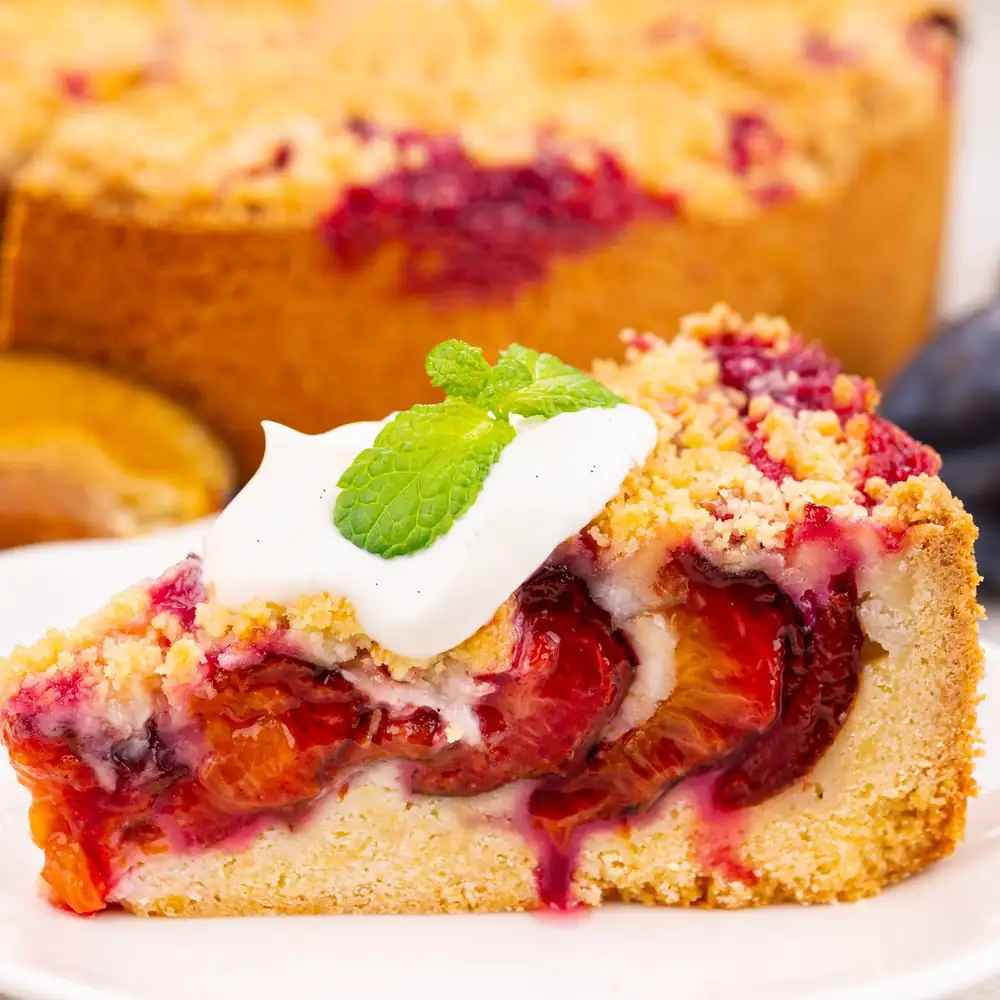
Place the cake pan on a wire rack in an oven preheated to 200°C (400°F). Select the middle shelf. Bake the cake for about 5 minutes, then reduce the temperature to 180°C (350°F) and bake for 60-70 minutes. Do not set a higher temperature, as this shortcrust pastry requires longer baking time. After baking, you can remove it from the oven immediately. Once it has cooled slightly, you can remove the sides of the pan. The cake needs to cool for at least a few hours before slicing and serving. This will make it the most delicate, soft, aromatic, and very flaky. It tastes best served the same day, without refrigeration. The two photos below show such a freshly baked cake served a few hours after removing it from the oven. In the photos, I served the plum and crumble shortcrust pastry with vanilla cream cheese. The cake will also release more juice (from the baked plums) before being refrigerated, as you can see in the photos below.
In the photo above, you can see the cake after spending the night in the refrigerator. It's firmer, and the plums are releasing significantly less juice, which has thickened. The plum crumble cake can also be served with a scoop of vanilla ice cream. If you'd like it warm, you can reheat it in the oven or microwave for about 20-30 seconds.
If the cake isn't eaten the same day, store it covered in the refrigerator. It will stay fresh for at least three days. If you plan to serve it after storing it in the refrigerator, it's a good idea to take it out at least an hour and a half to two hours in advance to allow the cake to soften naturally. Enjoy.